WTI Crude Oil 20260428

Shift To Economic War Against Iran to Deprive Funds to Regime and IRGC

What If Everyone Is Looking At The Wrong Things About Iran?

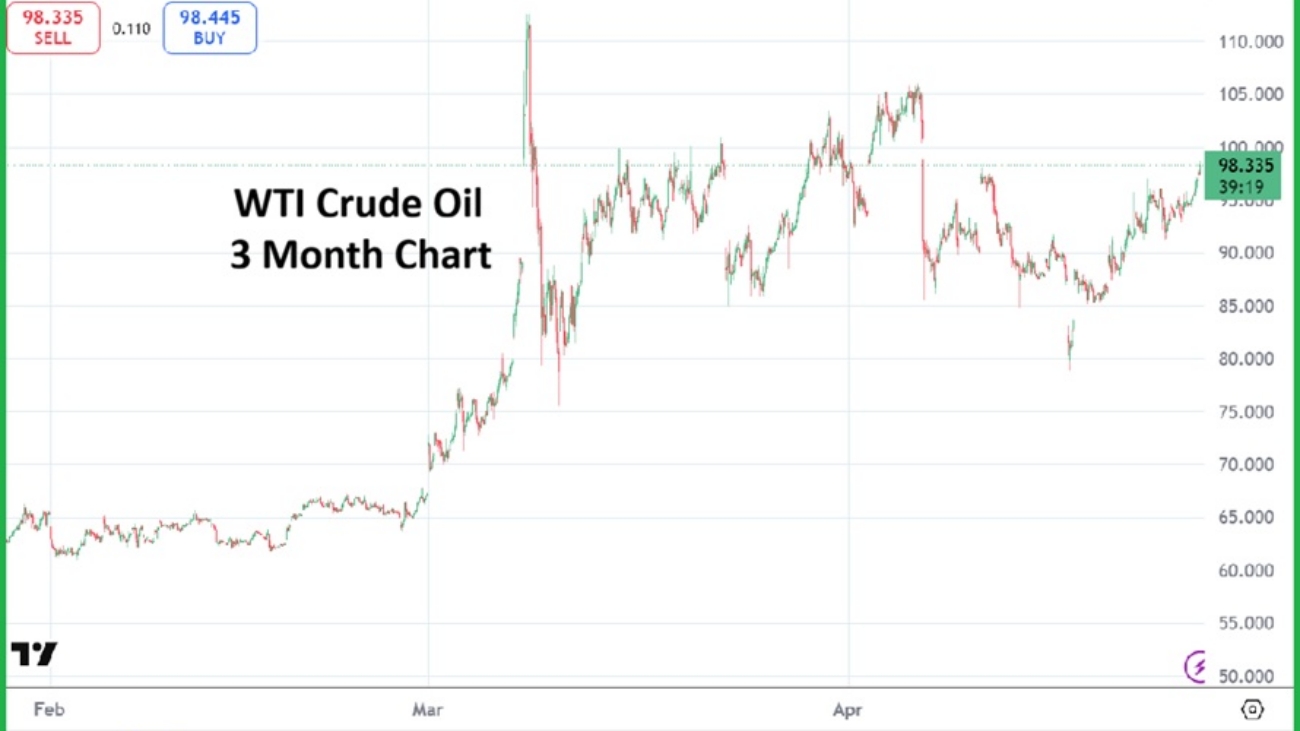
The current futures price for WTI Crude Oil is above $98.00. The cash price for the commodity is above $103.00. While many people continue to fret about what endgame strategy the U.S White House is conducting, what if we are seeing it play out in real time via the price of Crude Oil? Is it possible that President Trump has a coordinated plan to starve the Iranian regime and the IRGC of its much loved and needed money? It appears this is the case.

WTI Crude Oil Futures Three Months Chart on the 28th of April

Simply put, the Iranian Revolutionary Guard Corps is a mafia. They stay in power using the tool of fear brought upon by their ability to be ruthless to the Iranian citizens. They are a terrorist organization in the truest sense. If you disagree with that assessment, you are free to do so. However, facts when they are studied point to the conclusion Iran is a terrorist state led by its regime and the IRGC. 

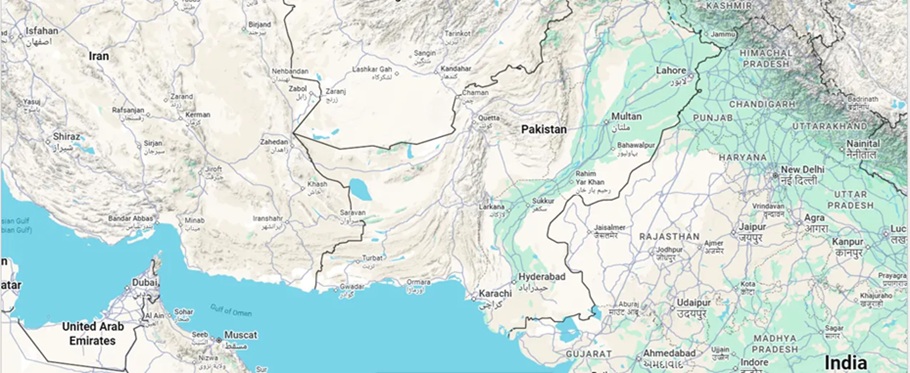
Iran has made massive amounts of money via its energy products for decades. The shutdown of the Hormuz Strait, or at least the inability to export Crude Oil freely, is putting a strain on global energy prices, and it is causing a major fracture in the main financial export of Iran. 

The U.S has not only shut down easy navigation in the Hormuz Strait, but it is also going after Iran’s cryptocurrency operations. The ability to receive and transfer digital money by Iran is being strangled. What if President Trump is not only listening to the opinions of his military officers, and Secretary of State Rubio and Vice-President Vance, but also Treasury Secretary Scott Bessent who has an abundance of financial knowledge about how money flows internationally and how to create obstacles.

If the IRGC is not able to pay its own members, and other adherents to the Iranian regime are only slowly reimbursed, the apparatus of the IRGC will certainly lose its influence. The inability to pay allies that exists merely because they are employed or corrupted by the IRGC likely is starting to cause fractures regarding loyalties. 

China needs Iranian oil too. And evidence is starting to be speculated upon that China is facing tough decisions about acquiring Crude Oil from other sources. China will not be happy about having to pay higher costs, this because discounted Iranian oil that has abundantly been used is no longer available. 

Equities via the major U.S indices have done incredibly well since the end of March. The Nasdaq 100 has seemingly forgotten about AI overbought concerns, the S&P 500 is within apex territory and the VIX is acting as if sunny days are in the forecast. Forex has been volatile, but the value of the USD is within known realms.  However, the price of WTI Crude Oil is high and it has gotten higher since the 17th of April when futures prices briefly flirted with the $80.00 realm – this before going into a weekend. And this is a clue that something is afoot, beside larger players speculating on what their outlooks are for WTI Crude Oil in the mid-term.

The weekend of the 18th and 19th of April witnessed talk of an end to the Iranian war fall short; and heard President Trump essentially declare the ceasefire is still on but with the caveat that the U.S would create a blockade in the Hormuz Strait. While the semantics of a blockade can be debated, the U.S has caused shipping problems for tankers that were supposed to ship Iranian Crude Oil. The U.S clearly decided to create economic distress for Iran.

The Iranian regime still stands, but its leadership is rather shaken. The IRGC is controlling a lot of the decision making for the time being, and it appears the U.S White House is trying to make the IRGC weaker by ending their financial lifelines. It appears that it has been figured out that an economic war which includes starving Iran of cash is the most certain way to create revolts inside of the nation. When the influence of money is eroded, and temptations via other spheres of power suddenly sound tempting and can be joined, this is when shifts in authority and leadership can occur. 

While many analysts wonder about the lack of an obvious endgame being announced by the Trump administration, maybe it is already being played out. President Trump has a large ego and he is happy to extoll the virtues of his ‘tremendous’ policies frequently, but he also has shown the ability to remain quiet when it comes to plans of action and carrying them out. Yes, this can be argued into the late hours by pro-Trump and anti-Trump people. But maybe Trump is simply telling the truth when it comes to the U.S having time on its side regarding the Iranian ceasefire and the Strait of Hormuz. Maybe the clock is ticking on the eroding cash pile the Iranian regime and IRGC has within its grasp.

Copy and paste the text from AMT that you want to share

Iran: What Victory Looks Like Part 2 - The Military

Iran: What Victory Looks Like, Part 2 – The Military

Missiles, Drones, the Straits and Regime Change

Opinion: The following article is commentary and its views are solely those of the author. This article was first published the 17th of March via The Angry Demagogue.

In a recent X post, Edward Luttwak, the elder statesmen amongst strategists and one who we ignore at our own peril, stated that “The regime is impotent viz the U.S but all-powerful against its own people. So, regime change with bombs may fail but without bombs it might last for ever.” In other words, American and Israeli bombing is a necessary, but not sufficient condition for the overthrow of the Islamic Republic. Luttwak also made it clear that the Iranian people cannot overthrow the regime without native military support.

Not only will bombing not be sufficient to overthrow the regime, but American and Israeli commandos combined with Mossad and CIA operations will not be enough because for the Islamic Republic, internal, Iranian opponents of the regime are a bigger religious and ideological threat than Americans, Israelis or Sunni Arabs and they will always have enough Kalashnikovs and machine guns to kill 30,000 Iranians a night.

But regime change is not the only path to military victory. The mistaken views of the war when the opponents are “shocked”, Casablanca style, when they realize that wars are difficult and unpredictable and come with speed bumps, unexpected ups as well as downs and that not everything is in your control.

The first path to victory is one that is occurring now. That is the destruction of the military and command and control assets of the Islamic Republic. That focuses as we know, on the Revolutionary Guards (IRGC) and the “Basaj” – essentially the IRGC’s domestic militia who are responsible for keeping Iranian citizens in line and are, for the most part, ideological hardheads. With other types of dictatorships, the embarrassing way their military has handled Israeli and American attacks past and present would have been enough to topple them. However, with Shiite fanatics who know no borders (morally or geographically) and whose main enemies are domestic, that is not the case – and no one expected that to be the case.

The attacks must continue until either the regime changes or until their military-industrial infrastructure is destroyed. This means its drone and missile production, its naval forces, air-defenses and underground missile storage and nuclear facilities must be done away with. It does not mean the nearly impossible attempt to secure enriched uranium. Regime change can lead to cease fire and negotiations but without regime change the attacks must continue until the mission is completed.

The second path to victory is the opening and complete control of the Strait of Hormuz. While there still are ships that make it through, this is the one thing that the regime still holds over the United States and the world. The missiles they send to Israel and the gulf will be degraded enough if the bombings continue, but the Western world cannot allow a vicious, cruel dictatorship to control any waterway. Freedom of navigation is one of the key reasons why Taiwan is so important (which Japan knows well – making us wonder why it has not sent ships to help with the Straits) and a key reason this war must be fought. We wrote the other day about the price premium that the Islamic Republic holds over the world (and there was a Jerusalem Post article quoting Peter Navarro, head of the White House Office of Trade and Manufacturing state that the price premium is between $5-15 a barrel – we think that is understated). The Islamic Republic must be denied this ability to blackmail the world.

Of course, it seems that Western Europe is happier with the Iranian regime not losing, than with the American (or Israeli) government winning, but that is something to be dealt with later

The third thing that will bring a military victory is of course, regime change. First, the presence of a new leader on Iranian soil must be attained. This can either be the Shah’s son, Reza Pahlavi, who has been encouraging his countrymen to revolt and therefore needs to show real leadership by making his way home, or someone, possibly a senior military figure, who is in Iran now. Pahlavi is the natural choice, but he must take some risks and show he has the pull and prestige with at least part of the military in order to be able to accomplish the mission of overturning the regime.

In order for that to happen, circumstances must be created where a few divisions of the regular army can protect Pahlavi as he enters the country and he can lead the people to revolt. Once a few divisions defect and with American and Israeli air-power, they can liberate territory, further army divisions will probably join in – assuming they see a path to victory. A revolution need not happen overnight but can come with the army moving across the country and the defeat or defection of some in the IRGC. A few million in Swiss or Dubai bank accounts will also encourage defection.

Without a leader and an organized armed force, the regime just needs small weapons fire to put down any citizen revolt – and they will.

Military victory can come either with the destruction of the drone/missile capabilities and stockpiles along with the forced re-opening of the Strait of Hormuz or with regime change. If the former two, then the Iranian people will continue to suffer, but the Persian Gulf countries, Israel, the United States and the rest of the free world will not. If the latter, then everyone except China and Russia will be winners.

Let us not forget what everyone has been saying since day 1 – that only the Iranians can overthrow the government and that will only be done if the regular army decides to throw itself to the side of the people. The United States and Israel can only create the necessary (but not sufficient) conditions for this to happen. Without regime change, but with the opening and complete control of the Straits, the destruction of the regime’s naval, air defense, missile and drone forces and production, along with the elimination of senior Basaj and IRGC commanders, will still constitute a satisfactory military victory.

Disclaimer: the views expressed in this opinion article are solely those of the author, and not necessarily the opinions reflected by angrymetatraders.com or its associated parties.

You can follow Ira Slomowitz via The Angry Demagogue on Substack https://iraslomowitz.substack.com/
Copy and paste the text from AMT that you want to share

post256

Crude Oil: A Guess from the Underbelly On What Happens Next

Crude Oil: A Guess from the Underbelly On What Happens Next

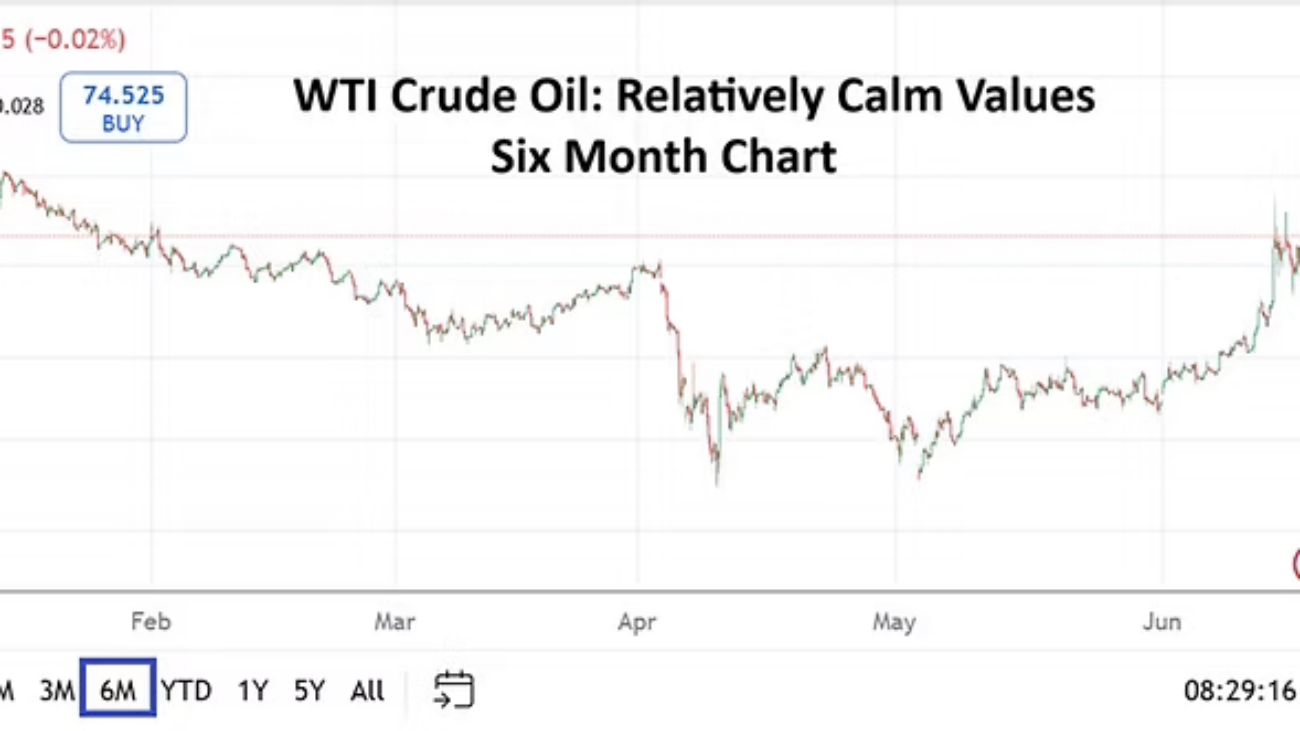
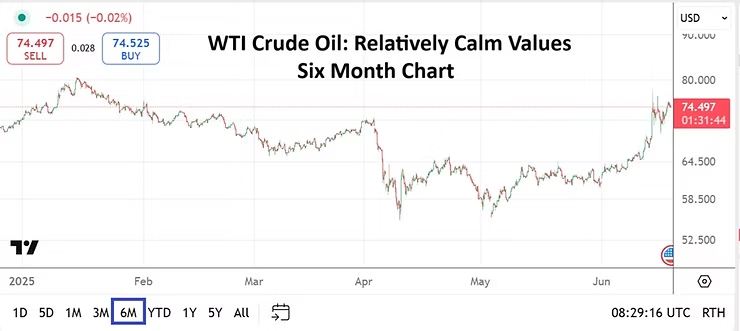
Why has the WTI Crude Oil Spot price remained relatively calm? The war between Israel and Iran has been going on per this latest violent phase since Friday the 13th. While tensions have been high between the two nations from the 7th of October 2023 in a very outward manner, and missiles were fired from Iran towards Israel on two separate dates in 2024 which then featured Israeli retaliation, the past handful of days is a new escalation.

WTI Crude Oil Spot Price Six Month Chart as of 18 June 2025

Day traders of WTI Crude Oil need to understand that large players in the energy sector have a vast amount of experience and intel regarding production and supply worldwide when they make their buying and selling decisions. However, the biggest oil traders do not always share the same political viewpoints, except to say most large players in the energy sector practice the art of realpolitik. Day traders of WTI Crude Oil should try to get into the minds of the real movers of WTI Crude Oil via realpolitik considerations.

As of this writing the price for WTI Crude Oil is around 73.930 Spot, late yesterday it did move higher to within sight of the 75.750 USD mark – this when information that President Trump is considering a U.S military strike on Iran heightened. Traders need to understand Spot Crude Oil and Futures pricing can be different. The current value of WTI Spot is higher than the Futures pricing because of the short and near-term known risks.

However, volatility in WTI Crude Oil Spot has remained fairly muted, almost tame as Israel and Iran wage war. Other spot energy prices like Brent and Natural Gas are being affected directly too because of shifts in behavioral sentiment. But again, the prices within the energy sector have remained calm considering what is at stake for global economics. Here are points that may be affecting the WTI Crude Oil landscape and energy complex, which some large traders may be contemplating:

  • It is highly likely the U.S has told Israel not to harm Iranian Oil production or supply sites, including shipping.

  • The U.S does not want the price of WTI to jump rapidly because of the current war between Israel and Iran.

  • Inflation would be a scrouge for the global economy, not to mention President Trump’s ambitions.

  • Even though the U.S has its own energy supply, the price of WTI is affected by behavioral sentiment within the global Crude Oil complex.

  • Meaning conflicts in the Middle East and elsewhere always cause ripple affects, even if Crude Oil is flowing freely in the U.S via its own production.

  • The U.S doesn’t want China to be given a reason to consider becoming an open belligerent in the Middle East war.

  • China gets a lot of Crude Oil from Iran. The stated percentage is around 15% of its total supply, but it could be more if Iran sends oil to other locations and then reroutes supply to China afterwards.

The U.S not only wants to keep China calm about its energy supply, but also doesn’t want to give China an excuse to escalate political or military tensions elsewhere – read Taiwan.

As an aside there are a lot facts and rumors coming from China, highlighting that a powerplay is emerging between competing factions for leadership in China’s military, this may include the authority that Xi Jinping has too. China will be conducting Politburo meetings in the coming weeks that will get plenty of attention via Beijing analysts. If U.S intelligence knows an internal political fight is taking place in China, they will want to keep China calm regarding external considerations and not give China excuses to act. Concerns regarding the Middle East as a justification for more Chinese actions against Taiwan in some type of economic political/ military theatre is a threat.

By telling Israel not to attack Iranian oil infrastructure, this allows the U.S to placate China. Only if Iran were to attack U.S infrastructure – including military assets or interests in the Persian Gulf via attacks on Gulf States like the UAE, Bahrain or Saudi Arabia would the U.S consider retribution against Iranian Crude Oil.

While the U.S has an interest in global politics certainly, it also wants to maintain a stable global economic environment. President Trump knows this and so does his cabinet supposedly. The Federal Reserve meets later today and they will certainly speak about uncertainty regarding inflation. Whether or not they mention the Middle East war will be interesting.

Thus, it is likely the U.S will only allow an attack on Iranian Crude Oil production and supply if it has been directly threatened. And this is where it gets potentially more interesting for Crude Oil traders. It appears likely the U.S will get involved directly in Iran by hitting known Iranian nuclear facilities deep underground with heavy U.S ordinance. If the U.S does attack Iran via B2s using heavy bombs, how will Iran’s Revolutionary Guard Corps react?

Will the existing IRGC allow for the destruction of its nuclear ambitions and accept that it will have to prepare for a new political environment in which their power will likely be challenged by not reacting? Or will those in power of the IRGC double down on stupidity and attack U.S assets with some of the Iranian military weaponry that still remains? An attack on U.S ‘interests’ would risk aggravating the U.S more – giving the U.S reasons to attack Iranian economic infrastructure which is mostly Crude Oil, and likely close the door on the chances of the IRGC to survive after the war concludes.

Things often do not work out via political and military outlooks. The law of unintended consequences is always a danger. The end game is quickly approaching for Iran’s current leadership. The U.S and Israel also hopefully have taken this into account. Recent outcomes in Iraq and Afghanistan have not gone as planned for the U.S when seeking a serene endgame.

As an example, it might be better not to eliminate the current Ayatollah Khamenei, and allow the people of Iran an opportunity to remove him if they want. The Iranian Revolutionary Guard Corps and its various factions are probably eyeing what will come after a capitulation. There will be a fight for survival politically and a leadership vacuum.

The IRGC fiefdom gets most of its money from Crude Oil revenues. It is quite possible in a forward looking manner the IRGC may choose not to risk having the U.S ruin Iran’s one giant economic asset, thinking rightly or wrongly that they can continue to profit from Crude Oil the day after the war ends.