30Y Treausry Yields 20260826

How Warsh Can Solve the US Debt Crisis With Just a Few Words at Jackson Hole!

A Roadmap for Fed Chairman Kevin Warsh to Rescue U.S Debt

Many think the market decides interest rates.

Wrong!

The Fed – and only the Fed – has full control over interest rates, all over the curve!

We just need to have the right person on board.

During the European crisis in 2011, speculators all around the world were betting that the Eurozone would explode and that the EUR would collapse under the weight of government debt that had started with Greece and spread to other countries that were shamelessly labelled “PIGS,” adding insult to the speculative attack.

Trichet, at that time chair of the ECB, seemed totally clueless, afraid to take any “unconventional” step, even at the risk of seeing the entire European financial system go bust.

The crisis seemed unstoppable… until Mario Draghi stepped in, replacing Trichet.

With just one magical statement (“the ECB will do whatever it takes to save the Euro. And believe me, it will be enough”) Draghi implied that he was ready to buy government bonds from European countries, even though such action was considered at the time to be “against the ECB’s statutes” and outside its mandate.

By going against the prevailing market narrative, and knowing very well the economic strength of the Eurozone, Draghi forced the market to follow him.

The speculation against the Eurozone stopped almost instantly, and European government bond prices recovered without the ECB even being forced to intervene!
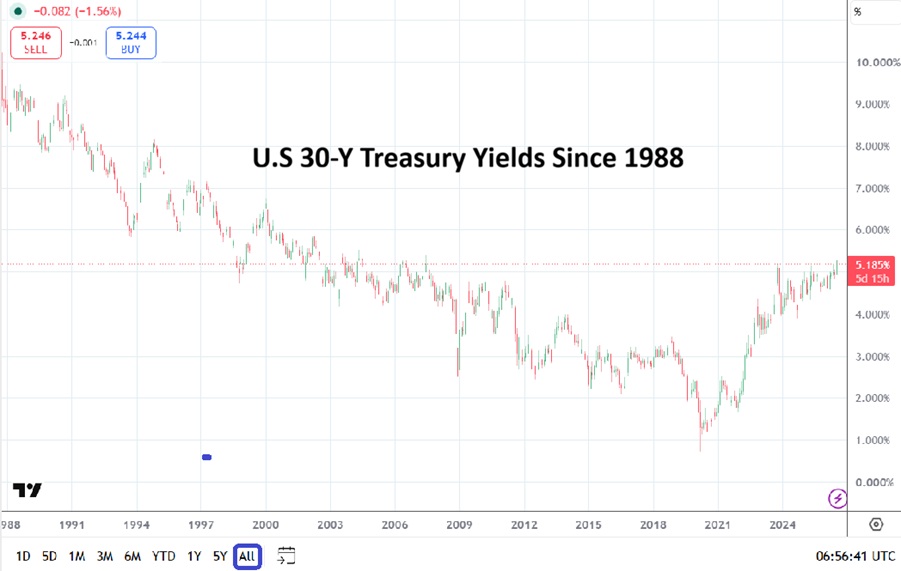
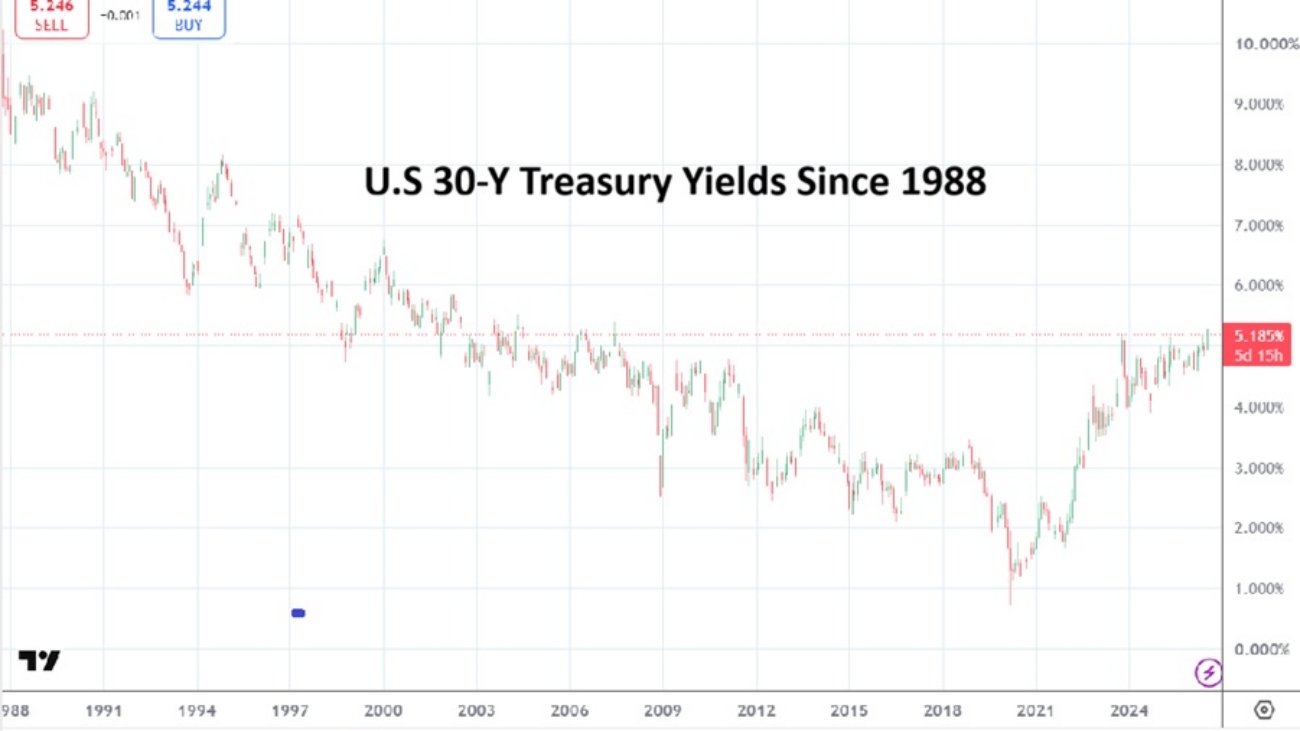
U.S 30-Year Treasury Yields Chart From 1988 until 26 August 2026

Today, the U.S is in exactly the same position!

A massive speculative attack is being waged against U.S debt (probably led in part by the crypto industry in an attempt to justify the “value” of its virtual tokens), with “inflation” suddenly becoming the ultimate beast.

Like Trichet at the time, the weak Powell got driven into the trap of raising rates abruptly on his own government, forcing it to pay more than $1 trillion in yearly interest, a massive and unnecessary injection of liquidity that is itself… inflationary!

In today’s world, driven by massive debt, raising interest rates on governments is INFLATIONARY!

Now that Powell is almost gone, all hopes lie on Warsh’s shoulders.

He can save the U.S from the current debt crisis with just a few words, exactly as Draghi did for Europe.

Warsh completely missed his first intervention a month ago. Instead of showing the market who’s boss, he showed total febrility.

Fearing being labelled a “Trump puppet,” he insisted on the 2% inflation target – an absurd threshold that nobody really knows where it came from – and claimed that “the economy is robust”… while we all know it is not!

Then he totally capitulated to the market by saying that he would “listen to the market” to determine where rates should go. The worst thing any Governor could ever say!

That’s how long-term yields exploded to levels not seen since 2007, and forcing Bessent to intervene to limit the damage.

We are now just one day away from the Jackson Hole Symposium.

Warsh can now either save the U.S or send it into Armageddon!

Every word he says could change the entire picture.

He simply has to focus on the right narrative:

  • Current inflation is geopolitical and driven by supply shocks. Raising interest rates has zero impact on such inflation.
  • The 2% inflation target is NOT an absolute figure. A 3% inflation rate should be acceptable when the economy is at risk.
  • Signs of recession are looming, with the labor market under pressure, rising bankruptcies, and record rates of defaults on credit cards and car loans.
  • Forcing the government to inject more than $1 trillion through interest payments is itself inflationary. Raising interest rates to fight inflation is counterproductive at such a high level of government debt.

If Warsh is capable of highlighting these arguments, yields will drop instantly without any intervention from Bessent.

Then the Fed can start decreasing interest rates gradually, with the market accepting whatever rate it sets.

What if Warsh deliberately gave a disastrous speech a month ago, taking a tough position against what Trump appointed him to do and allowing the market to drive rates to extreme levels… only to radically change his position following the recommendations of the task force he appointed?

This way, he would have absolved himself from being labelled Trump’s puppet while executing exactly the plan of reducing interest rates.

We can therefore suspect that he will take the opportunity at Jackson Hole to present the first findings of this task force, which could include, among other things:

  • A questioning of the 2% inflation threshold, especially when the economy is at risk of entering a deep recession.
  • Stressing that inflation comes mainly from geopolitical issues and supply shock. Fighting such inflation with high interest rates is totally inefficient.
  • A highlight of the absurdity of raising interest rates on the U.S government and forcing it to inject $1 trillion in interest payments – an unnecessary injection of liquidity that is itself inflationary.
  • The necessity of coordinating with the Treasury Department to fight inflation where it hurts the most, through subsidies, tax relief, and other targeted measures, while primarily fighting “greedflation” through higher profit taxes on specific industries.
  • A warning about the increasing risk of recession, with record numbers of corporate bankruptcies, credit-card defaults, and a deteriorating job market.

Warsh has a unique chance to prove that he is the right person for the job by rescuing the U.S from the massive speculation against its debt, exactly like “Super Mario” did when he saved Europe from collapse in 2012.
Copy and paste the text from AMT that you want to share

Share:
New Zealand Dollar 20260825a

NZD/USD: Elevated Value for Kiwi Coming Within Sight of Mid-Term Prices

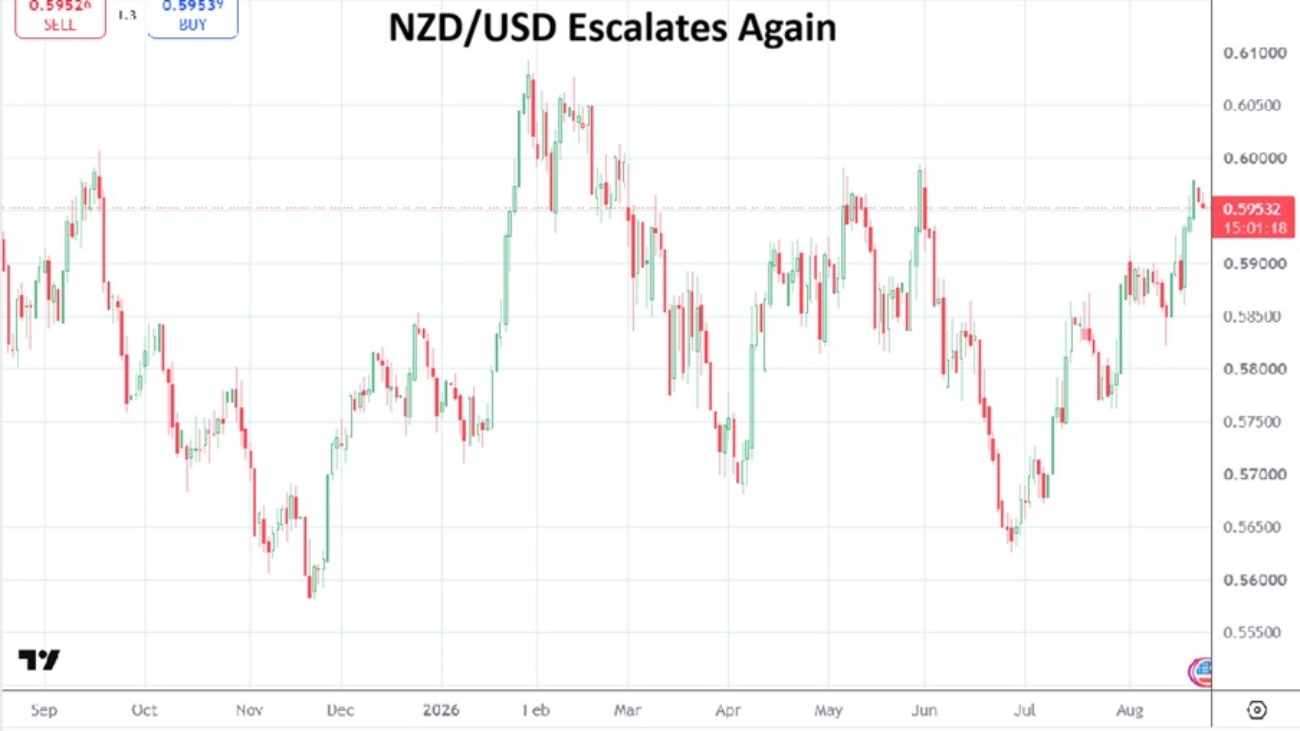
The NZD/USD is around 0.59550, last Friday’s highs near 0.59885 vicinity flirted with mid-term highs

The NZD/USD remains a speculative currency pair that offers fast results and velocity. The relatively low liquidity of the NZD/USD compared to the upper tier of major currency pairs allows for sudden bursts of movements which experienced traders may find tempting and inexperienced retail folks wagering could find exhausting and costly. The NZD/USD ranks typically around 7th per the size of its volume in Forex. Ahead of it at number six is the AUD/USD.

New Zealand’s growth rate of near 1.5% has been holding steady for the past half year. On the 8th of July the Reserve Bank of New Zealand raised its Official Cash Rate by 0.25% and the next decision from the RBNZ is next week on the 2nd of September. Because of inflation concerns some analysts believe another quarter of a basis point will be added. The current price of WTI Crude Oil is over $85.00, but it needs to be noted that New Zealand imports refined petroleum product most of which comes from Asia – like South Korea and Singapore. The current rate of inflation in New Zealand is around 4.1%.

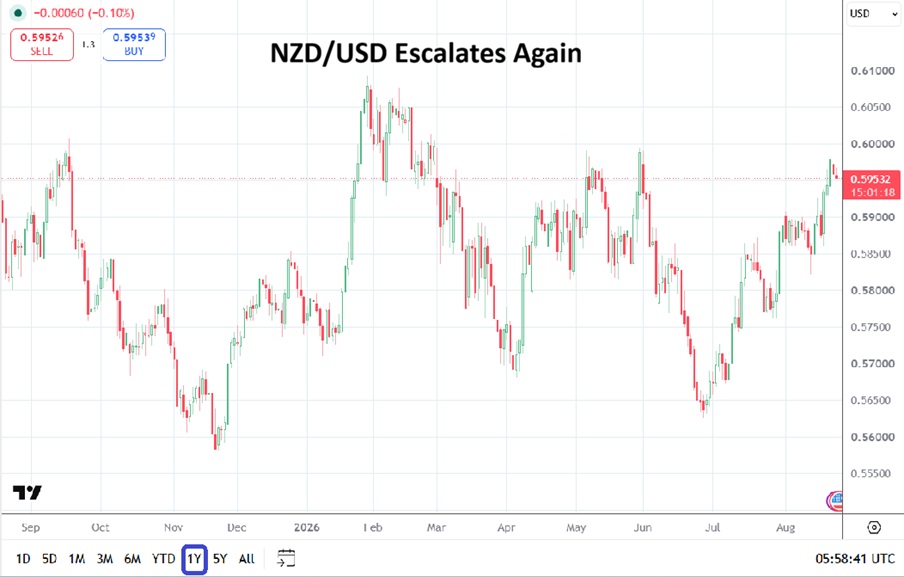
NZD/USD One Year Chart as of 25 August 2026

What will the RBNZ Do Next Wednesday

The Reserve Bank of New Zealand like other global central banks has a dilemma because of the sticky higher costs of energy due to the Iran and U.S conflict. The situation in the Middle East is unlikely to be resolved in the coming month. The conservative led New Zealand government would likely prefer not having to raise the Official Cash Rate, but the central bank may feel like it has no other choice. The U.S Jackson Hole Symposium led by the Federal Reserve starts this Thursday and a key speech will be delivered by Fed Chair Kevin Warsh this Friday, New Zealand officials will be a participant.

If the Official Cash Rate is raised in New Zealand by 0.25% to 2.75% it may supply the NZD/USD some additional reasons for greater Kiwi strength. However, what should concern day traders is the suspicion that part of the interest rate hike has already been baked into the value of the currency pair. Psychological support for the NZD/USD is easy to see at the 0.59500 mark for near-term traders. Those looking for upside may want to use slight moves lower to wager on potential reversals that they believe could ignite upwards if they are conservative.

Near-Term Wagers on the NZD/USD and Risk Management

The NZD/USD is a favorite for many Forex traders because of its volatility and often its ability to produce rather intriguing trends. The currency pair has seen upwards value since last Wednesday and has shown an ability to sustain it elevated status while correlating to the broad Forex market. On Wednesday the 29th of July the NZD/USD was near the 0.57650 ratio. The currency pair was flirting with 0.60000 rather consistently in February before the Iran and U.S conflict escalated into military action. 

Day traders tempted to look for additional upside in the NZD/USD cannot be faulted. If Fed Chairman Kevin Warsh somehow sounds dovish regarding U.S interest rates this coming Friday and talks about a strong U.S economy, and the RBNZ were to raise the Official Cash Rate next Wednesday this could bolster the value of the New Zealand Dollar. Risk management for retail traders is essential because sentiment shifts within the current higher terrain of the NZD/USD could attract more bullish perspectives that also include USD centric weakness, but if a sudden headwind blows – velocity in another direction could create volatility downwards if those leaning into a stronger NZD/USD were to become concerned about their outlooks and abandon ship.

Copy and paste the text from AMT that you want to share

Share:
Singapore Dollar 20260818

Forex: Compressed Tight Realms Signaling Nervous Reactions

Sentiment Storms as Financial Institutions Remain Unsure about Outlooks

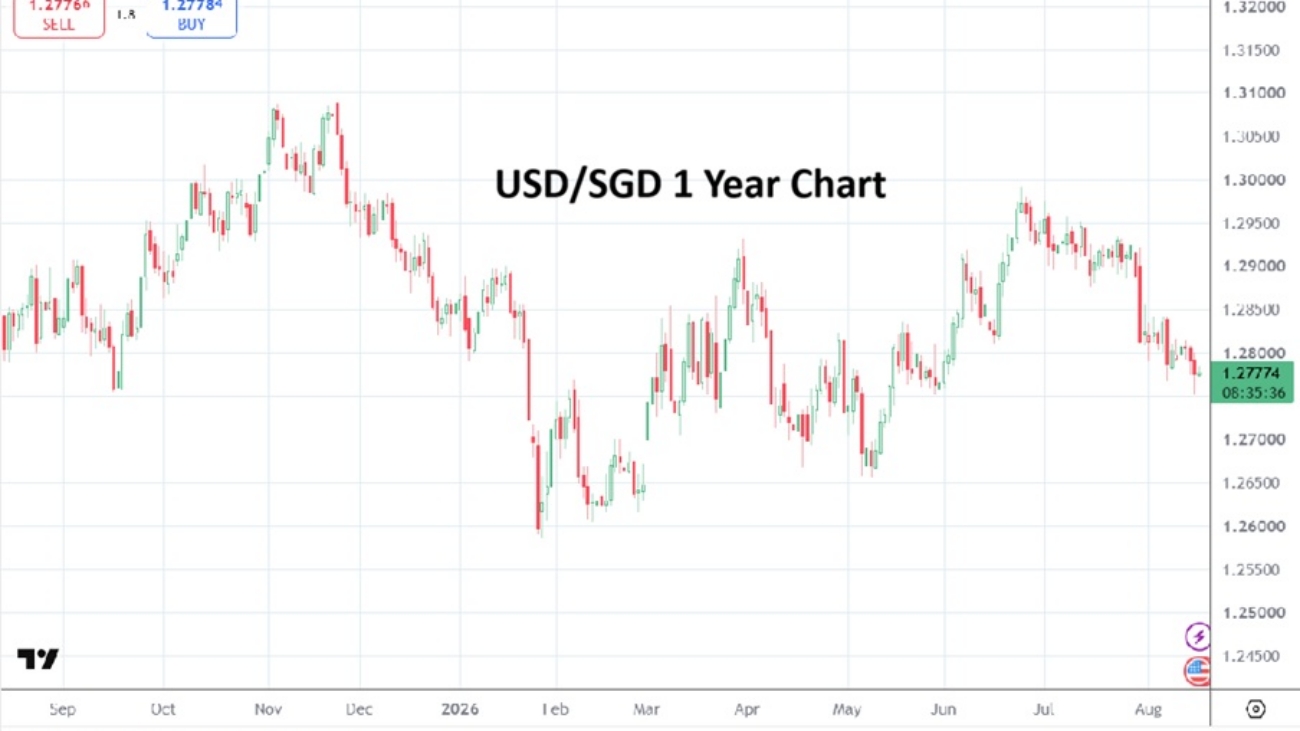
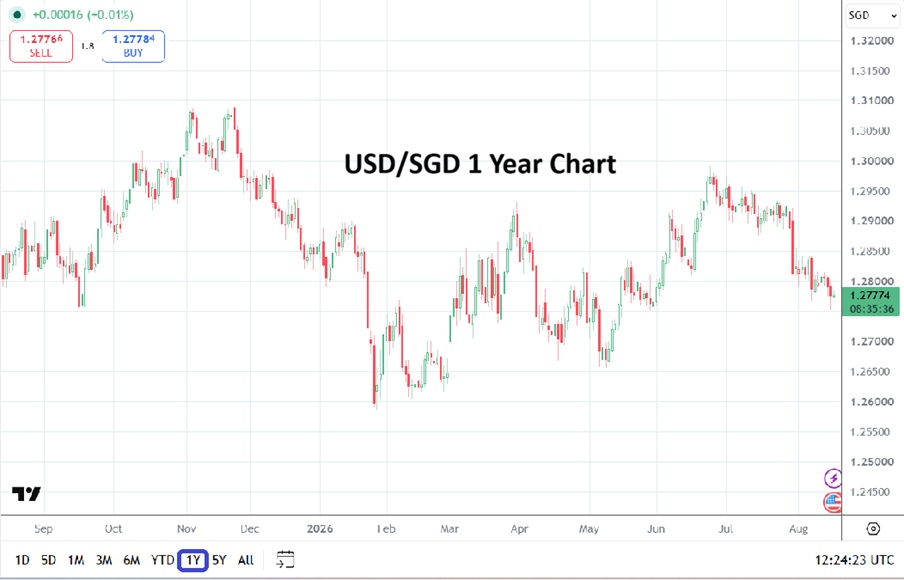
Price action in the USD/SGD has continued to demonstrate a rather significant turn downwards since the last week of June. The price of the currency pair is near 1.27800 as of this writing and is traversing near values seen the 1st of June and towards the end of the first week of March. Importantly, the USD/SGD has also seen recent lower depths and was below 1.27000 in the second week of May.

The USD/SGD traversed deeper ratios in late January when the 1.26000 vicinity was challenged and these levels were sustained until the middle of February. On the 26th of February the USD/SGD was near the 1.26500 mark. Now that the above numbers have been established, let’s discuss why this is potentially important for Forex traders as developing trends surface.

The past few years of trading have seen a compression of Forex deviations, in other words the FX market has grown more tame. However, the Bank of International Settlements (BIS) now reports that over 9.6 trillion USD in value is traded daily. This is a stark increase compared to 2022 when Forex saw an average daily market around 7.5 trillion – meaning there has been a 28% increase over the past four years.

USD/SGD One Year Chart as of 18 August 2026

The scope of volume is presented not to cause fear, but to show Forex traders what is at stake and the size of the marketplace and its potential for sudden jolts of volatility if it is established. 

Turning our attention to the new Fed Chairman Kevin Warsh and his preference to not give concrete forward guidance is important. U.S Treasury yields are dangerously high (the 30-Y yield is near 5.31%), and the military conflict between Iran and the U.S  continues to fester. Threats remain on the horizon which need observation, insights that prove correct regarding how these bits of information will influence the Fed Chair and the impact on the USD could prove significant for financial institutions.

Large players have reasons to be critical about a lack of clarity and this might spark more choppiness in Forex – even though value realms are said to be in a compressed state. This opens the door for technical traders who may have a better gauge on existing behavioral sentiment of the Forex markets compared to fundamental traders who have too many tea leaves to interpret which are moving rapidly as the cup gets shifted. Technical traders may have a good sense of where algo trading is directing its velocity per current Forex sentiment. 

While some analysts make a case for an increase to the Federal Funds Rate because of inflation concerns, what happens if they are wrong? And what if large players are now discounting their initial fears regarding higher interest rates and are actually starting to position themselves for the Fed Funds Rate to remain the same or be lowered in the mid-term? Is this one of the reasons why the USD has become weaker recently?

What if the new Fed Chairman Kevin Warsh proves stronger than people believe and has the ability to talk lower interest rates into reality? The U.S Treasury faces a huge and expensive task trying to pay off the yields of the high flying 10-Year and 30-Year bonds. What if Treasury Secretary Scott Bessent who has a solid relationship with Fed Chair Warsh proves influential? Read AMT’s Charles Najjar’s article on his thoughts about why the Fed should aim for a 2% Fund Rate: https://www.angrymetatraders.com/why-the-us-fed-should-lower-interest-rates-to-2/

Yes, the Middle East situation remains troubling from a mid-term economic viewpoint regarding the implications on WTI Crude Oil prices and ancillary energy costs globally. Inflation must be battled, but is raising the Federal Funds Rate going to help decrease the cost of energy or lessen its demand? Mostly likely no.

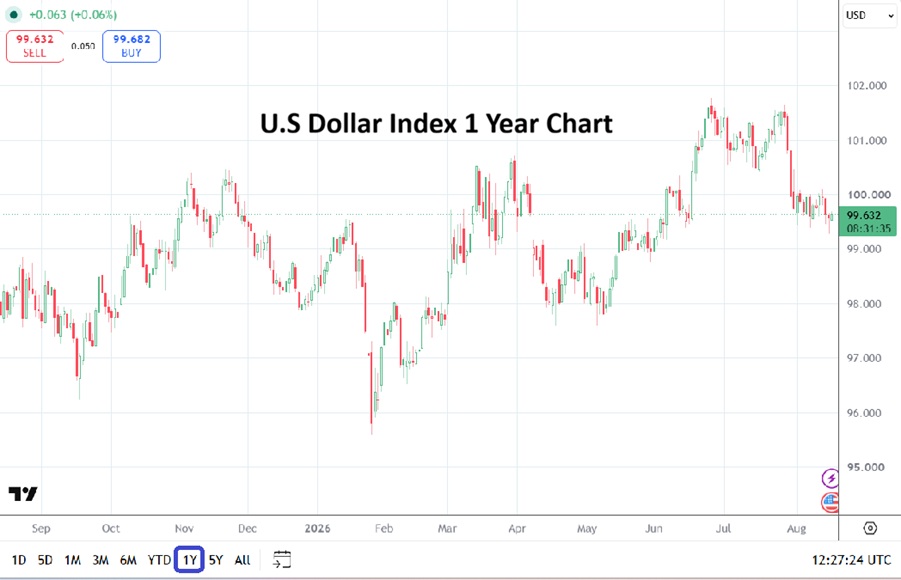
U.S Dollar Index One Year Chart as of 18 August 2026

The gold market has started to show signs of price velocity the past couple of weeks. The precious metal is trading near $4,395.00 as of this writing. Investors with a long-term window and troubled perspectives about the health of the USD have plenty of reasons to be more comfortable holding gold compared to staying in cash. 

U.S equities have been doing well via indices, but nervous shadows are hovering (maybe they always are). And this is why diversification is always important via long-term investment. Equities, bonds, gold and a small proportion for speculative purposes – this for those who want to try and increase their wealth while maintaining a status quo regarding preservation of wealth.

However, from a speculative standpoint, the Forex market is starting to show signs of alarming behavior, some may even call it a lack of correlation caused by storms forming. Yes, we know the USD/JPY is within its own environment as the BoJ and U.S Treasury/Fed play tag team trying to scare folks away from buying the currency pair. However, putting the JPY to the side for the moment, USD centric weaker positions are showing ability to sustain trends. 

The USD/SGD is a prime example of this momentum. The Fed’s Jackson Hole Symposium begins on the 27th of August and ends on the 29th  and all the major central banks will be attendance. Financial institutions will be keen to hear discussions about U.S bond yields, U.S and Japan currency interventions, but importantly will also want to monitor what Kevin Warsh and his cast of FOMC officers have to say about U.S interest rates. And it has to be known given the past two months from the new Fed Chair, he may remain rather quiet regarding outlook. 

And that might be good for the Forex market and spark some opportunities for traders to find an advantage. Because if nothing new or convincing comes out of the Jackson Hole meetings that financial institutions can decipher regarding their mid-term outlooks, perhaps the near-term will produce more volatility.  The next Federal Reserve FOMC meeting decision will be on the 16th of September. Do not expect interest rates to be raised.

Copy and paste the text from AMT that you want to share

Share: