India's National Stock Exchange Magic Act Needs to Diversify
The National Stock Exchange (NSE) of India has been planning for an IPO quite a while. The total valuation of NSE is estimated at 5 trillion Rupees ($53 billion USD). The issue size is 22,569 crore ($2.4 billion USD) while shares are priced at 1700 to 1785 per equity share. Share value of 65% are blocked for institutions and 35% for the retail segment. The IPO is open from September 17th to the 21st. The sales is an offer by existing shareholders, not a fresh issue of equity shares.
The rise of stock trading apps in India has made applying for primary offers easier, especially after 2020. The NSE’s value has soared over the past decade as India’s capital markets have expanded and retail participation has been surging. NSE’s unlisted shares were bought by wealthy individuals and NRIs (Non-Resident Indians) over the last few years in order to capitalize from the new trading boom.
The NSE IPO is priced at 42 times its earnings, a steep valuation compared to its global peers. NSE investment bankers were advising the stock exchange to issue 148.9 million shares at a higher valuation, but upon sensing less market depth and cautious appetite, bankers have reduced the number of shares offered to 126.44 million.
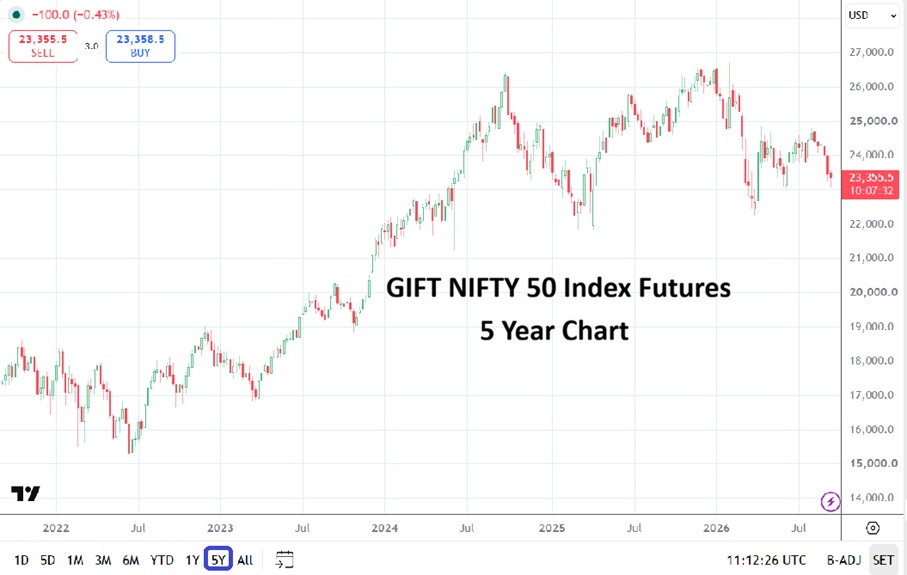
GIFT NIFTY 50 Index Futures Five Year Chart as of 18th September 2026
Reports from the last few days say anxious brokers have been calling individual investors and trying to entice them to invest in NSE. As an example, the Life Insurance Corporation (LIC) IPO in 2022 did not demonstrate as strong a marketing push from brokers compared to this NSE event.
What’s the reason for the NSE IPO is being rushed to the marketplace when internal macro conditions are not accommodative? Various India state owned enterprises own stakes in the exchange including the State Bank of India and its subsidiary SBI Capital Markets entities – they and others likely want to be part of a ‘win’.
The NSE IPO comes at a time when the regulatory barrier on brokering and trading has intensified in recent years. Options activity propelled a gigantic boom in retail activity and helped strengthen NSE’s capital position. But it could not have happened without the regulator, the Securities and Exchange Board of India, providing a relaxed attitude regarding influencers who sugar coated facts and were partnering with brokers to attract millions of uneducated and struggling youth to bet on India’s index derivatives market.
As someone who worked in a private full service broker, I have seen countless numbers of people lose money while options betting. College students, retired people, small shop owners opened trading accounts in mass with a number of digital brokers and began to bet on weekly option wagers where the odds of winning were stacked against them.
The Indian government by igniting this machine has so far collected 90,000 crore ($9.37 billion USD) between Financial years 2021 and 2026. The flip side is the mounting losses incurred by retail traders. From FY 2021 to 2025 the losses are estimated to be around 287,000 crore ($30 billion USD) per SEBI’s data. Individual traders lost money in this casino like atmosphere around 91% of the time. The numbers are staggering because option sellers, hedge funds, prop and other wealthy traders made money at the expense of retail losses.
The government has collected income taxes on these capital gains from profits generated by the option sellers. While retail traders who had borrowed money via personal loans to wager in these dangerous trading instruments are now suffering severe financial liabilities, paying 40-60% interest rates on their loans. Many youngsters have lost serious money. This is a severe situation because the average annual income for a person is around 15,000-20,000 Rupees ($208 USD) per month.
The NSE meanwhile has made revenues of around 35,000 crore ($3.65 billion USD) between FYs 2021-2025 for facilitating this disastrous betting landscape. In other words, the National Stock Exchange has seen profits rise by more than three times in these last four years due to the retail boom. Brokerage offices have collected handsome rewards too.
After the regulator begun to scrutinize losses incurred by retail traders in 2023 and 2024, they increased the minimum margin requirements for option traders to participate on particular contracts by a multiple of 3. This means those who were wagering with 500 Rupees now have to spend 1500 Rupees for pursuing the same contracts, assuming the premium per unit of the contract is unchanged. The regulator also limited numerous other option contracts on various indices to streamline the segment, i.e. allowing weekly expiry options for NSE and for the BSE (Bombay Stock Exchange). The chief aim of these measures was to discourage people from rapid, speculative bets on options that expired within days and it worked. Within a few weeks the high frequency retail trading frenzy had deflated sharply.
The biggest loser to this action is the NSE, which is getting around 60% of revenues from derivatives trading volumes. As retail traders activity cooled, exchanges like NSE shifted towards attracting patient long term capital from institutions for listings and rely heavily on traditional cash markets for generating revenues.
Despite pundits arguing that India has deepened the capital market inclusion, the reality is it has made very few changes in the existing system. For instance, the Reserve Bank of India ordered the closure of the exchange traded currency derivatives market in 2024, which helped small scale exporters and importers to hedge their risks efficiently. The country also has made little in-roads trying to expand the corporate bond market, and 75% of financing is still done by corporations through bank credit lines. India despite making numerous changes in regulations has failed to foster the development of financial institutions with bonds.
Short selling of shares remains banned, meaning a buyer of shares has two variables whenever he or she is purchasing, profit or loss. They can’t hedge. There is also no major marketable securities avenue for government or corporate bonds. Government bonds are still fix-rated like bank deposits. In the last decade many who people who ‘invested’ and funded instruments in shadow banking firms lost huge amounts of money, and so have individuals who invested in non-convertible debentures (NCDs) via Yes Bank and Dewan Housing Finance Limited.
If the National Stock Exchange wants retail investors to participate in its IPO shares it should diversify avenues for making money and issue a lower valuation to be attractive. The NSE cash machine has stumbled. Profits in the India financial markets industry have slowed as wealthy high net worth individuals and prop traders have shifted bases to UAE and Singapore. The NSE should not expect retail traders and small investors to subscribe to its IPO when people are struggling to pay their monthly bills. The NSE minted a huge amount of money from retail traders via a casino like binge and helped institutions and governments earn superlative profits. Now the NSE wants to replicate this cash magic act with its IPO.