Iran Pt One 20260316

Iran: What Victory Looks Like, Part 1 – The Economy

Ridding the World of the Islamic Republic Price Premium

Opinion: The following article is commentary and its views are solely those of the author. This article was first published the 16th of March via The Angry Demagogue.

There has been much chatter about what “victory” over the Islamic Republic means and it is mostly an attempt to deny the very concept of victory. We wrote about “The End of Defeatism and a Return to Victory” last week where we criticized the whole aversion to victory in Western society. The naysayers don’t like to admit that an anti-Western regime can be all that bad, and therefore endless diplomacy needs to be a goal until the final surrender of the West. They don’t really care about the cost of gasoline in the United States – they actually want it to rise – but as long as it was brought up, let us examine in part, the cost of the Islamic regime and what “economic victory” will look like.
Victory in WWII meant not only the defeat of the evil that was Nazi Germany, but it also meant the resurgence of Europe as an economically successful continent. The Marshall Plan that was the crux of the European revival was as much a part of the Allied (sans the Soviets) victory as the surrender signed by German generals.

What is “economic victory” in this war? The media is all over the costs of the war, but no one has examined the costs of allowing the Islamic Republic to continue as it is. No one has examined the cost that the mere existence of the Islamic Republic (as opposed to non-Islamic Iran) creates for the world in general and the United States in particular.

Let’s start first with the most talked about and panic-ridden event and that is the Strait of Hormuz, the gateway to the Persian Gulf and a chokepoint in international shipping to and from that region. It is the gateway to much of the oil shipped to the world, but also fertilizers and other products. The Wall Street Journal news section in another ignorant headline it considered a “scoop”, wrote that President Trump was told that the Straits might be closed in case of war and he attacked anyway. I am not sure there is a knowledgeable military or diplomatic figure or layman in the world who didn’t consider that an option, but to the WSJ news editors it was the surprise of the century.

As Condoleezza Rice said on the recent episode of Hoover Institutions “Goodfellows” a 50 cent rise in gasoline prices for a few weeks is not a reason not to attack a country who has been at war with you for 47 years. But before we even get to that point, has anyone analyzed the cost of giving Iran a veto over who gets to ship through those straits?

If we look at the insurance rates for shipping through the Strait of Hormuz from Lloyds of London we will get a first hint. From 1970-1979 (before the Islamic Republic) the typical premium was 0.01-0.05%. Once Khomeini took power the rates were 0.05-0.2%. During the Iran-Iraq war when there were the “tanker wars” (between 1984-7) those rates jumped to around 5% with a peak of 7.5%. The post Iran-Iraq and Gulf war period of 2004-19 ranged from .0.05-0.25% – well above the pre-Islamic Republic days.

As for absolute figures, a tanker valued at $200m with a rate of 0.01% (pre-Islamic Republic) cost $20,000 and .05% will cost $100,000. The cost at 0.5% is $1million. So, the pre-Islamic republic rate for a $200m tanker ranged from $20,000-$100,000 while the absolute rate at the lowest level since the Islamic Republic came into existence ranged from $100,000-$400,000 – during the best of times. This does not take into consideration the war premium for the many years Iran threatened and even hit tankers even without the excuse of American or Israeli bombing. The average “war premium” from 1979-2020 was 0.83% or $1.66 million for a $200 million vessel.

We don’t have the wherewithal to continue this analysis, but this is exactly the type of article that we used to expect from the pre-ideological WSJ (or even NY Times) news sections. Maybe some economist or even the WSJ editorial page can start to do the heavy lifting and tell us how much the Islamic Republic of Iran has added to the gasoline bill of the average American even during non-war periods.

In economic terms – victory means a eliminating the price premium for shipping energy and global trade in general brought on by the very existence of the Islamic Republic. We will know victory is here when there is a return to the insurance premiums of the pre-Islamic Republic days and when the price of oil, due to increased supply from a non-terrorist Iran reaches the levels it is capable of. A 50 cent or even a 1 dollar rise in gas prices for a month will be followed by $2-3 decreases permanently. We won’t reach the 28 cents a gallon I remember from my childhood (actually 27.9 cents), but neither will it be $4.00 (except maybe in California).

This economic victory will reverberate to other theatres. While the Russians might profit from a temporary rise in oil to $100 a barrel, in the medium and long term, if oil drops to $40 a barrel or even less, they will struggle to support the war effort.

The short term costs and dire predictions that the journalists and diplomats have foisted upon us will end up being a drop in the bucket after economic victory is achieved.

Disclaimer: the views expressed in this opinion article are solely those of the author, and not necessarily the opinions reflected by angrymetatraders.com or its associated parties.

You can follow Ira Slomowitz via The Angry Demagogue on Substack https://iraslomowitz.substack.com/ 

Copy and paste the text from AMT that you want to share

post233

Stock Market Narrative and Looking for a Trump Silver Lining

Stock Market Narrative and Looking for a Trump Silver Lining

S&P 500 One Year Chart as of 14th March 2025

U.S stock markets have been hit on the nose in recent weeks, the major indices have put in rather consistent declines since the 19th of February, and the selling frenzy and particularly noise have grown worse since the start of March. Narrative regarding tariffs and a lack of clarity have certainly had a negative effect. The notion that there is a part of the media that wants to see a downturn in the markets and blame President Trump could also be factoring into concerns and fragile sentiment among indices participants. I am not blaming the media for the downturn, just pointing out that there are some entities which are not unhappy about the recent selling in the stock markets, this because it fits comfortably into their narratives.

While the bearish decline on the S&P 500, Nasdaq 100, and Dow 30 have all been easy to see, defining the dynamics of the downturn, and reactions from day traders and investors are complicated. The stock markets are not guaranteed to always go higher. This may sound naive, but people have gotten so used to the notion that U.S indices always go up that they forget about the potential for downturns. Yes, the stock markets have turned negative, but a one month decline is not uncommon historically. And some of the folks rooting against Donald Trump may want to take that into consideration.

Risk premium has certainly been factored into the markets which has influenced equities, but has created forceful moves in Forex too. Risk adverse tension because of persistent rhetoric about tariffs and their impact on behavioral sentiment cannot be discounted. However, the stock markets are still higher over the past year.

The Trump Effect is certainly being pointed at by many as the cause for the sudden downturn, but it should be remembered that all-time highs occurred after Trump won the election. Yes, the selloff has definitely happened too, and stock markets are now traversing values seen before the election. And support levels are being looked at with caution and more selling could lead to a test of psychological ratios which pressure market confidence further. Yet, it should also be remembered the S&P 500 at this time last year was around the 5,150 ratio compared to its current mark near 5,565.

Day traders have been hard pressed to find momentum with solid wagering opportunities, particularly if they have been in search of a bullish trend in recent weeks. The belief that U.S indices always go up eventually is a solid reference, but in the short-term can cause expensive losses for stubborn betters. Investors certainly have an easier time with stock indices if they practice the long-game and do not worry about the daily and monthly gyrations when their money is parked in indices. The use of leverage when betting on the daily results of stock markets can become ultra expensive for speculators, particularly when upside bias is being counted upon.

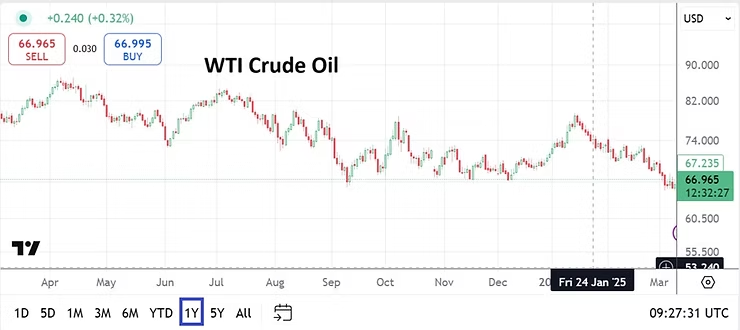
WTI Crude Oil One Year Chart as of 14th March 2015

Data this week from the U.S has actually been positive regarding lower inflation, both the CPI and PPI reports released the past two days has shown a slow down in costs. Yet, these results have little to do with President Trump, since he has only been in power less than two months. However, the lower WTI Crude Oil prices being achieved at this moment will start to factor into weaker inflation and will benefit the U.S economy.

The U.S Federal Reserve will have to be watched, because Fed officials seemingly continue to be among the crowd worried about tariff knock-on repercussions. But it should be remembered during Trump’s first term in office, there were tariff concerns too and inflation was tame. It will take a few months to still see results via inflation under this Trump administration, but if energy prices remain stable and low, this can mitigate circumstances while the tariff winds blow and their effects are waited upon. Interest rates from the Federal Reserve, U.S taxes on the public will continue to come under scrutiny. The likelihood of Trump and the Federal Reserve locking horns regarding interest rates seems to be a certainty in the coming months.

U.S stock markets have proven dangerous for bullish perspectives the past handful of weeks, but the viewpoint that markets have been too discounted will certainly start getting the attention of large players. U.S Treasury yields remain a barometer, but short-term results do not always correlate. Speculators without deep pockets may want to continue to watch from the sidelines.

Traders should also remember there is the ability to short U.S indices, but this brings up the healthy question about when will price support start to become a factor. It is nearly impossible to pick the precise moment financial assets will stage a turnaround for day traders, but history does indicate that bullish sentiment will start to be seen. Betting on a continued downturn could prove more expensive in the end, compared to speculating on upside.

Trading is not easy. It takes a lot of stamina to endure price movements that do not go according to plans. The financial markets are proving difficult for many. We are likely not out of the woods yet because clarity remains problematic, investors who have longer timeframes are likely anxious too. Price velocity needs to be given attention, markets can certainly go lower. However, at some juncture equities will start to look cheap to important long-term players. Behavioral sentiment among investors will likely also start to acclimate to the Trump Effect.