10Y US Treasury Yield 20260716

Why the U.S Fed Should Lower Interest Rates Closer to 2%

Fighting Inflation with Higher Interest Rates is Totally Counterproductive

For nearly a century, central banks have relied on one dominant prescription to fight inflation: raise interest rates. The theory is straightforward. Higher borrowing costs discourage spending and investment, reducing demand and eventually slowing price increases.

While this approach may have worked reasonably well in the past, today’s economy is fundamentally different. Applying the same monetary formula developed in the past century by Irving Fisher is obviously creating more problems than it solves. In many cases, raising interest rates has become a counterproductive way to fight inflation.

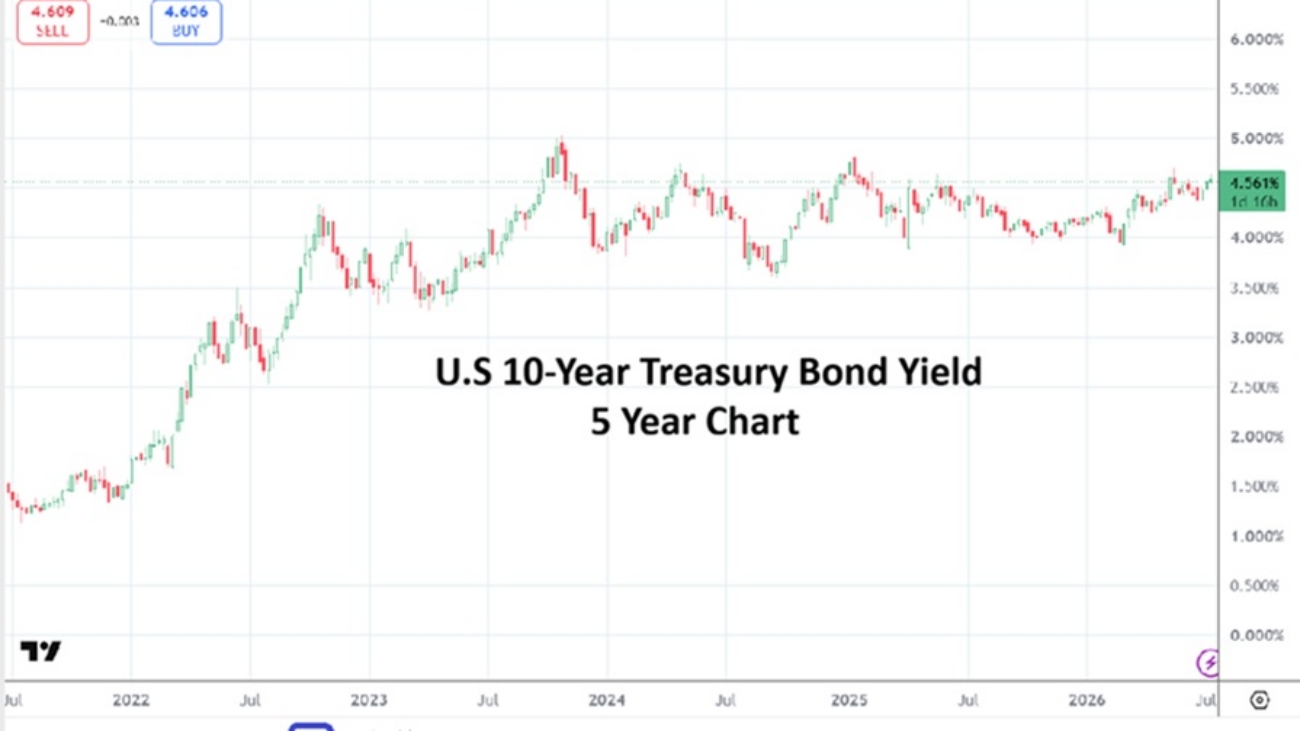
  • The first and most obvious consequence is the impact on government finances. As interest rates rise, the U.S. Treasury must refinance its enormous public debt at increasingly expensive rates. The result is an explosion in annual interest payments, which now exceed $1 trillion. Those payments are in fact a direct injection of additional liquidity into the economy while simultaneously widening the federal deficit.

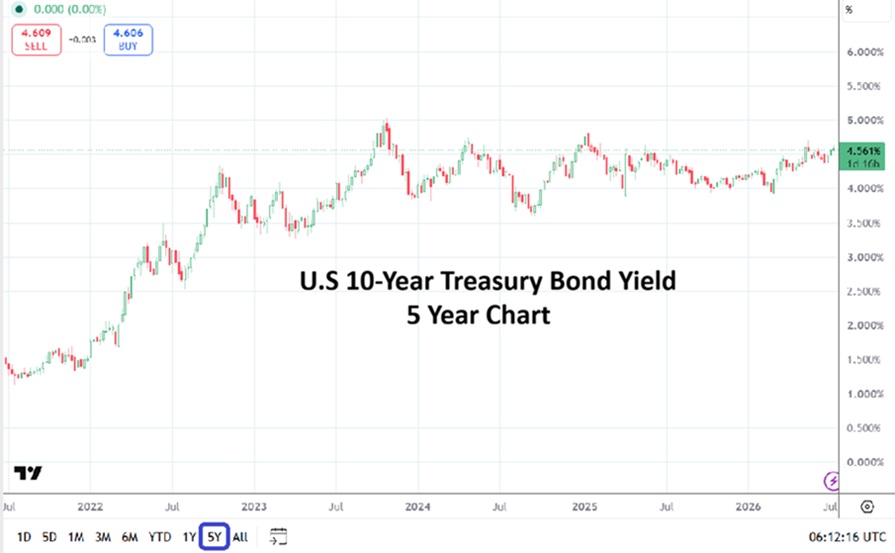
U.S 10-Y Treasury Yields Five Year Chart as of 16th of July 2026

Ironically, a policy designed to reduce inflation is contributing to larger government spending through higher debt-servicing costs. Instead of easing inflationary pressures, excessively high interest rates may actually reinforce them through this fiscal channel.

  • Consumers also bear a heavy burden. Modern households depend far more on credit than previous generations. Credit cards, auto loans, and consumer financing have become an integral part of everyday life. When the Federal Reserve raises interest rates, millions of Americans see the interest on their credit card balances climb to 20% or more.

Many families attribute their declining purchasing power entirely to inflation, when in reality a significant portion of the financial pressure comes from soaring interest payments.

  • Businesses suffer as well. Higher interest rates increase the cost of financing, while the same capital could be dedicated to investment, expansion, innovation, and research. Every additional dollar spent on interest is a dollar that cannot be invested in productive activity.

A recent example is SpaceX, which issued debt carrying a yield of approximately 6.65%. Given the company’s negative cash flow, investors naturally require a risk premium. However, if the Federal Reserve’s policy rate were closer to 2% rather than current levels, the company’s borrowing costs would be at least half their current level. The extra interest payments would instead be directed toward research, development, hiring, that would strengthen long-term economic growth.

In the current race for AI, that requires heavy investments, the Fed should lower the financing burden on U.S companies. Every additional percentage point of interest represents billions of dollars transferred from productive investment to debt servicing. Money that could finance AI chips, data centers, engineers, research laboratories or new factories instead goes to creditors.

The U.S cannot simultaneously declare China its principal strategic competitor while maintaining a monetary policy that systematically makes capital more expensive for American businesses than for their Chinese rivals, that benefit from much lower rates. The Fed may intend to fight inflation, but it is also making it more costly for American companies to invest in the industries that will determine economic leadership over the decade. The Fed may believe it is fighting inflation, but it is simultaneously increasing the cost of winning the AI race.

Perhaps the greatest weakness of relying on high interest rates is that much of today’s inflation originates from supply-side shocks that monetary policy simply cannot fix.

How does raising interest rates reduce the price of oil when energy prices are driven by geopolitical tensions such as the war with Iran?

How does raising interest rates lower egg prices when shortages stem from productivity issues in the poultry industry?

How does raising interest rates lower the prices of wheat, corn, or cocoa when inflation is due to droughts, floods, or other climate-related events?

How does it reduce insurance premiums that are rising because natural disasters have become more frequent and more costly?

In each of these cases, higher interest rates are totally inefficient to address the underlying cause of inflation. Instead, they merely increase financing costs across the economy while leaving supply constraints largely unchanged.

A more effective strategy would be to fight inflation where it actually originates. Governments possess fiscal tools that can be deployed with much greater precision than broad monetary tightening. Temporary subsidies, targeted tax relief, incentives for increased production, strategic investment in critical industries, and, in exceptional circumstances, carefully designed price controls can address specific inflationary pressures without unnecessarily slowing the entire economy.

For example, if geopolitical tensions cause oil prices to spike, temporarily subsidizing fuel or reducing fuel taxes is likely to be a far more direct and effective response than raising interest rates across the entire economy. Similarly, boosting domestic agricultural production is a better solution to food inflation than making mortgages, business loans, and credit cards more expensive.

The Fed should therefore focus on reducing the financing burden on both the federal government and the private sector. Maintaining interest rates closer to 2% would significantly lower debt-servicing costs, support productive investment, and allow fiscal authorities to intervene more effectively with targeted measures when inflation arises from specific sectors.

The doctrine of fighting inflation through higher interest rates was developed by Irving Fisher nearly a century ago, in an era with very different financial institutions, consumer behavior, and sources of inflation. Credit cards did not exist. Household debt was far lower. Global supply chains, geopolitical energy shocks, and climate-related disruptions were not defining features of inflation.

The modern economy requires modern solutions. Rather than relying almost exclusively on higher interest rates, policymakers should recognize that today’s inflation often demands targeted fiscal responses. Persisting with an outdated monetary framework risks imposing unnecessary costs on governments, businesses, and households while failing to address the real drivers of rising prices.

Supporters of high interest rates often argue that they are unavoidable whenever inflation rises. Yet international experience suggests otherwise.

Switzerland has repeatedly maintained policy interest rates close to 1%, or even below zero in previous years, despite being exposed to many of the same global shocks affecting other economies. Switzerland imports energy, is affected by fluctuations in oil prices, and faces the same geopolitical uncertainties. Yet the Swiss National Bank has generally preferred to tolerate modest inflation rather than impose unnecessarily high financing costs on households, businesses, and the government.

This illustrates an important principle: not every inflation shock requires an aggressive monetary response. When inflation is primarily imported through energy prices or supply-chain disruptions, forcing the entire economy to pay dramatically higher borrowing costs creates more economic damage than the inflation itself.

Copy and paste the text from AMT that you want to share

AMT Top 10

AMT Top Ten Miscellaneous Meditations for the 16th of June

Memorandum of Misunderstanding, the SPCX Rocket, the Knicks and Brazil as Jazz Plays in the Background

10. Legacy: Sonny Rollins passed away on the 25th of May at the age of 95. Rollins was a master jazz musician and saxophonist who will be listened to forever. His sound, cadence and imaginative ability to create while playing with bands, and often lead via his unique style make him an everlasting legend. If you haven’t listened to Sonny Rollins start out with his song St. Thomas via Saxophone Colossus.

AMT Top 10 Miscellaneous Meditations for the 16th of June, 2026

9. Surreal: The New York Knicks won their first NBA Championship in 53 years. Some Brazilian football fans returning to their hotels after their team’s 1-1 draw versus Morocco in their Group Stage World Cup match in New Jersey had to walk through throngs of Knick fans celebrating on the streets of Manhattan in bizarre looking circumstances as they worried about their national team. Walt Frazier and Pele both wore Puma and met in the 70’s.

8. Strategy: Michael Saylor continues to claim the wet and cold Bitcoin wind blowing back in investors’ faces is a refreshing mist that will invigorate the HODL crowd eventually. In the meantime MSTR is near $131.00 and BTC/USD around $66,300.00. Saylor sees Bitcoin above 1 million eventually and beyond, while some others see headwinds and more losses developing.

7. Bleeding Money: Political mismanagement shadows Chicago which appears ready to lose the Bears football team via a new stadium across state lines in Hammond, Indiana, this as team officials and ill-equipped Illinois leaders argue about property taxes and other business considerations (and maybe kickbacks). NYC is hurting for funds too, this as important companies make plans to place their corporate headquarters and employees elsewhere and avoid Mayor Mamdani’s nonsense. Apollo Global Management is the latest to decide to venture forth into Texas and make its New York presence less important. 

6. Commodities: Gold is near $4,330.00 this morning, Silver around $70.00 and WTI Crude Oil close to $78.00 via futures pricing.

5. Nasdaq 100: The index finished 3.06% higher yesterday and at a value of 30,543.92 per last night’s close. The Nasdaq 100 has been delivering a wild ride for speculators and investors. The index saw all-time highs in early June when it went above the 30,700.00 level. The S&P 500 concluded Monday’s trading at 7,554.28 and up by 1.65%, the index’s high was also in early June when it went above 7,600.00. For all the talk of doom and gloom over the past week and a half with fears about a sustained run downwards in the U.S indices, they are showing upwards momentum for now. 

4. BoJ: The USD/JPY remains within sight of the 160.000+ mark consistently. While other major currencies have gained a bit the past few days against the USD, the Japanese Yen remains sticky near its highs as the Bank of Japan is likely watching speculators wager on the higher realm. FX traders need to remember that the BoJ may act when it feels it has enough clarity regarding the Iran saga and inflation concerns. In other words, a warning shot may come soon threatening an intervention. Buyers beware.

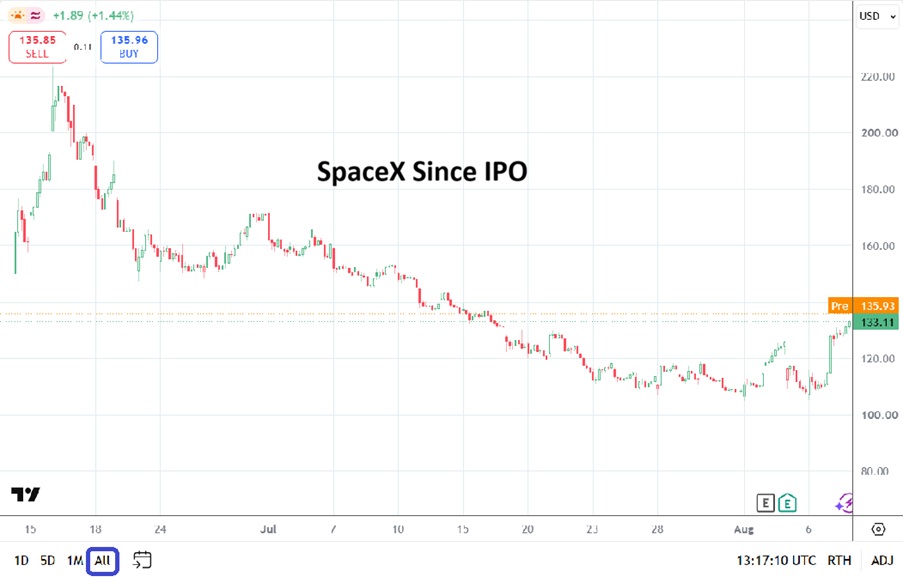
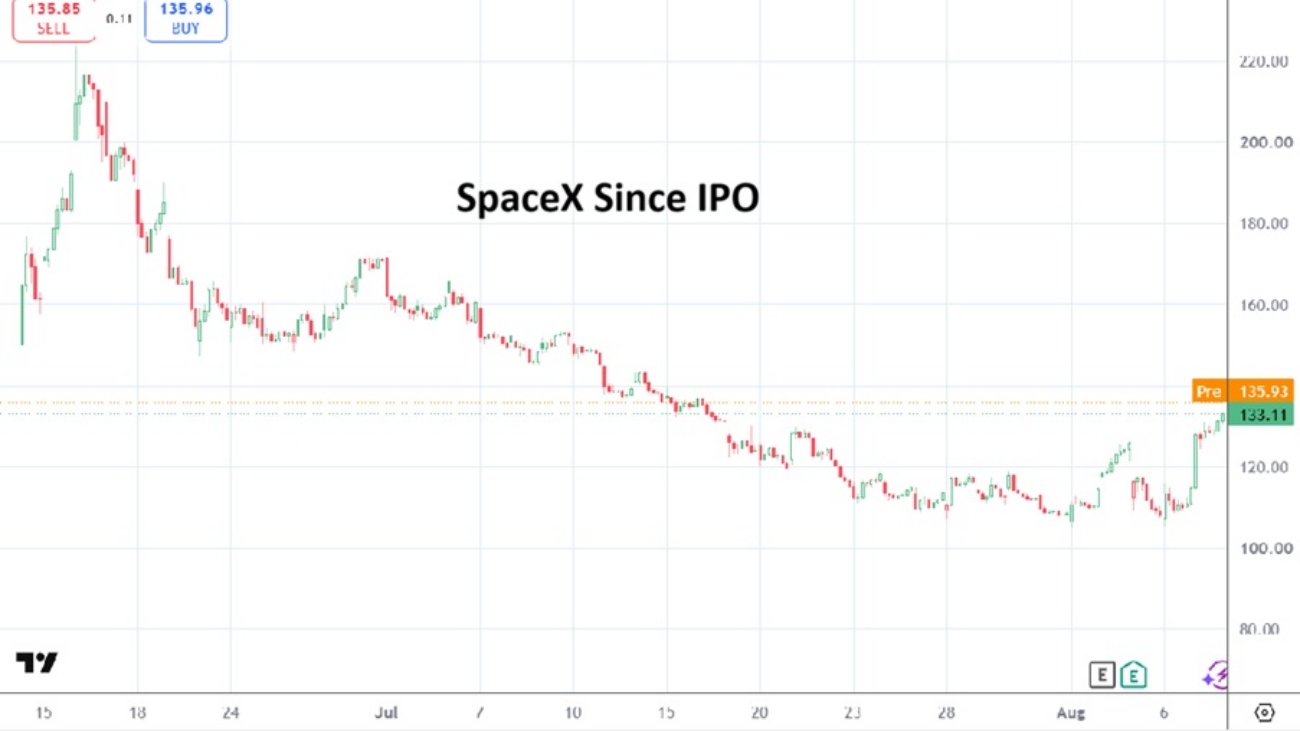
3. SpaceX: Is it a bird or a plane? No, its a 2.1 trillion market cap valuation via a rocket like IPO on the Nasdaq 100. While some may want to bet against Elon Musk early, those type of decisions have proven costly mistakes for some short sellers in the past when dealing with Musk and Tesla. Some may argue for value of $115.00 and less per each SPCX share, but it might prove unwise to step in front of the upward trend for the moment. Case in point, Tesla is near $411.00 per share and causing chagrin within certain crowds as they point to weakening sales, but only see the company do better in value. Oh, and SpaceX ended Monday’s trading at $192.50.

2. Fed: Kevin Warsh leads the FOMC Committee as the Chairman for the first time as the Federal Funds Rate decision awaits this Wednesday. Some think the Fed will increase the interest rate by 0.25%, AMT does not based on the opinion Chairman Warsh likely wants to start off his job on friendly terms with the White House and Treasury, while also counting (hoping) on cheaper energy prices.

1. MoU: The Iran conflict awaits a signed agreement. The terms of the Memorandum of Understanding are being whispered, but transparency has not been delivered and won’t be until Friday supposedly when the U.S and Iran attend a ceremony in Switzerland. While financial institutions and global markets are ready to turn the page and engage in optimistic outlooks, it remains to be seen if negotiations will lead to tangible results as multiple questions and concerns linger. In the meantime a sizeable part of Iran’s population still lives under tyranny. Who won? Did President Trump make a quiet deal with China to guarantee oil flows from the Strait of Hormuz and receive something in return during his visit to Beijing from the 13th to the 15th of May? There appears to be room for plenty of misunderstanding.

Copy and paste the text from AMT that you want to share

Nasdaq 100 20260608

Nasdaq 100: Terrible Friday Being Confronted by Manic Monday

Fear of the Middle East Not the Main Motivator for the Nasdaq 100

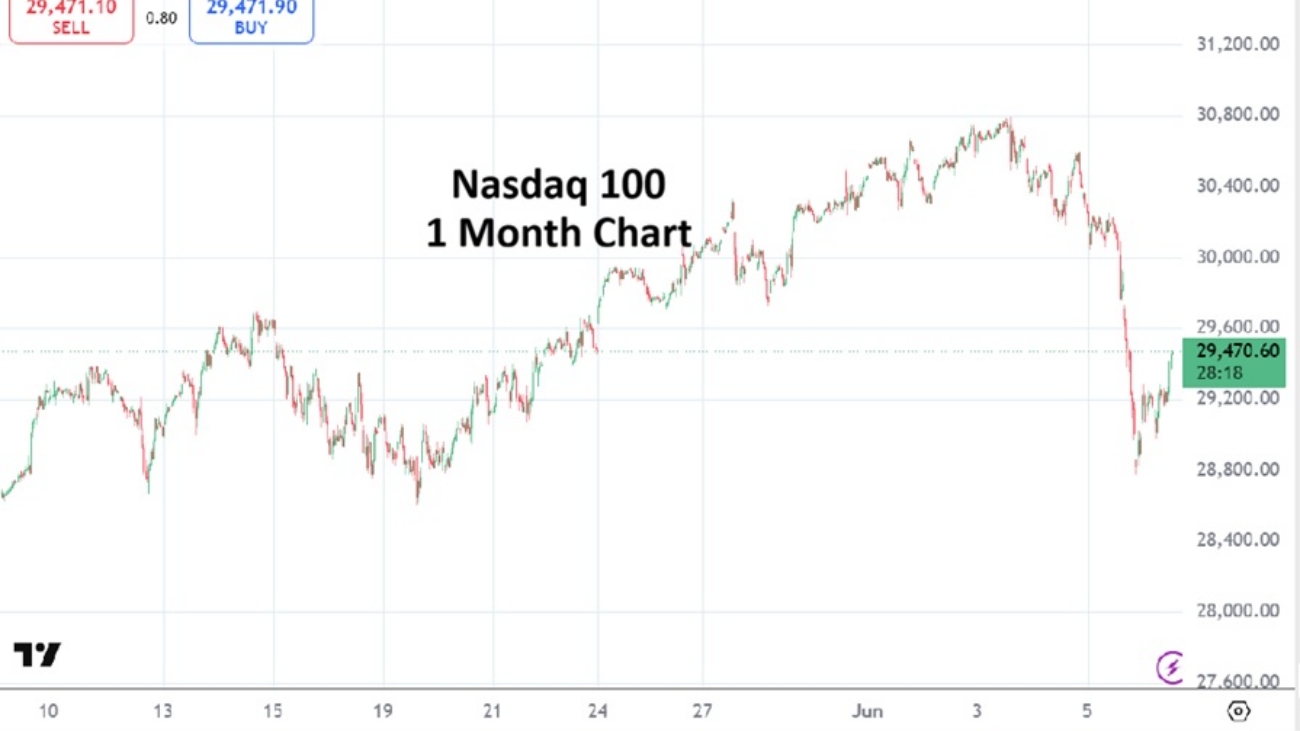
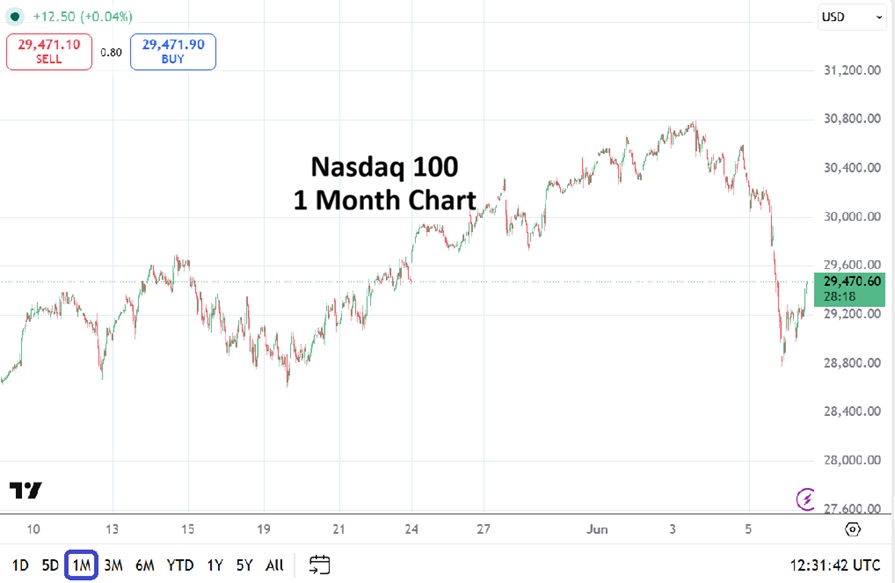
After Friday’s selling surge and a fall of -4.77% with a close of 28,957.60, the Nasdaq 100 futures trading this morning has actually seen an increase and is near the 29,479.00 mark as of this writing before the cash Nasdaq 100 market opens.

Friday’s selling nightmare for traders who found themselves stubbornly locked into what were to be short-term buying positions and saw the Nasdaq 100 plummet -4.77%, probably woke this morning believing ugly conditions may not stop. An escalation in military action via proclaimed retaliatory moves between Israel and Iran started today’s trading with a high degree of more anxiousness. USD centric strength in Forex was demonstrated early.

Nasdaq 100 Futures Value 1 Month Chart as of the 8th of June 2026

However, in the past couple of hours calmer heads have prevailed among financial institutions and USD centric buying in the broad Forex market has run out of steam – at least momentarily. For instance the USD/JPY is near 159.927 currently, opposed to earlier highs seen this morning which challenged the 160.400 vicinity. What does this have to do with the Nasdaq 100 and its current status? 

It appears via futures trading that large players may also have taken a sedative and looked at the index as having been oversold on Friday. The Nasdaq 100 has actually gained early today and signs that a de-escalation of military force between Israel and Iran is being reported. However, that still leaves day traders wondering what will happen as the cash market opens soon and volumes increase.

Let’s Say Quiet Prevails the Remainder of the Day

Not because of a utopian outlook, but a geopolitical perspective, let’s try to image Iran’s stated intentions of no more retaliatory strikes being launched towards Israel as true. The past couple of hours have been more tranquil as a signal in case you are wondering. Then investors and financial institutions will have to digest the Middle East concerns as they have done over the past couple of months in U.S equities, and decide to operate again on the Nasdaq 100 with near and mid-term outlooks.

Friday’s huge selling was blamed by some on the likelihood of a ‘potential’ U.S Federal Reserve interest rate taking place on the 17th of June. This because better than expected jobs numbers showed to some that the U.S economy was running hot once again. 

Additionally expressed fears, which are legitimate, about higher energy costs sparking sticky inflation have been discussed and worried about aloud. Yet, again let’s decide to say even if U.S inflation numbers via the Consumer Price Index come in higher than expected this Wednesday via the coming CPI data, that doesn’t shut the door on the possibility the new Fed Chair Kevin Warsh won’t fight against an interest rate hike during the FOMC meeting next week. In other words it still seems rather unlikely – to me – that the new Federal Reserve Chairman is going to want to initiate higher interest rates the first month on the job. So what if there was another reason for the steep selling on the Nasdaq 100?

Not Paradise but Purgatory

The Nasdaq 100 actually has other questions which have been raised as possible fodder for its large selling this past Friday. Was it spawned because of profit taking by those who took advantage of the index’s fabulous rise knowing that many institutions had been front running the IPO of SpaceX which is scheduled to happen on the 12th of June – this Friday? 

Did large players who rode the wave of frontrunning by financial institutions up in the Nasdaq 100 since late March, decide to cash in profits. There is plenty of nervousness surrounding what will take place with SpaceX in the coming months and long-term via outlooks because of its rather inflated valuation which looks like it will be around 1.7+ Trillion plus at share values of $135.00 per share this coming Friday. 

Questions surrounding SpaceX’s price per sales rhetoric, this instead of price per earnings (because SpaceX is not making a net profit) is just one example. While denying Elon Musk’s genius and ability to create clamor for his companies has proven to be a losing proposition for many, doubters still remain. 

Folks might have cashed out winnings on Friday and decided to now wait on the sidelines to see where behavioral sentiment takes the Nasdaq 100. After two full months of paradise for the Nasdaq 100, a few days of purgatory and seeing which direction U.S indices go may be the right decision by folks who rely on clarity; this as the Middle East gets untangled (or becomes more complicated), the Federal Reserve offers insights on the 17th of June, and large financial institutions lead the way regarding investment decisions.

Copy and paste the text from AMT that you want to share

postR196

Top Ten Miscellaneous Slogans for the 21st of October

Top Ten Miscellaneous Slogans for the 21st of October

10. Evil Empires: The Yankees and Dodgers will square off in the World Series with their ultra expensive rosters competing for the championship. Maybe this is exactly what the U.S needs so people can take their minds off of U.S election concerns. A contest between Los Angeles and New York is a big selling card. TV ratings should soar as Shohei Ohtani, Juan Soto, Mookie Betts, and Aaron Judge battle for the supremacy of baseball.

9. Vision: SpaceX achieved magical results as a Falcon 9 rocket booster was caught by ‘chopsticks’ as planned for and engineered. Elon Musk proved again that his preposterous ramblings are frequently correct. SpaceX is in a solid position to provide logistics for outer space exploration and development, but to also create new business endeavors as it evolves. The implied value of SpaceX mid-2024 was estimated to be around 200 billion USD.

8. 2017: Bitcoin was around 1,000.00 USD in January of 2017. The price of the digital asset is now approximately 68,500. The perception and betting that a Trump victory may be putting a spring in the step of the cryptocurrency market is intriguing. Bitcoin trades based on behavioral sentiment and not intrinsic value. Trump has spoken about crypto favorably time to time. A more welcoming SEC and CFTC regarding crypto could help values. For those looking for further correlation to BTC/USD and Trump, when he left office in January of 2021, Bitcoin was near 31,000 USD.

7. Downturn: Environmental, social and governance investing has taken a hit compared to results from the past couple of years as outflows from investment vehicles led by the likes of BlackRock and others make noise. ESG has lost its luster as the race for superior profits has run into headwinds and analysts question values and revenues. What will happen over the next few years, particularly if ESG investing finds that it has fewer friends in the U.S halls of power?

6. Data: U.S economic statistics will be rather lacking this week, the highlight may be the Flash Manufacturing PMI numbers on Thursday. Some may try to make the weekly Unemployment Claims a spectacle too, particularly brokers who may be trying to entice day traders into Forex positions. However, the rather calm seas regarding data will turn tumultuous next week because U.S Advance GDP, Core Personal Consumption Expenditures, and the Non-Farm Employment Change results are all on the schedule.

5. Underwater: WTI Crude Oil started to flirt with the 70.00 USD mark last Tuesday, and after a few days of remaining within a rather tight range, support was proven vulnerable. As of this writing WTI is near 69.65. The lack of an attack on Iranian oil infrastructure by Israel has seemingly calmed the energy sector. Fearmongering and bombastic rhetoric have not caused WTI Crude Oil to sustain highs. The commodity is within the lower elements of its long-term price range technically.

4. 24 Carat: Record values in gold are being traversed. As of this writing the precious metal is near 2,734.00 per ounce. Gold was around 1,200.00 USD in January of 2017. Inflation, speculation and concerns about central banks are likely helping gold shine. Some may say the rise in value is a derivative of safe haven investing. Day traders may view the price as speculatively high and dangerous because of its intraday volatility, but long-term gold bugs know the historical track record of the precious metal and its ability to preserve wealth.

3. FX: Major currencies paired against the USD are finding increasingly choppy waters near-term. The USD/JPY is dangerously close to the 150.000 mark, the USD/MXN is within sight of 20.00000, and the GBP/USD is hovering above 1.30000. The EUR/USD is battling too and scuffling below the 1.09000 ratio. With no major data coming this week, but major risk events approaching on the horizon, now is the time for Forex traders to remain cautious and not get too ambitious. Forex may provide technical traders with the ability to wager on perceived support and resistance near-term. But soon, a huge wave of volatility is going to hit currency speculation and financial institutions are certainly getting prepared for the storm.

2. Tick Tock: The U.S election is only a bit more than two weeks away. This may be the last week for any huge surprises which could sway the decisions of voters. Harris and Trump and campaigning hard and receiving intense media coverage. Early voting is underway, but November the 5th is the date everyone is focused on. When the clock strikes November the 6th in the U.S, global investors will react.

1. Behavioral sentiment: Key market barometers will continue to get plenty of attention in the coming days. U.S indices serve as a heat check regarding the potential outcome of the U.S election. Equities are near highs and this seems to be a rather solid indication risk appetite remains the dominant feature. While some will not want to hear it, this likely means many folks in the investment world are starting to believe Donald Trump might win the U.S election.

postR196

AMT Top Ten Miscellaneous Punches for the 28th of June 2024

AMT Top Ten Miscellaneous Punches for the 28th of June 2024

10. Cricket: The ICC T20 World Cup Championship will feature South Africa vs. India. The two teams are familiar with each other competitively and the final match will be held at the Kensington Oval in Bridgetown, Barbados on Saturday.

9. Selling Pressure: Lows are being challenged in Bitcoin as it hovers above 61,000.00 USD. Cocoa has stumbled dramatically this week and is below 8,000.00 per metric ton. Who will be courageous and wager on reversals higher? Speculators should remain cautious and understand price velocity that looks tantalizing can also prove costly to trading accounts.

8. Grounded: Boeing’s Starliner remains docked to the International Space Station. Problems have plagued The Boeing Company the past handful of months, and their ambitions of becoming a power within NASA’s explorations are also underachieving. SpaceX and Airbus are certainly paying attention to Boeing’s ineffectiveness.

7. Teetering: The African National Congress and Democratic Alliance political parties in South Africa are feuding about how coalition power will be shared within the National Unity Government. The USD/ZAR has become volatile and is near 18.21000 as tensions mount and reversals hit. Financial institutions are waiting for an optimistic resolution, while also fearing the possibility of an abandonment to positive visions.

6. Inflation: Core Personal Consumer Expenditures Price Index statistics will be released today from the U.S. Yesterday’s GDP Price Index came in slightly higher than anticipated which kept USD centric bullish positions relatively strong. However, other American statistics have weakened significantly and the mid-term looks troubling for the U.S economically. Stagflation remains a concern. The Federal Reserve is likely hoping to see today’s PCE numbers come in weaker than expected, which would allow the central bank to hint towards Federal Fund Rate cuts later this year.

5. Ennui: President Macron could find his political power further eclipsed after France’s first round voting results this coming Sunday. French voters appear ready to deliver a resounding message of dissatisfaction to the listless ruling government. Election turnout statistics should be watched. The second round of voting will be on the 7th of July. Financial institutions have braced for a shift of power already, but the EUR/USD will still produce volatility in the days ahead.

4. Geopolitical Risks: Russia, China and their allies are likely considering how they will prepare for a potential change in the U.S White House. Foreign policy following last night’s debate between Biden and Trump must be planned. The fact that Trump is viewed as a rather flamboyant personality and not bound by cautious diplomatic attitudes creates a calculus that U.S adversaries will have to consider. While the potential exists that some nations may try to be more aggressive now, they also know that a Trump victory in November would change the international political landscape long-term.

3. Bank of Japan: The Core Tokyo Consumer Price Index produced a gain of 2.1%, which was above the forecasted amount of 2.0% earlier today. The BoJ continues to remain far too dovish regarding interest rate policy and financial institutions are buying the USD/JPY in massive waves. The USD/JPY is around 160.750 as of this writing and did traverse above 161.000 earlier, these are Forex levels not seen since the late 1980’s for the USD/JPY. Japan’s attempt to stimulate the economy with a weaker Japanese Yen may work, but the U.S and others may start to look at the BoJ’s soft devaluation in a very negative light. Speculators of the currency pair need to be extremely careful, because the BoJ has the ability to intervene violently and cause momentary spikes which could prove deadly for day traders trying to take advantage of the outlandish bullish trend.

2. Behavioral Sentiment: Markets will be a looking glass into the future today, this as trading houses react to the realization that Donald Trump is likely going to be the next U.S President. While there are no guarantees regarding the U.S election outcome yet, the broad markets will certainly feel a shift of momentum in the coming days as large players adjust from a cautious approach to more aggressive postures regarding a Trump presidency. U.S equity indices remain near record highs, and the potential of a more business friendly White House which doesn’t threaten tax hikes on U.S corporations will likely affect speculative outlooks.

1. Power: The resounding defeat of Joe Biden last night in the Presidential debate will spark a heated battle among Democratic power brokers. Biden will certainly be asked to step aside after last night’s poor performance. However, Biden is stubborn, and Dem leaders like Nancy Pelosi and Barak Obama among others will have a difficult task to try and convince Biden for the sake of the nation that he must do the honorable thing and release his political delegates at the August Democratic National Convention in Chicago. If this doesn’t happen, the Republicans may be able to achieve a landslide victory by taking control of not only the White House but the Senate too, along with maintaining power in the House of Representatives. All the camouflage in the world last night, including the liberal media, couldn’t mask the inability of Joe Biden to be coherent.