Income Comparison via Two Distinct Districts: Tiruvannamlai and Madurai
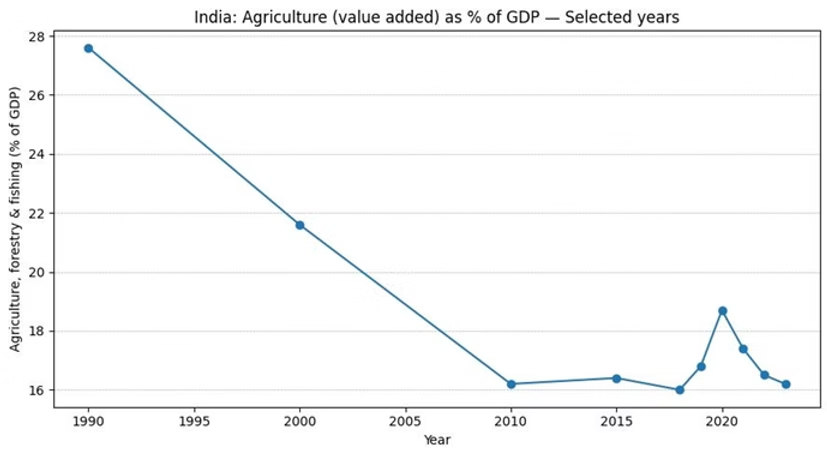
India is a vastly developing economy, but its national accounting frequently relies on formal sector performance to extrapolate the conditions of the informal economy. Despite official statistics continuing to rise, the economic reality of rural India remains largely unchanged.
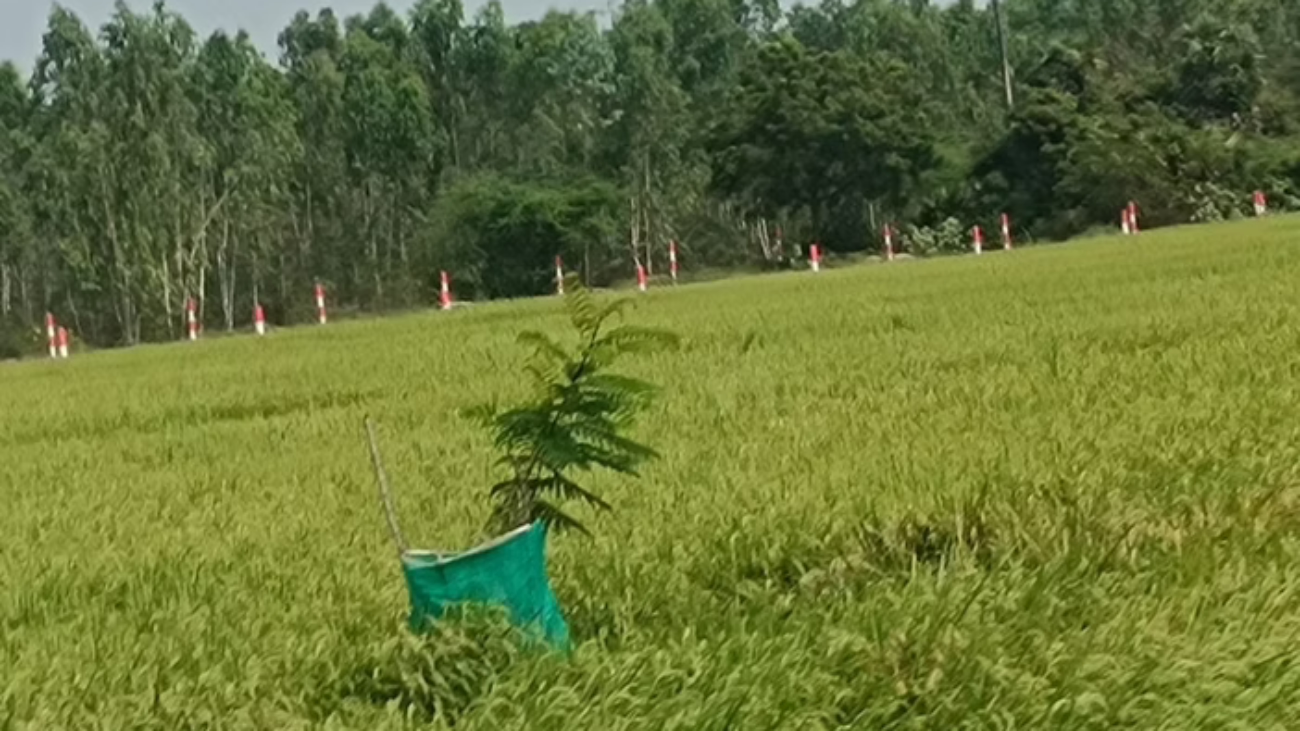
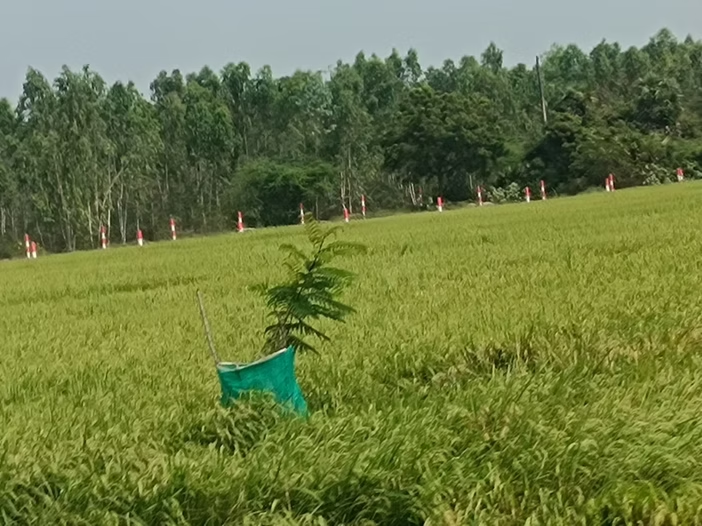
Recently, I was travelling extensively across villages in the Tiruvannamalai district of Tamil Nadu State in South India, trying to understand how capital formation works in rural and semi-rural areas.
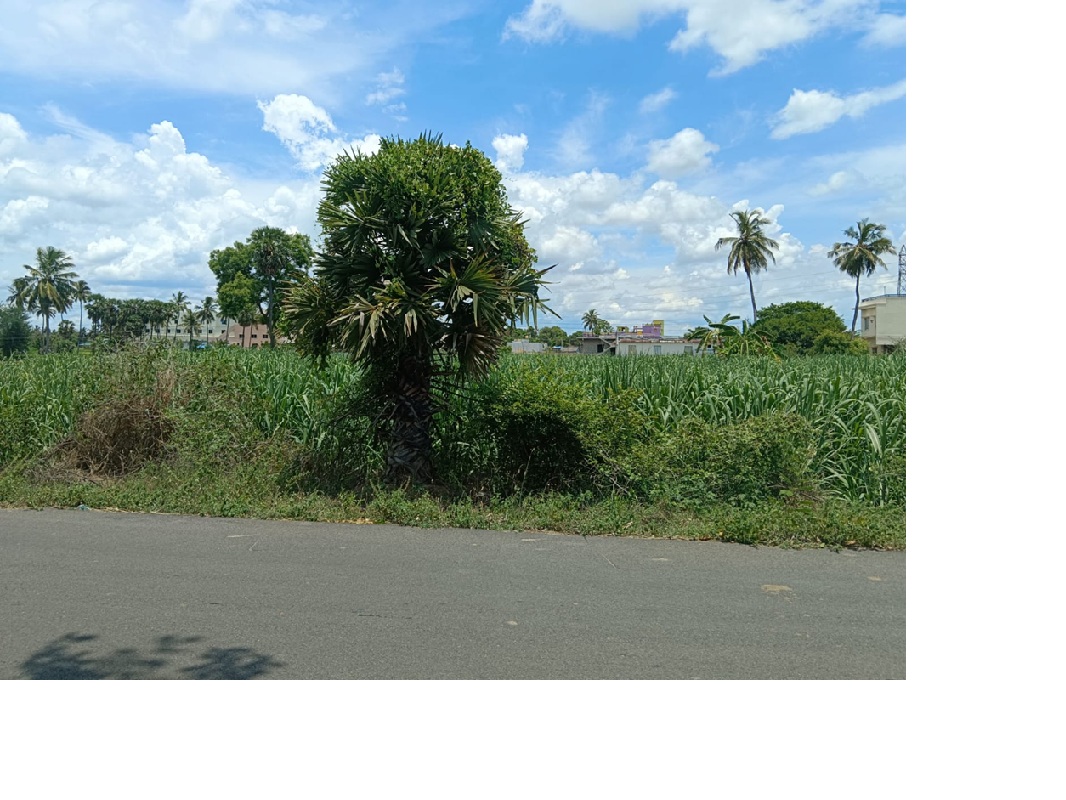
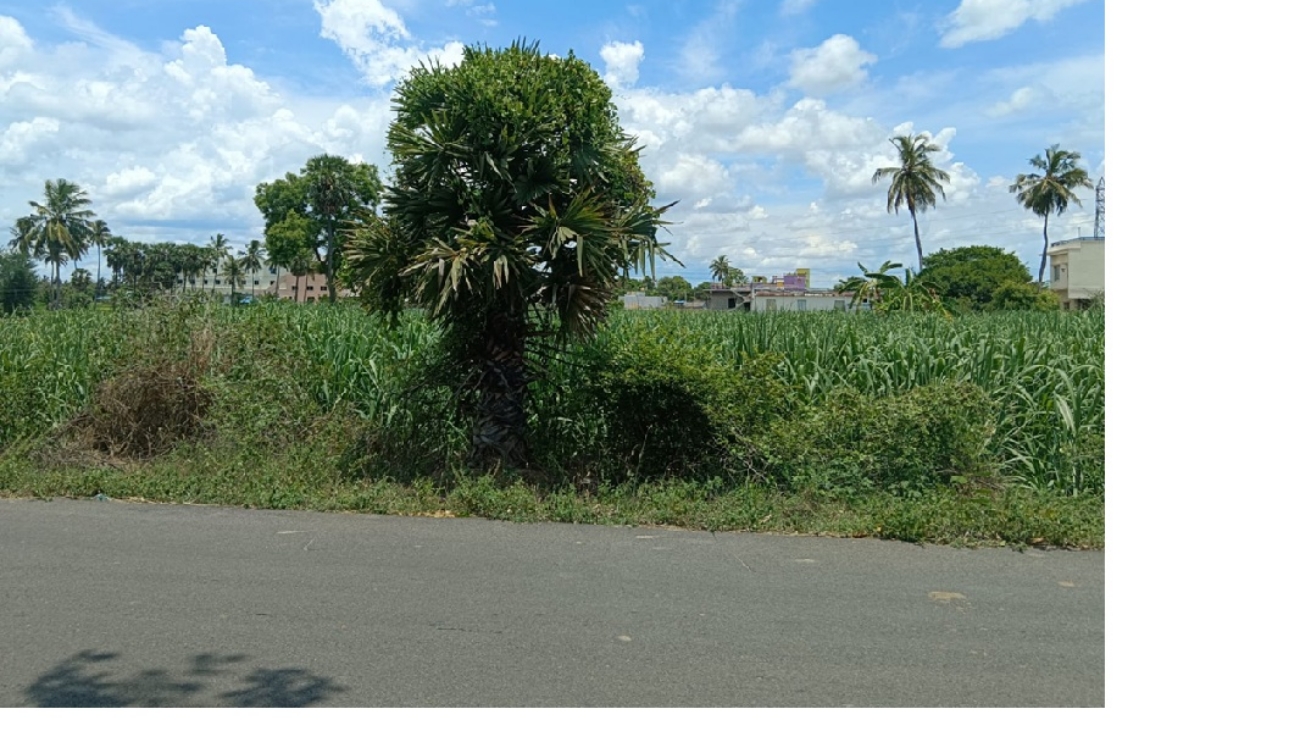
For more than 50 kilometers, there were barely any shops related to consumption activity. There is no absolute poverty in these areas, but income levels are clearly not standard enough to support strong consumption patterns.
Many people in Tiruvannamalai district villages work in neighboring cities liken Tiruppur, Bengaluru or Chennai and send cash back to their families. Apart from these remittances, agriculture and related seasonal income add to household earnings.
The second observation based on my extensive survey with about 55 women, was that I hardly saw anyone wearing gold chains or ornaments in villages. In other words, household income is often not sufficient enough for families to consistently accumulate gold or jewelry, which traditionally act as a form of savings in Tamil Nadu households.
Evidence suggests the reason for weak savings and low capital formation in Tiruvannamalai is due to low household income generation. And the reason for low household income can be attributed to a lack of local opportunities which offer weak wage growth, plus dependence on migration and the seasonal nature of agriculture sector. Education also plays a decisive role, but the broader issue demonstrates inadequacy of stable income generation.
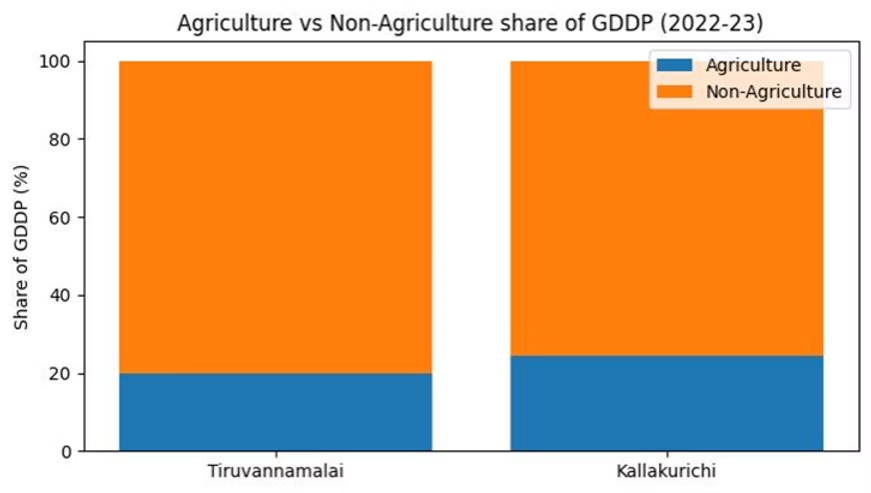
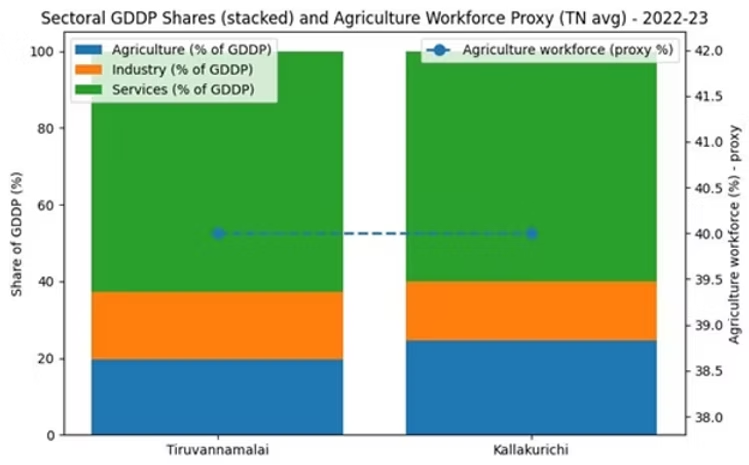
We do not have sufficient recent district level data to fully validate many of these observations. Tamil Nadu State GDDP data (Gross District Domestic Product) exists, but it often lags. RBI remittance data does helps, but that is largely available at the State level rather than district level.
However, these observations do find relevance in prior surveys conducted by the Tamil Nadu Government before COVID-19. Districts such as Tiruvannamalai were often catagorized as relatively backward compared to more industralized districts where consumption pattern improved dramatically through manufacturing and urbanization.
Instability via MNREGA’s Distress Hills Data
One interesting way to study this phenomenon is from Mahatma Gandhi National Rural Employment Guarantee Act (MGNREGA) employment data. MGNREGA data is measured in lakh person-days. (A lakh equals 100,000). In simple terms, it measures the amount of labor generated through a combination of workers and days worked under the scheme.
Say for example, if 100,000 people work for 10 days, or 50,000 people work for 20 days, then: lakh person-days per 100,000*10 equals 10 lakhs person-days. And conversely 50,000*20 equals 10 lakhs person-days.
Sometimes, fewer workers, often work for many days or many workers work for fewer days. Thus, economists use person-days instead of counting only people.
In Tiruvannamalai the pattern of MGNREGA demand reveals a strikingly seasonal and distress driven rural labor cycle. Person-days generated surged to nearly 19.8 lakhs during May, before falling sharply toward November as agricultural activity resumed. The peak compared to it low variation is close to 5:1, creating what can be described as a steep “distress hill” in rural employment demand.
Such a dramatic fluctuation suggests that a large share of rural households rely on MGNREGA not as supplementary employment, but as an emergency income stabilizer during periods of agricultural inactivity and cash flow stress. The intensity of the spike indicates the absence of diversified rural income sources, exposing the structural vulnerability of the local informal economy.
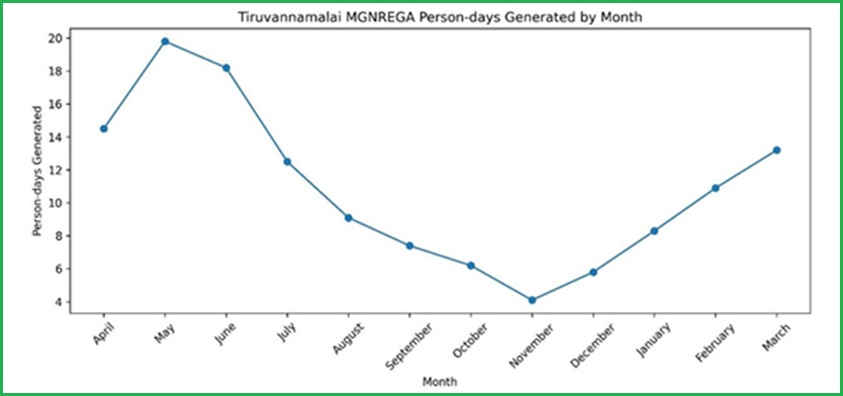
Tiruvannamalai District: FY monthly 2024-2025, from MGNREGA person-days shows sharp seasonal distress, peaking near 19.8 lakh person-days during May before collapsing toward November.
In contrast, the Madurai district in Tamil Nadu State presents a far more stable rural employment profile under MGNREGA. Peak demand was comparatively lower, reaching around 11.4 lakh person-days, while the decline across the year was considerably less severe than in Tiruvannamalai. The peak to low ratio was closer to 3:1, indicating significantly lower seasonal volatility in rural wage dependence.
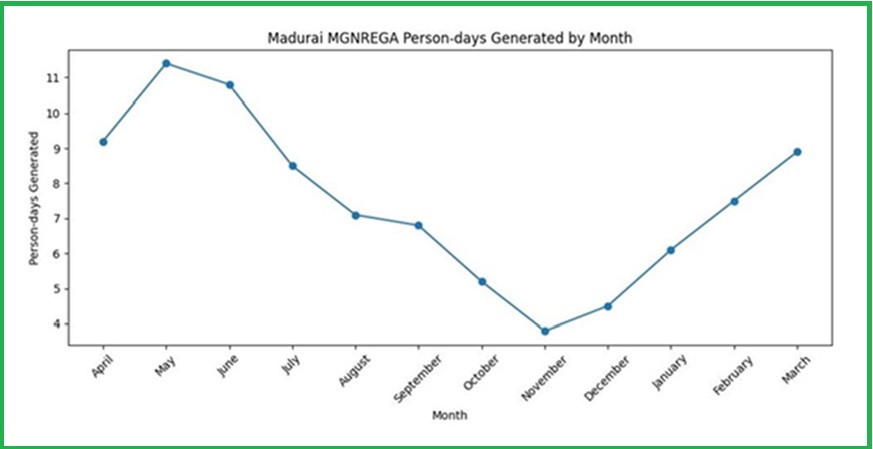
Madurai District: FY monthly 2024-2025 displays a smoother MGNREGA employment curve with lower seasonal volatility, indicating stronger economic continuity and more diversified income generation.
Rather than exhibiting a sharp distress hill, Madurai’s smoother employment curve suggests a more diversified local economy. This because households may have greater access to non-farm income sources including urban linkages or more stable agricultural activity. The reduced fluctuation implies that MGNREGA functions more as a supplementary employment buffer than as a critical survival mechanism in Madurai compared to Tiruvannamalai.
Seemingly it is evident that consumption oriented businesses may struggle to scale in districts such as Tiruvannamalai, where disposable income growth and household surplus remain weak.
Industrialisation changes this dynamic because stable wage growth improves consumption depth and household savings. Without stable income growth, retail expansion and capital formation remain structurally weak.
The distress hill therefore represents far more than a simple employment fluctuation. The steep seasonal dependence on MGNREGA highlights how large sections of the rural economy remain vulnerable to agricultural cycles, with insufficient diversification, weak consumption resilience, and limited avenues for sustained wealth creation.
Notes:
Chart Sources: Ministry of Rural Development, Government of India, MGNREGA Dashboard (District level monthly person-days generated data).
Distress hills refers to my analysis of seasonal MGNREGA employment patterns to measure rural income instability and economic vulnerability. When plotted month-by-month, districts experiencing severe seasonal stress tend to exhibit a steep hill shape, characterized by sharp spikes in person-days generated during agricultural lean periods, followed by rapid declines once farm employment resumes. The steeper the hill, the greater the dependence of rural households on emergency wage employment for income stabilization.