Celtics and the Middle East 20260609

Falling into the Middle Eastern Trap

When Talking Becomes an Obsession

Opinion: The following article is commentary and its views are solely those of the author. This article was first published the 9th of June via The Angry Demagogue.

The United States is falling into the Middle Eastern trap that Israel fell into thirty years ago. This trap fits nicely with the post cold-war progressive Western way of diplomacy in that its goal is “talking”. Perpetual talking rather than deal making is the key to understanding the Middle Eastern way of things and Israel has become a practitioner in the “way” that led directly to October 7. The idea of perpetual talking is to reach a situation where you can defeat your opponent without making concessions. In the Middle East, they suck you in to a point where just “talking” becomes an obsession. The United States is heading into the same where results are less important than the act of discussion itself.

Falling into the Middle Eastern Trap – When Talking Becomes an Obsession 9th of June 2026

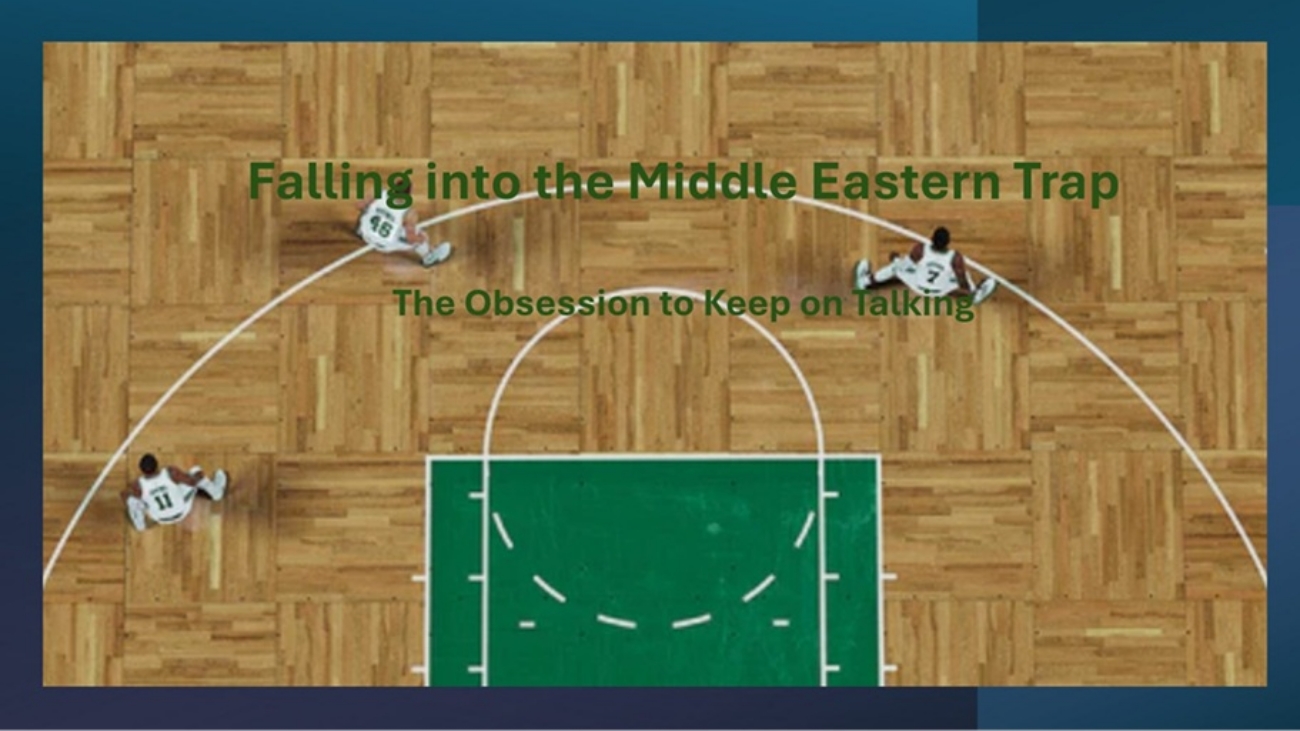
This obsession, this being sucked into something against your best interests reminds me of a wonderful episode of Cheers, the sitcom that takes place in a Boston bar – a bar in which pints of beer plus inane discussions over anything that leads to nowhere is its reason for being. The episode that I am thinking of has Boston Celtics great Kevin McHale as a guest and the two main instigators of irrelevant and purposeless conversation, Norm and Cliff, (not so) innocently ask McHale how may bolts are in the famous parquet floor at the Boston Garden.

The waitress Carla, Boston working class par excellence, begs the basketball star to ignore them, knowing he will become obsessed and sucked into something that clearly will lead to a disaster for him and her beloved Celtics. Sure enough, the episode ends with McHale driving towards the basket with what ought to be the winning shot only to get distracted by trying to figure out how many bolts are in the floor of the Boston Garden.

That is exactly what is happening now in in the Middle East where President Trump is the basketball star being distracted by Iran and their attempt to suck him into endless discussions that are meant to lead to nothing productive. We don’t know if McHale ever figured out the number of bolts, but besides going back to Cheers with the answer, it is a useless endeavor that can only lead to defeat. So too, with the Trump Administration and the sacred talks with Iran where the end game might be something he can bring back to a press conference in DC or a rally in Pennsylvania but will be worth as much as knowing the number of bolts in the Boston Garden floor.

Israel fell into this trap with the Palestinian Authority of Yasser Arafat and when talks ended, the only goal was to start them up again. Just return to talking. The result didn’t matter. This trap picked up again after October 7 when the goal seemed to be to always be talking with Hamas via Qatar or Egypt even if everyone knew it would lead to nowhere. Ironically, it was President Trump who realized this and was able to do his dealmaking magic to free the hostages – but only after the IDF put Hamas in an untenable situation and Qatar wanted a “great deal” with the Trump administration. Talks never led anywhere.

So here we are, the Trump Administration is hell bent on continuing discussions for the sake of discussions no matter how many times Kuwait, UAE, Bahrain, Israel, or even the U.S military get shot at by Iran. When the goal is talking – when the obsession becomes talking – you have fallen into the Middle Eastern trap much as Keven McHale fell into the trap of inane bar talk for the sake of inane bar talk.

While the American President is a deal maker par-excellence, the Middle Eastern leaders, this time Iran’s, are the experts at making you think that talking is always the best outcome – because it is, for them. Eventually, their experience tells them, you will make a mistake. The Administration has allowed Iran to attack allies at will in the Gulf and in Israel, as Iran gains concession after concession due to the trap that is “talks at all costs”. The first concession was linking Lebanon to the talks and the next, done just yesterday was in putting Iran and Israel on the same level.

This is the mistake one would expect from the Obama-Biden crowd where they always believed that talks were the purpose – they didn’t have to fall into any trap as they were there already. However, the Trump Administration understood the fallacy of forever talks which is what makes it so painful to see them fall into the same Middle-Eastern and Western, progressive trap. Obsession to make a deal is good because results oriented; but an obsession that is just to “get back to talking” will lead only to results that you never wanted in the first place.

Disclaimer: the views expressed in this opinion article are solely those of the author, and not necessarily the opinions reflected by angrymetatraders.com or its associated parties.

Follow Ira Slomowitz via The Angry Demagogue on Substack https://iraslomowitz.substack.com/

Copy and paste the text from AMT that you want to share

WTI Crude Oil 20260601

Clues and Insults: Forex and Equity Indices During the Iran Saga

Profits: Optimistic Wagers and Preserving Self as the Party Rages

New Federal Reserve Chairman Kevin Warsh certainly doesn’t want to have problems with President Trump. On the 17th of June the FOMC meeting via the Fed will make their interest rate decision known. Who really believes that during the first month on the job at the helm of the U.S central bank that Warsh is not going to fight to keep interest rates in place?

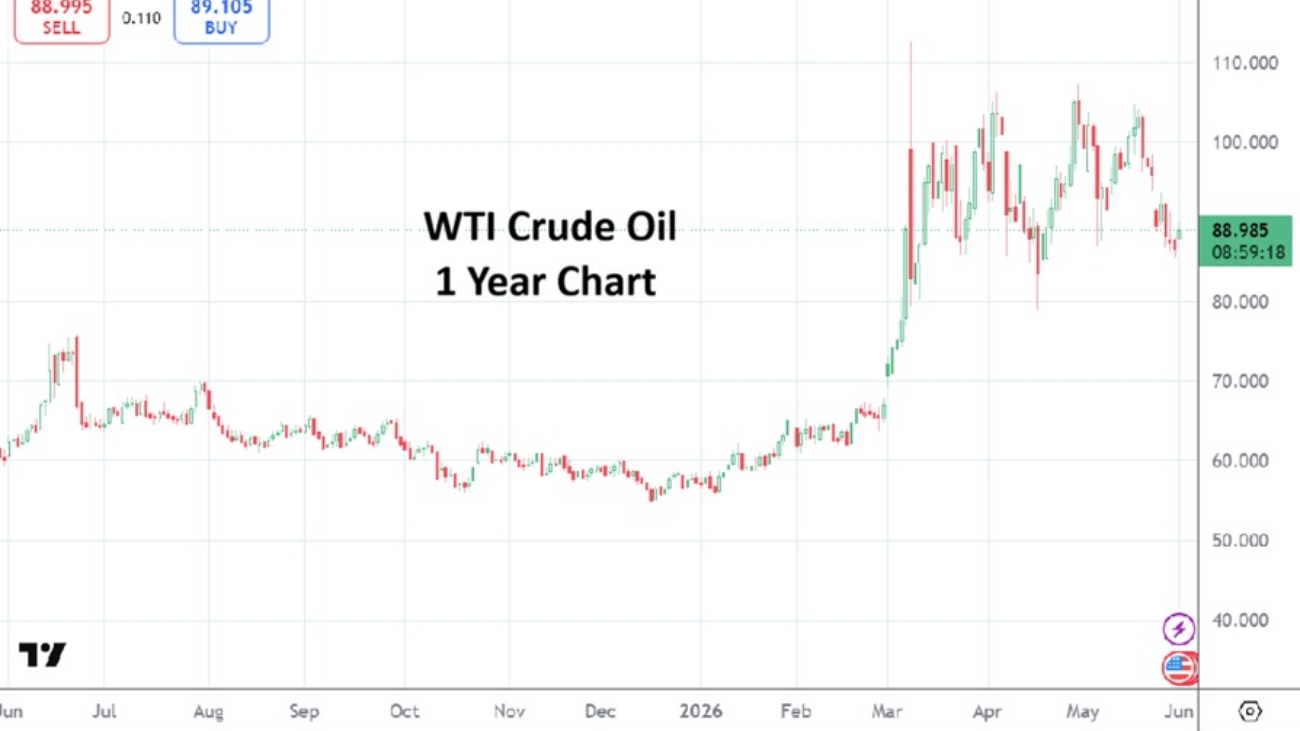
Those who are expecting an interest rate hike in June of a quarter of a point (0.25%) are most likely wrong. Yes, the price of WTI Crude Oil is high and the situation in Iran via narrative varies from one moment to the next per the reported incidents on the Strait of Hormuz.

However, just like the Fed there is a certain amount of reality that must be dealt with regarding human nature and behavioral sentiment regarding Iran and how it is dealt with via market participants. From the department of no news is good news: financial institutions and investors would like the noise to be kept to a minimum so they can continue doing their jobs and not be criticized themselves for potentially wrong outlooks. The art of making sure disclaimers are up to date is important for everyone who wants to stay employed.

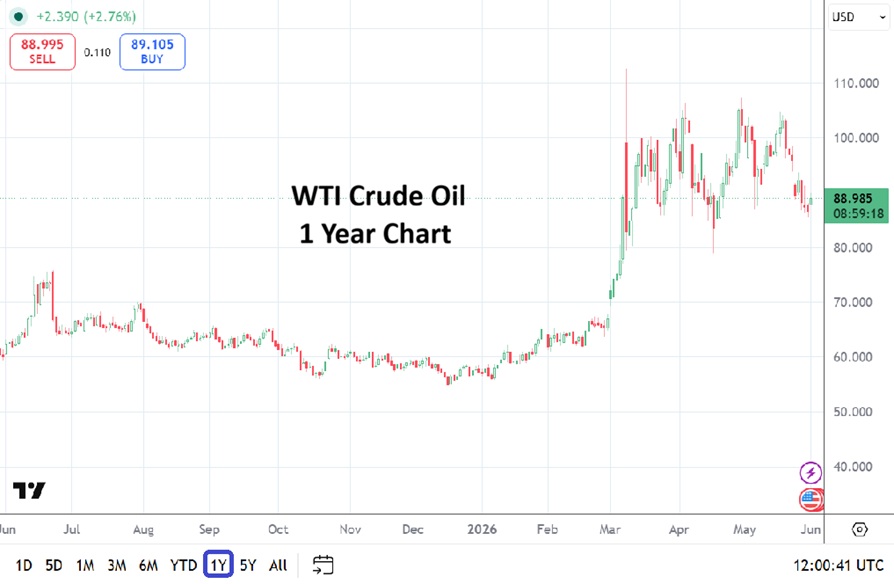
WTI Crude Oil 1 Year Chart as of 1st June 2026

USD centric weakness was seen late last week in many currency pairs, but a quick glance at the majors: EUR/USD, GBP/USD and USD/JPY actually show the pairs traversing rather cautious values. The EUR has gained slightly for instance, but at its current levels around 1.16410 some may believe it is a safe equilibrium. (One that may be able to be taken advantage of by those with the ability to bet on mid-term higher trajectories).

Central Banks globally also want to keep the noise down in their various locations. Inflation concerns persists worldwide depending on the amount of knock-on effects that higher energy costs have on national economies.

Also adding additional intrigue to the storyline of wanting to keep quiet while volatility threatens the gates, is that many people with comfortable jobs in various government institutions do not want to step out of line and sacrifice their careers for the sake of being proven right. They would rather be proven wrong, but would like to do this quietly without facing consequences.

The fact that we are now in a situation in which we are afraid to undertake critical thinking aloud is going to cause problems down the road, but for the moment most will simply go on with their various duties and pretend all is well.

U.S equity indices have been having a massive upwards party since the end of March as record heights are attained. Certainly some long-term investors are simply throwing money into indices as a way to get positioned before the SpaceX IPO which is coming soon. There will also be the Anthropic IPO which is reportedly set for late 2026.

The SPCX which seems to be aiming for the 12th of June will create a valuation well above 1 Trillion USD for SpaceX. The perceived value of Anthropic is becoming a loud talking point among analysts in the tech sectors and they are keen to have the company join the 1 Trillion USD party. The cost of admission for bragging rights is getting more expensive.

There was a time when things like PE (price and earnings) ratios mattered on Wall Street. Some brave folks still whisper about such things in meetings and bars late at night, but many do not want to be insulted or possibly worse get marketing folks selling these high priced products angry. The reason for speaking softly about actual earnings regarding SpaceX is because the company is actually working via an earnings loss, and instead price to sales estimates are being offered as some type of guideline. Having said the above, it would be foolhardy to bet against SpaceX and Elon Musk. And it might be equally unwise to bet against Anthropic in a handful of months. And thus, the rush into equity indices because there is a genuine fear of missing out does exist. Afterall, we all want to be part of the party.

And that brings us back to Fed Chairman Kevin Warsh who has the backing of President Trump and Treasury Secretary Scott Bessent, he doesn’t want to insult these men either. Warsh may be quite good at what he does, he might be an expert and have real world business experience, and that might be a real clue for Forex traders who think higher interest rates are coming. Warsh will likely want to keep his first months on the job at the Fed on good terms with the White House and the Treasury. Kevin Warsh might be a free-thinker and know legally he is an independent leader of the Federal Reserve, but he also knows he was hired with a stated mission. There is a pro-business, free enterprise administration in power at the White House. Bessent, Warsh and Trump are on the same team.

So again, while some traders may believe the Fed will raise interest rates in June because of concerns of higher inflation, it most likely will not happen. While the Iranian war continues to make headlines in the financial world and dealt with via sentiment decisions, actual economic U.S data will start being watched in the coming days and weeks and might even influence perspectives. Investors will get bored of the Iranian saga as long as its narrative stays somewhat tepid. Meaning investors will start looking at CPI and PPI numbers coming from the U.S next week and talking about higher interest rates that will likely not be delivered in the upcoming FOMC meeting. 

The price of WTI Crude Oil as boring as it is to say remains a strong sentiment gauge for traders intraday. Large players involved in Forex might believe this will involve higher interest rates, but on the 17th of June it is more likely that Kevin Warsh will say that for the moment the Fed chooses to watch energy sector costs with the belief prices will decline in the coming months. The Fed will not use the term ‘transitory’ which was used infamously during the Covid crisis and turned into a poison pill with inflation that was not effectively fought. What the Fed will likely do is say they want more info to be gathered and more clarity regarding the Iranian situation and its overall effect on oil prices for a little while longer. Some patience will be asked for and it might be granted by investors who want the party to continue via equities.

Day traders should expect cautious markets to prevail in Forex with choppy results as financial institutions weigh their behavioral sentiment and try to make believe they are not too worried about near-term inflation. The CPI and PPI readings next week will prove of interest, but the results may be brushed aside by market pundits.

In the meantime, the celebrations on Wall Street continue as folks march merrily into the frenzy. Retail speculators who want to pursue short or near-term profits on the Nasdaq 100, S&P 500 or Dow 30 indices need to be careful and might want to stay away from daily bets and instead engage in conservative positions that allow for a full week of results. The gains made since the end of March have been outlandish and likely will not be repeated anytime soon, but why try standing in front of a trend that can crush you.

Near-term considerations in these markets should be done carefully. The mid-term may be very different from where we stand today and our current outlooks. One thing that may bother some risk analysts is that it may prove wrong to bet against the current parade of optimists who insists on participating in dangerous conditions and profit, while they (the risks mavens) stand in place.

Copy and paste the text from AMT that you want to share

US Dollar Index 20260627

The USD and The Art of Not Knowing

Being Mature Enough to Know You Don't Know as You Watch the Marketplace

Ask anyone that typically knows how they gauge the state of the global marketplace for the near-term and you are likely to either get a solid, “I have no idea” now. Or a bunch of thoughts on what might happen, which might lead to being more confused. Simply put at this point, it is easier to admit that potential conclusions regarding the world’s current affairs taking place and effecting the global marketplace are out of most peoples’ hands. 

Even those who have duties within the higher paid grades likely are just as confused about the potential unintended consequences not wanted, and results they hope will be achieved. And what am I speaking about exactly, regarding the world and its state of affairs, is that even qualifying the particular topics are difficult to put a finger on. Ramblings certainly include the Iran saga, but Cuba, the Ukraine, the NATO pact, shifting world alliances and future ones are creating a whirlwind. Besides the rather noisy political landscape of the USA. Not to mention China and Russia and other nations with aspirations.

Yet, the global markets continue to trade, albeit within a confused haze it sometimes appears. But do not be despondent day traders, brokers and their platforms will offer you the opportunity to wager on results of the USD in Forex, and CFDs certainly contain opportunities in major equity indices the world over, various big singular companies, commodities and yes cryptocurrencies (apologies to Bitcoin fans – who insist it is called a digital currency).

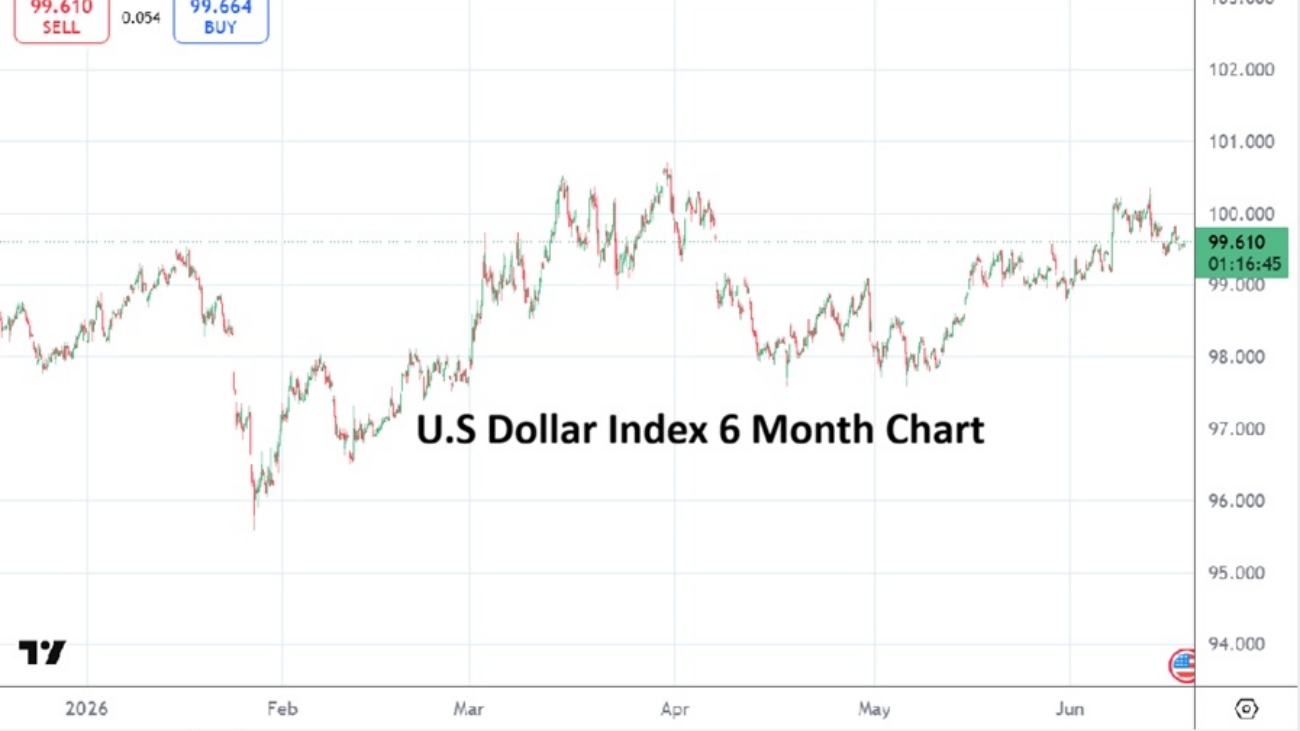
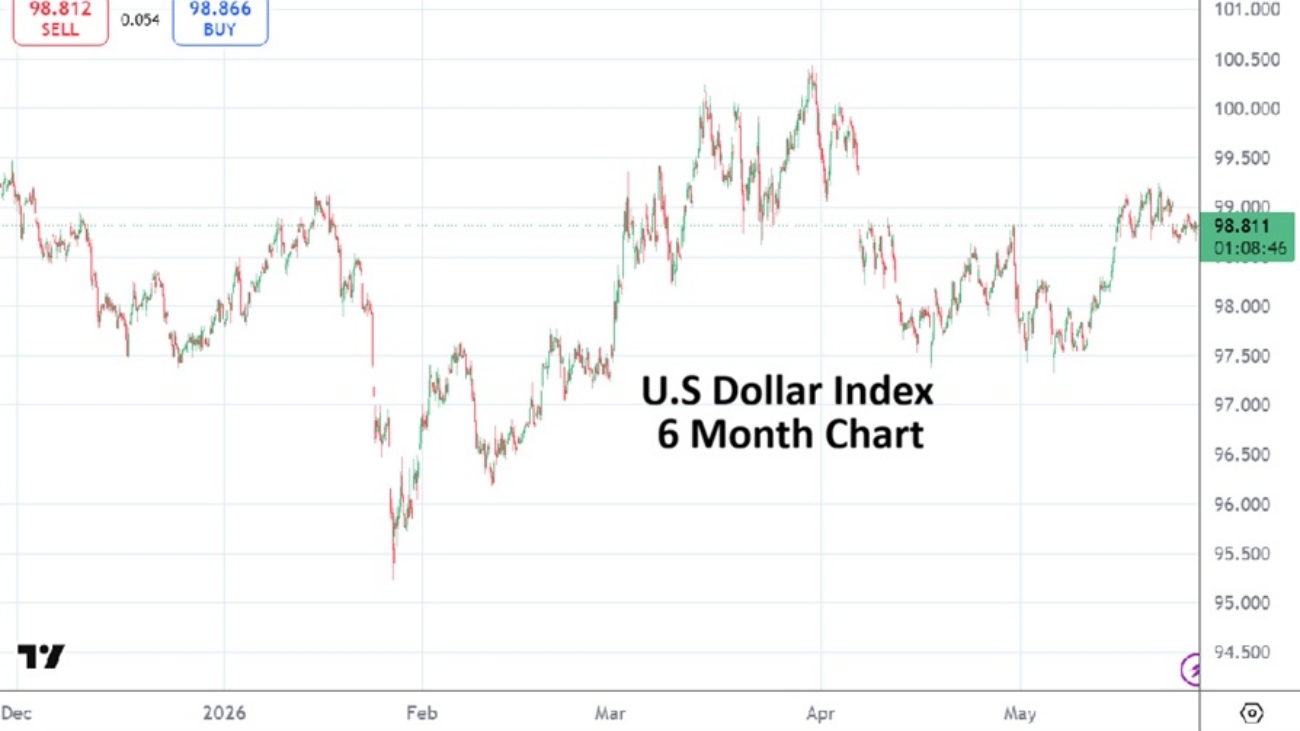
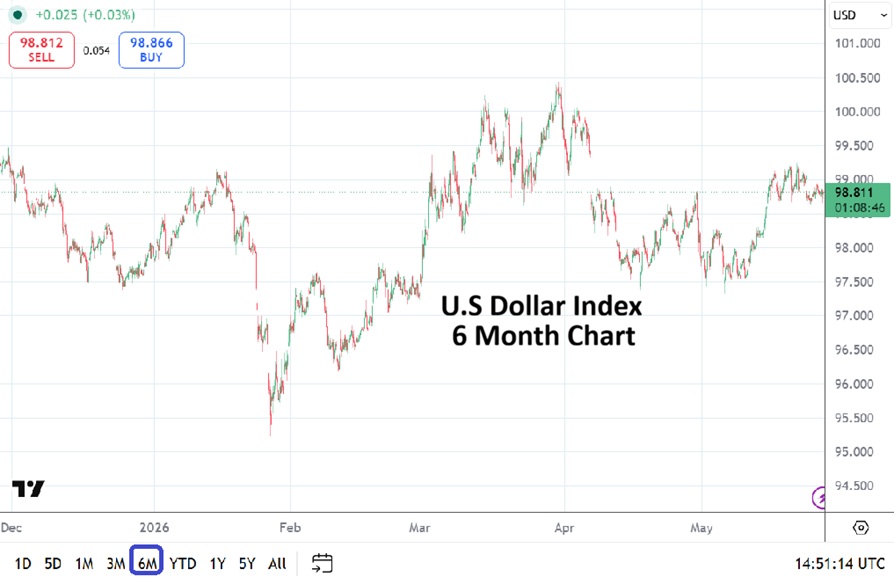
U.S Dollar Index Six Month Chart as of 27th May 2026

Iran War and Unclear Results

The U.S Dollar Index for the moment is near the 98.880 ratio, which it should be pointed out is near the values it swam upon the April 8th announcement of a ceasefire between Iran and the States, this after dropping from its 99.800 threshold on the 7th when investors were more troubled. The ceasefire is still in effect and now there seems to be a resolution which is being hoped for by the U.S White House – although when pressed about what negotiations between Iran and the U.S will result in delivers a few different versions of ideas. 

Perhaps that is to be expected via the fog of war, but what should not be expected is an easy path to a genuine resolution. And even if there is a pact of some type, what objectives will have been genuinely fulfilled? But alas, that is a question for those in the future, because the facts on the ground do not bode well for ordinary Iranians who have yearned for freedom. 

The Fed Has a Problem

But again, let’s not dwell on things like the individual rights of people, money is at stake…..(that is humor folks, others can call it sarcasm). The price of WTI Crude Oil has dropped this week on the idea that a resolution will actually be accomplished between Iran and the U.S – one at least that allows tankers to navigate the Hormuz Strait. 

The price of WTI via futures at this moment are around the $90.00 mark again, this after moving within sight of 88.00 USD earlier today. At the end of last week the $96.00 mark was in sight for WTI. And the price of energy continues to cast a shadow that is moving over the U.S Federal Reserve and has large implications for the new Fed Chairman Kevin Warsh. 

The mid-term versus the long-term in financial institutions as they judge their interest rate perspectives are likely making for rather entertaining dialogue. And let’s not forget ladies and gentlemen, the U.S mid-term elections are approaching in November of this year and are resulting in primary elections that are punishing Republicans who voiced criticism towards President Trump. The question about who will hold power in the U.S House of Representatives is a big riddle. Even the U.S Senate leadership may be fragile. Why is that important, because if President Trump were to become what is known as a lame-duck President during his last two years in office, this would produce different outlooks among investors. Stay focused on the money people. 

Our Forex Friend: The BoJ

The USD/JPY is now traversing its 159.490 vicinity again, and perhaps that is a bell weather for soothsayers to criticize again. The Bank of Japan is watching the Japanese Yen as its trades within sight of its weakest values, and yes, the BoJ can be expected to issue another warning to speculators once again about being run over by an intervention. The BoJ’s broken record about interventions have produced solid results for folks who are able to trade the USD/JPY with positions that can be held for a few weeks at a time – namely hedge funds, large players and some financial institutions. Retail traders trying to take advantage of the USD/JPY are likely suffering trauma via anxiety if their wagers have gone in the wrong direction.

SpaceX and Scams in the Cryptoworld

And as a bonus, let’s not forget about rumblings regarding SpaceX and another topic within the I do not know category. Elon Musk has set the table for an attempt at a 2 trillion USD market cap after the IPO for the corporation is launched in the second week of June. The value of SpaceX can be and will be argued for the next few years as admirers and critics lineup to be heard and spread sheets are compared regarding revenues against one of the greatest marketing giants of our time. Intriguingly, however, are hints that there has been a lot of cryptocurrency fiddling regarding how the corporation is going to allow investors to participate. Apparently there have been tokens issued in the cryptocurrency world that have promised some type of participation in SpaceX and most are being exposed as scams and have nothing to do with the company or Musk. Buyer beware folks.

Copy and paste the text from AMT that you want to share

AMT Top 10

AMT Top Ten Miscellaneous Insights on the 18th of May, 2026

Valuations and Drinking, Bad Storms and Politics Amidst the Resilient Nature of People

10. Resilience: The Western Cape of South Africa endured strong storm conditions last week. One of the hardest hit areas was the Cape Winelands District, but electricity and water have been widely restored. And a collective of people have proven working together can produce solid results when needed. 

9. Spencer Who: The Los Angeles mayor race is growing intriguing. A reality star turned social influencer threatens to become an influenza for his opponents. This as Spencer Pratt’s campaign gets noticed for its entertaining social media videos. This has caused many folks to ask what has happened to the state of politics and meaningful policy. But if NYC can elect a socialist, why can’t L.A elect an influencer and make some people feel sick?

AMT Top 10 Miscellaneous Insights for the 18th of May, 2026

8. Two Trillion: SpaceX early investors have agreed to allow a five for one stock split, meaning the company (and Elon Musk) are now aiming for a potential doubling of its worth when its IPO is initiated – on Nasdaq – in the second week of June. Some very serious accountants will be kept busy trying to show how SpaceX will produce enough revenue over the next twenty years in order to make a 2 trillion USD valuation palpable to future investors.

7. Drunk: Brown-Forman Corporation will begin its trading near $26.28 on the NYSE today. The company is the majority owner of Jack Daniels and other alcohol related enterprises. The value of Brown-Forman Inc. in June of 2021 was around 80.00 per share. The sobering phase of the public – particularly among young drinkers – to avoid bars and clubs, and instead stay on their mobile phones has hurt share values in many alcohol related companies. There are also concerns that too many drink companies now exists. Before Brown-Forman becomes the life of the party again, it appears some competition will have to go dry.

6. Deals: Prime Minister Modi visited Abu Dhabi a few days ago, and one of the results was an agreement to purchase and store energy reserves on a large scale in the United Arab Emirates. Modi also confirmed India’s strong connection to the UAE politically. While always trying to maintain a non-aligned stature, India appears to be moving closer to an increasingly important alliance with the UAE – which has also aligned with Israel strategically. The potential of these three nations acting together will ruffle feathers in a few noteworthy Middle Eastern and Asian countries.

5. Populists: President Trump’s tendency to say outlandish things and then suddenly turn around and show a willingness to negotiate terms has always been part of his art of the deal composite. However, saying what people want to hear and then turning on a dime and not delivering is also a symptom of populism. Trump isn’t the only politician suffering from this flaw. What do politicians really think, and how differently would they act if a they didn’t need votes for themselves or backers to remain in power?

4. Wall Street: After attaining apex highs early last week, the three major indices have taken a step backwards. Near-term concerns are effecting outlook as financial institutions balance risk averse tactics to long-term belief that sunnier days will prevail. While the Dow 30 didn’t set a record last week, the ability of the index to climb above 50,000 was noticeable. Equity markets appear tentative as this week begins and folks seemingly wait for more thunder and its potential effects.

3. Emirates: The UAE was attacked by drones yet again yesterday, this time at the Barakah nuclear facility. The hit has been downplayed, but highlights that military conflict with Iran remains very possible across the region. It is doubtful conversations are being conducted with polite undertones behind closed doors. The U.S, Israel and other nations are watching Iran – and Iran is watching them. The price of WTI Crude Oil remains a key barometer regarding the markets and concerns about the war igniting in full once more. Prices of oil remain sustained above $101.00 per barrel in the futures markets. The UAE might not want to be a focal point, but it isn’t backing down either.

2. Hawkish: The U.S Federal Reserve may have to actually consider raising interest rates before they can realistically discuss the notion of cutting borrowing costs, particularly if energy prices remain elevated and spark a sustained inflation threat over the mid-term. The USD started to show renewed strength the past few trading sessions in Forex, this as financial institutions compare their near-term anxiousness to growing concerns about mid-term ramifications regarding higher fuel costs.

1. Ego vs. Hubris: The U.S and China summit held largely in Beijing this past Thursday and Friday matched competing politicians and ideologies. In one corner U.S President Trump spoke with a rather inflated sense of himself while he detailed policy objectives and his perspectives. In the other corner Xi Jinping, the President of China, might have displayed some hubris as he warned the U.S about the Thucydides Trap. Xi expressed his belief that China is the emerging super power and that the U.S is a declining nation. However, China’s economy is known to be suffering because of a myriad of complex reasons, and could face more headwinds if energy prices and supplies remain hard-pressed.

Copy and paste the text from AMT that you want to share

AMT Top 10

AMT Top Ten Miscellaneous Early May Reflections

May Day Parades and Wishing on Santa Claus

10. NBA Playoffs: Basketball has now entered its serious season, one in which rest days are no longer done in order to gain better draft day lottery odds, nor appease star players who feel the need to take a day off. There have been a couple of upsets already during these playoffs with Houston, Denver and Boston all of whom were favored to win their first round competitions going down in flames. Semi-conference championship contests will begin tonight. Basketball fans are now getting the NBA product they want.

9. May Day: Parades and protests were seen throughout the United States this past Friday. The once treated contemptuous flag of communists was held aloft and portrayed as a viable ideology at many demonstrations. Protestors marched and chanted their displeasure about free enterprise. A lack of historical knowledge about the massacres ignited by Joseph Stalin, Mao Zedong and Pol Pot while paying homage to iconic Che Guevara images was evident. However, their longing for a Santa Claus like figure to come bearing free gifts did not appear. 

AMT Top 10 Miscellaneous Early May Reflections on the 4th of May 2026

8. $80,000.00: Bitcoin has been traversing higher and continues to flirt with the eighty thousand USD realm in its sights. Strategy (MSTR) finished last week above the $177.00 ratio. Are the new higher avenues a sign momentum will continue to endure for these two highly flammable speculative wagers, or will profit taking douse them again when suspicious caution reemerges?

7. NYC: Mayor Mamdani has made it known the city is not going to be able to meet his budget requirements and has postponed the publication of New York City expenditures until the second week of May. Mamdani has called on the State of New York to change is financial arrangements with NYC in order to facilitate his wishes. In the meantime, the Mayor has decided to pick a battle with hedge fund manager Ken Griffin, the primary owner of Citadel, which if unresolved is likely to cost NYC vital jobs and income. Charm and ignorance are likely to get Mayor Zohran Mamdani only so far.

6. Warning: USD/JPY is traversing near 156.900 as if this writing. Last week the USD/JPY was over the 160.000 ratio and sustaining values. But official murmurs from the Bank of Japan proclaiming readiness to intervene sent the Forex pair tumbling. Japanese Yen speculators betting against the BoJ should remain alert and understand that quick profits and escaping before an actual intervention strikes is a very dangerous game to play. The USD/JPY is the domain of large players and financial institutions. Yields on Japanese bonds have escalated, which is a sign that belief in Japanese fiscal policy remains lukewarm, but participating in the USD/JPY via wagers needs to be done with extreme care.

5. Hormuz Strait: WTI Crude Oil values continues to effect behavioral sentiment amongst investors and speculators. The price for spot Crude Oil is above $106.00, while futures are challenging the $100.00 realm. Inflation concerns are turning from whispers into fact. Airlines are being impacted, and logistics for large companies like Unilever are becoming higher costs for global consumers.

4. Reality Shock: Escalating electricity costs for the giant data centers that Artificial Intelligence infrastructure needs are starting to not only be realized, but causing investors to understand genuine profits for the mega-sized ambitions of many companies may prove fleeting. Hyper-scaling companies seeking to build bigger electrical capacity include Microsoft, Alphabet, Meta, Amazon Web Services and Equinix and it will not be easy. Potential and real electricity shortages are causing some nations, states and cities to plead for help due to too much demand on their overwhelmed power grids.

3. Voting: Jerome Powell has decided that he will remain as one of the seven Federal Reserve Governors, which allows him to vote fully on interest rate (FOMC) policy. Powell’s action is highly irregular and one that certainly doesn’t please the Trump administration. Treasury Secretary Scott Bessent has expressed his exasperation regarding Powell’s non-departure from the FOMC. Powell will step down as the Chairman of the Fed on the 15th of May, but his position as Governor doesn’t end until the close of January 2028. Because the Fed is an independent entity in theory, President Trump and those aligned with Trump’s economic outlooks will have to deal with Powell who will clearly not bend to White House desires. 

2. Apex Peaks: The official start to the Middle East conflict – this time – began on the 28th of February. Since deciding the Nasdaq 100 and S&P 500 were vastly oversold in late March, a parade upwards bearing gifts has developed and both indices attained record heights this past week. The Dow Jones 30 is still below its all-time levels produced in the second week of February when it scorched above the 50,000 level, but the granddaddy of U.S indices also did remarkably well in April. 

1. Exit West: The decision to officially leave OPEC by the United Arab Emirates is a clear sign that the Iranian war has turned into a philosophical realism regarding existential outlook. The UAE’s has aligned itself with the West and has said no to radicalization. The United Arab Emirates desire to become a Singapore like model in the Middle East that practices free enterprise and provides a worldwide hub for commerce is clear. Many people are not connecting the dots regarding the UAE’s choice, a realignment of the Middle East is underway and it will have a profound economic effect globally.

Copy and paste the text from AMT that you want to share

WTI Crude Oil 20260428

Shift To Economic War Against Iran to Deprive Funds to Regime and IRGC

What If Everyone Is Looking At The Wrong Things About Iran?

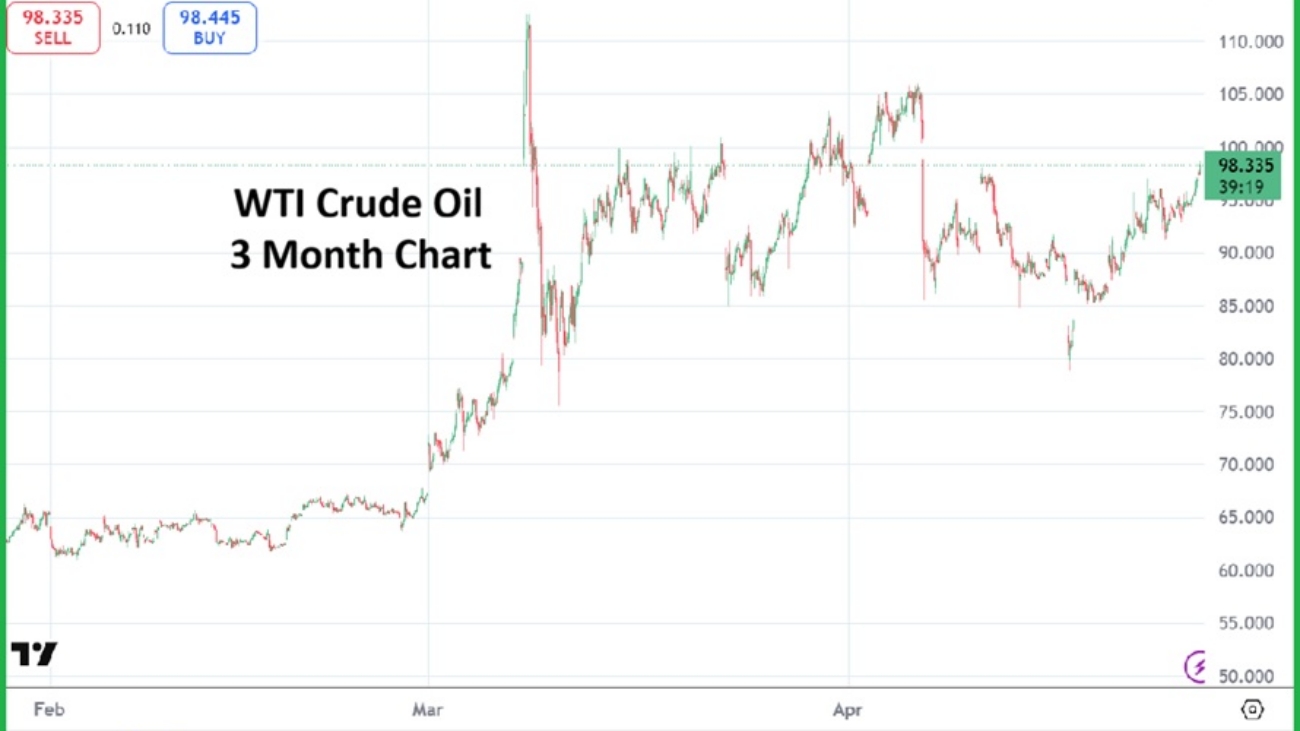
The current futures price for WTI Crude Oil is above $98.00. The cash price for the commodity is above $103.00. While many people continue to fret about what endgame strategy the U.S White House is conducting, what if we are seeing it play out in real time via the price of Crude Oil? Is it possible that President Trump has a coordinated plan to starve the Iranian regime and the IRGC of its much loved and needed money? It appears this is the case.

WTI Crude Oil Futures Three Months Chart on the 28th of April

Simply put, the Iranian Revolutionary Guard Corps is a mafia. They stay in power using the tool of fear brought upon by their ability to be ruthless to the Iranian citizens. They are a terrorist organization in the truest sense. If you disagree with that assessment, you are free to do so. However, facts when they are studied point to the conclusion Iran is a terrorist state led by its regime and the IRGC. 

Iran has made massive amounts of money via its energy products for decades. The shutdown of the Hormuz Strait, or at least the inability to export Crude Oil freely, is putting a strain on global energy prices, and it is causing a major fracture in the main financial export of Iran. 

The U.S has not only shut down easy navigation in the Hormuz Strait, but it is also going after Iran’s cryptocurrency operations. The ability to receive and transfer digital money by Iran is being strangled. What if President Trump is not only listening to the opinions of his military officers, and Secretary of State Rubio and Vice-President Vance, but also Treasury Secretary Scott Bessent who has an abundance of financial knowledge about how money flows internationally and how to create obstacles.

If the IRGC is not able to pay its own members, and other adherents to the Iranian regime are only slowly reimbursed, the apparatus of the IRGC will certainly lose its influence. The inability to pay allies that exists merely because they are employed or corrupted by the IRGC likely is starting to cause fractures regarding loyalties. 

China needs Iranian oil too. And evidence is starting to be speculated upon that China is facing tough decisions about acquiring Crude Oil from other sources. China will not be happy about having to pay higher costs, this because discounted Iranian oil that has abundantly been used is no longer available. 

Equities via the major U.S indices have done incredibly well since the end of March. The Nasdaq 100 has seemingly forgotten about AI overbought concerns, the S&P 500 is within apex territory and the VIX is acting as if sunny days are in the forecast. Forex has been volatile, but the value of the USD is within known realms.  However, the price of WTI Crude Oil is high and it has gotten higher since the 17th of April when futures prices briefly flirted with the $80.00 realm – this before going into a weekend. And this is a clue that something is afoot, beside larger players speculating on what their outlooks are for WTI Crude Oil in the mid-term.

The weekend of the 18th and 19th of April witnessed talk of an end to the Iranian war fall short; and heard President Trump essentially declare the ceasefire is still on but with the caveat that the U.S would create a blockade in the Hormuz Strait. While the semantics of a blockade can be debated, the U.S has caused shipping problems for tankers that were supposed to ship Iranian Crude Oil. The U.S clearly decided to create economic distress for Iran.

The Iranian regime still stands, but its leadership is rather shaken. The IRGC is controlling a lot of the decision making for the time being, and it appears the U.S White House is trying to make the IRGC weaker by ending their financial lifelines. It appears that it has been figured out that an economic war which includes starving Iran of cash is the most certain way to create revolts inside of the nation. When the influence of money is eroded, and temptations via other spheres of power suddenly sound tempting and can be joined, this is when shifts in authority and leadership can occur. 

While many analysts wonder about the lack of an obvious endgame being announced by the Trump administration, maybe it is already being played out. President Trump has a large ego and he is happy to extoll the virtues of his ‘tremendous’ policies frequently, but he also has shown the ability to remain quiet when it comes to plans of action and carrying them out. Yes, this can be argued into the late hours by pro-Trump and anti-Trump people. But maybe Trump is simply telling the truth when it comes to the U.S having time on its side regarding the Iranian ceasefire and the Strait of Hormuz. Maybe the clock is ticking on the eroding cash pile the Iranian regime and IRGC has within its grasp.

Copy and paste the text from AMT that you want to share

postN87

AMT Top Ten Miscellaneous Bits of Clarity for the 19th of April 2026

In a World Filled with Bread and Circuses, Now a Dose of Transparency

10: The Risk Reward Show: Sommer and Petrucci will return to the airwaves this coming week, via sources like Spotify and YouTube, with their podcast starting after a long break (absence).

9. Hardball: Major League Baseball is back and the sport continues to attract more fans and growing attention with its quicker games, a new computerized strike zone, and maybe even more dislike of the Los Angeles Dodgers. Yes, Shohei Ohtani remains a dominant and positive force in the baseball world.

AMT Top 10 for the 19th of April 2026

8. Populism: Politicians on both sides of the Atlantic continue to display a wide display of nonsensical rhetoric and bold asinine actions equating into empty spectacles. An example from the Left is Zohran Mamdani the mayor of New York City with his socialist platform, which is certain to fail and equate into more people and companies leaving NYC for less expensive and friendlier tax environments. And from the Right Italian Prime Minister Giorgia Meloni who talks a tough game but consistently falls short of backing up her words when she senses she could lose control of her power base. The putrid smell of trying to please voters with rotting bread and circuses prevails.

7. Speculation: Gold finished Friday’s trading near $4,837.50, Silver around 80.78. Bitcoin is close to $75,570.00. 

6. AI: While the Artificial Intelligence hangover has been widely discussed for a handful of months, health continues to be seen via Nvidia which closed above $201.00 going into this weekend, and Anthropic PBC which appears to be aiming for an IPO in late 2026 or early 2027. At this moment Anthropic has an estimated valuation of 800+ billion USD. If Nasdaq is able to secure a listing with Anthropic it will immediately factor into the Nasdaq 100. Are some investors betting on upside now which they believe will be seen when Nasdaq reorganizes its index?

5. Optimism: India, South Africa, Brazil and other emerging markets have experienced Forex volatility like all nations the past month and half due to the Iranian war. However, in the past two weeks the Indian Rupee, South African Rand and Brazilian Real have performed better as global markets have calmed. The ZAR and BRL have actually outperformed major currencies over the past handful of months showcasing existing optimism within financial institutions dealing with these currencies.

4. Money for Something: Lefarge, a French company specializing in concrete, was found guilty this past week of paying ISIS (Daesh) and other terrorists groups money in the years from 2012 into 2014, this in order to maintain their business operations in Syria. While Lafarge claims they paid the money to keep their operating staff safe, a French court ruled Lafarge was buying not only safe passage to allow employees to work, but also paying for physical resources needed from quarries that were controlled by the terrorists. Critics of Lafarge point towards the company’s massive infrastructure investments leading up to 2012 and a decision to seek profits no matter the costs of dubious morality. Some Lafarge former senior executives involved have been sentenced to prison including Bruno Lafont and Christian Herrault. Lafarge and Holcim (a Swiss conglomerate) merged officially in July of 2015.

3. WTI Prices: The value of the world’s most famous Crude Oil went into the weekend near $83.30 via futures markets. The commodity is certain to open with volatility early on Monday, this as folks weigh in via their existing behavioral sentiment which will range from speculative perceptions to insights they hold to be true (but that could prove false). WTI Crude Oil challenged 79.00 USD momentarily on Friday, before sparking upwards as cautious attitudes likely ignited doubts about what would happen this weekend in the Middle East regarding potential developments. Wagering on WTI in the coming days for day traders may be akin to spins of the roulette wheel.

2. Apex Heights: The winning streak and surge upwards for the Nasdaq 100, S&P 500 and Dow 30 via gains have caught some investors by surprise and standing on the sidelines. Some large financial institutions may find they have to explain why they did not participate in the rally which has unfolded since late March. The S&P 500 has gone up around 9.5% during this time.

1. Straight Talk: The Hormuz and whether or not the strait is open for oil tankers will remain a catalyst for all global assets until clarity is gained. In the meantime a whirlwind of noise and threats from President Trump, the U.S White House and Iran will remain a menace for all traders – small and large. Is the Strait of Hormuz open or closed?

Copy and paste the text from AMT that you want to share

Negotiation 20260415

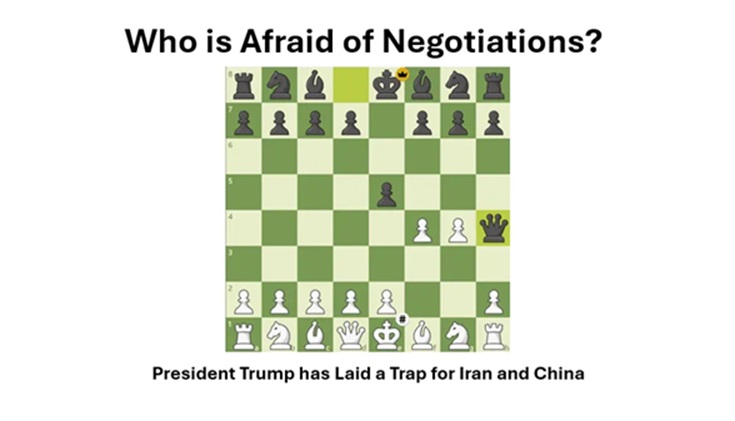
Checkmate: Who is Afraid of Negotiations?

President Trump has Laid a Trap for Iran and China

Opinion: The following article is commentary and its views are solely those of the author. This article was first published the 15th of April via The Angry Demagogue.

Both the defeatist camp and the “victory now” group see the advent of negotiations between the United States and Iran as a defeat for the United States and Israel. The argument by the defeatists is that victory was supposed to be quick and now we are stuck and looking for a way out since no one saw Iranian use of the Straits of Hormuz coming. The defeatists claim that only negotiations can end the conflict and anyway, Iran never should have been considered an enemy so the United States and Israel have overemphasized Iranian danger. The defeatists do not want a military victory and assume defeat as the moral choice.

For the victory now group, negotiations are seen as a weakness by the United States and Israel since a further pummeling of Iranian military and civil assets is the only thing that will guarantee a non-nuclear Iran incapable of threatening their neighbors – and the Straits of Hormuz. If there is no regime change, this group says, then there is nothing left to do except continue fighting until the regime falls or until there is nothing left for them to fight with.

A third group sees tactical victory and strategic defeat – or at least strategic stalemate which has forced both sides to the negotiating table meaning for the United States and Israel it is at least a temporary defeat since a stalemate is not victory.

Which if any of these assessments are correct? Or is there a third explanation that says that the negotiations themselves are a victory even if the absolute goals of the war, removing Iran from the Chinese-Russian axis has yet to be accomplished. We won’t retread the arguments about how much punishment the Islamic Republic has endured nor will we agree that as long as they have one missile launcher and enough Kalashnikov’s to stay in power there is no victory.

However, we do agree as we argued in The Art of the (Middle Eastern) Deal, that negotiations done incorrectly will be a precursor to defeat. Each time there is a rumor of continued negotiations there is panic from the victory now crowd, assuming that this time, President Trump will cave into Iranian demands. The defeatists on the other hand assume that the fact of negotiations is a good thing since military defeat is assured. The Macron-Starmer wing of the defeatists are trying to pretend to be the grownups in the room, as they want to be part of the opening of Hormuz but not be on “either side”. Their attempt to insert themselves into the situation but not on “either side” puts them a step or two below Pakistan but maybe one level above Sanchez’s Spain in influence.

Back to the real world. While the negotiations are between two countries and hosted or mediated by a third, there are two other countries involved on the Iranian side – China and Russia, and four on the American side – Saudi Arabia, Qatar, UAE and Israel. Each has its own interests and in general most of those mesh with the main participants in the talks. American allies need a non-nuclear Iran that is weak enough that it can’t threaten those countries and America has the same interests. Although a non-Islamist regime would be the best guarantor of that, it is not something that can be done only from the outside.

Russia and China need an American defeat more than anything especially after the world has witnessed the poor performance of their weaponry. They will try to re-arm Iran in order to create a war of attrition with the United States that America will be forced to end. This is where the interests of Russia and China clash. Russia would love the damage if not the destruction of Persian Gulf oil fields and refineries but the subsequent rise in oil prices would further damage China’s increasingly fragile economy. If Putin’s Russia has a goal of survival, self-enrichment and embarrassing the west (one seems to go with the other for Putin) and China’s goal is to dominate the Indo-Pacific, then the survival of Iran is a nice to have for Russia but a need to have for China.

China does not have the will and/or ability to do what is necessary to defend their Iranian ally, so they are really in a no win situation without a nuclear Iran. The American insistence on a complete end to the Iranian nuclear program is a shot right at the Chinese global strategy. Without the Iranian nuclear umbrella, China will depend on the United States for the flow of oil to their country.

As for Iran, they have one goal in this war and that is to survive with enough firepower intact to continue their quest to destroy Israel, rid the middle east of the United States and eventually to bring the Sunni Arab states in the Gulf under their thumb. As opposed to a dictatorship that is “only” corrupt and can be bought, they also need their theological goals met – and that starts with the destruction of Israel and genocide of the Jews. That, like Hitler’s Germany is an aim greater than the goal of winning the war.

They have come to the negotiating table because they felt that a continued bombing attack by the U.S and Israel and possibly the Gulf states risks their goals more than negotiating. This is the same reason that Hamas agreed to release the hostages as they saw the needed respite from the IDF in order to retain control of at least part of Gaza. This could be seen as Iran’s last ditch effort to survive and are using the cease fire to reconstitute their industry, re-arm and most important – to dig out and reach their underground missile cities

So why has the United States come to the negotiating table? Is it a show of weakness? An attempt to re-arm and bring more troops to the region? Is there a regime change plan that needs time to take share?

As for the last of these, over that last two days there have been car bombs and shootings at Basij checkpoints and the commander of Basij forces of Teheran has been assassinated. There is clearly something going on inside of Teheran and the head of the Mossad, David Barnea stated yesterday that the Iran mission will not end until there is regime change. Not only are the IRGC using the cease fire to regroup, so, it seems, is the opposition.

In addition to continued operations in Iran, the blockade of the Straits of Hormuz, an act of war in itself, tells Iran not to see negotiations as a sign of weakness by the United States, but rather as an opportunity for the US to widen their attacks beyond bombs and missiles.

The move from bombing to negotiations have trapped both Iran and China in a place where neither can win unless the U.S, against all statements by the President, VP, Secretary of State and Secretary of War, decides to fold.

Iran is trapped in a place where if they starts to shoot they will have their economy in worse shape than it is now and they no longer are lords of the Straits of Hormuz – THE trump card (no pun intended) that the defeatists have been gloating about.

China is trapped in a place where they need the United States to guarantee their flow of oil and their ally is no longer able to sell it to them on the cheap.

Negotiations have taken away the two things that were pressuring America and its allies – Iran’s daily missile attacks and their veto over the Straits of Hormuz. While they are using the time to try and rebuild what has been destroyed, that will take so long that, assuming no surrender by the United States, will be irrelevant to this war and the next -if there is one.

President Trump and the United States have set a trap for Iran and China and there does not seem to be a good way out. That doesn’t mean Iran will recognize it and end their genocidal quests, but it does mean that their path to victory has been shut down.

Checkmate?

Disclaimer: the views expressed in this opinion article are solely those of the author, and not necessarily the opinions reflected by angrymetatraders.com or its associated parties.

You can follow Ira Slomowitz via The Angry Demagogue on Substack https://iraslomowitz.substack.com/

Copy and paste the text from AMT that you want to share

postN87

AMT Top Ten Miscellaneous Morsels for the 12th of April 2026

Optimistic Hopes Appear Ready to Fade into the Distance

10. B-ball: The NCAA Men’s Basketball Championship concluded early last week with a rather resounding outcome for the University of Michigan who won their 2nd Men’s trophy, the first one coming in 1989. Michigan dismantled the Arizona Wildcats and then handled the Connecticut Huskies. The NBA playoffs will start this coming week. The Oklahoma Thunder and the San Antonio Spurs are getting a lot of attention, and the Denver Nuggets might have something to offer.

9. Trump: A week of optimism now leads towards threats of additional noise. Peace talks held in Pakistan appear to have failed this weekend, and now another countdown has begun as the Iranian conflict appears ready to escalate. The U.S White House and President Trump will certainly make more noise in the coming days.

AMT Top 10 for the 12th of April 2026

8. Logistics Advertising: Kit Kat and Nutella have been rewarded with massive exposure. The Kit Kat truck heist of 12 tons of product (reportedly said to be in a special F1 designed candy bar theme) made headlines. Kit Kat’s owner, Nestle, was obviously content with the free publicity and proof of demand. And a jar of Nutella floated across the Artemis 2 spacecraft unexpectedly this week, gaining international attention and sparking smiles from fans of the Italian chocolate hazelnut spread.

7. Creator: Yet another candidate accused of being Satoshi Nakamoto has been produced. Blockstream’s CEO Adam Back has been named by the N.Y Times as a potential creator. In the meantime, the real question is whether anyone but Iran (as they run their illicit shadow economy), Michael Saylor of MSTR and a few big whales consisting of institutions and hedge funds are really paying any attention to BTC anymore. The BTC/USD price as of this morning is around $71,600.00. Bitcoin was traversing near $126,000.00 in the first week of October 2025.

6. Greenback: USD/JPY 159.240, EUR/USD 1.17225, USD/ZAR 16.38540, USD/INR 93.0480. USD centric strength may prove solid this coming week and other currencies may suffer a bit.

5. Sideways Shimmer: Gold finished the week near $4.745.00, roughly $100.00 above its starting point last Monday. U.S 10-Y Treasury yields went into this weekend around 4.34%. Shifting outlooks this coming week will likely ignite turbulence in both assets.

4. Blind Eyes: More than a handful of U.S politicians have been featured as big winners regarding their stock trading abilities. Their gains far exceed the winning percentages of the overall returns made by indexes (as a benchmark). Little has been done to stop what many view as insider trading. There are many forms of political corruption around the world. However, a variety of places and people, including Americans seem to accept this potential misconduct. The ‘Stop Insider Trading Act’ has been brought forth in the House of Representatives and Senate, but the legislation may simply meet a slow death and disappear.

3. Inflation: U.S interest rates via the Federal Reserve will be held in check at a minimum over the next few months. The higher costs of energy will certainly seep into prices for transportation, manufacturing and agriculture. Fed Chairman Jerome Powell may be quite content to leave his position May the 15th. The next Fed FOMC interest rate decision is due on the 29th of April.

2. Strait of Hormuz: WTI Crude Oil closed above $90.00 going into this weekend. When futures markets open early on Monday, the price of the commodity is likely to rise via increased anxiousness which will build into the mindsets of large players today because of the failure of peace talks in Pakistan. The price of Crude Oil remained high last week, only moving to a low of around $85.00 this past Tuesday, showing cautious attitudes remained. Prices above $100.00 will likely become a new target quickly for some who bet. Will an early spike upwards this week then start a counter reversal lower, or will a climb become sustained?

1.  Risk Off: The S&P 500 and Nasdaq 100 will get plenty of attention this coming week as behavioral sentiment remains fragile. Having skirted near its 200-days moving average lows in recent weeks, the indices have gained handsomely since the 31st of March. Will the upwards momentum come to an abrupt end this week, or have financial institutions been able to digest their nervousness and will they show a capability of remaining buyers?

Copy and paste the text from AMT that you want to share

Outflows 20250220a

India Insider: Macro Stress a Capital Flow Problem, Not a Trade One

India Insider: Macro Stress a Capital Flow Problem, Not a Trade One

Editor’s note: This article was originally written in January 2026. It has been updated to incorporate developments through February 2026, including the U.S – India interim trade agreement and subsequent capital flow data.

India is currently experiencing what can best be described as macro stress. By macro stress, we mean pressure across the broader economy that shows up simultaneously in the currency, financial markets, and capital flows, rather than a problem limited to one sector or company. In India’s case, this stress is visible in a weak rupee, persistent foreign investor outflows, and rising concerns about equity valuations.

This stress is often misinterpreted as a trade or export problem. In reality, the pressure on the Rupee and the growing fragility in equity markets stem primarily from the capital account, not from collapsing exports or remittances. Even as the U.S Dollar softens – helped by Federal Reserve rate cuts and renewed trade tensions under U.S President Donald Trump, India continues to struggle to attract foreign capital, exposing a deeper structural imbalance.

Source: NSDL (FPI Equity Flows): Reuters and author’s calculations.

Recent weakness in the USD would normally support emerging market currencies and risk assets. This time, however, the response across emerging markets has been uneven. Capital has flowed toward economies linked to artificial intelligence, semiconductors, and commodities, as well as toward markets where valuations have already adjusted. South Korea, Hong Kong, Chile, and South Africa have all benefited from this rotation. India has not.

The Rupee’s weakness reflects this divergence. USD/INR continues to trade around ₹91.5–91.6 despite the absence of a sharp deterioration in India’s trade fundamentals. Services exports, particularly IT services, remain resilient, and remittances continue to provide a steady source of foreign exchange. This brings us to the current account.

The current account represents a country’s net trade balance with the rest of the world, including goods, services, and remittances. India runs a current account deficit, meaning it imports more than it exports. While this deficit persists, it is manageable at present, supported by stable services exports and remittance inflows.

The real problem lies in the capital account, which tracks investment flows such as foreign investors buying or selling Indian equities and bonds. When foreign capital flows into the country, it helps finance the current account deficit. When it flows out, pressure builds quickly on the currency and financial markets.

Foreign capital is neither entering India in sufficient scale, nor remaining invested. Portfolio outflows have become persistent, and this has emerged as the dominant driver of currency pressure. In calendar year 2025, foreign portfolio investors sold approximately USD 19–20 billion worth of Indian equities, marking one of the largest annual equity outflow episodes in recent years. Importantly, this selling has been sustained rather than episodic, pointing to a structural reassessment of India’s growth outlook and valuation premium rather than a temporary risk off shock.

Crucially, this capital flight is not the result of a collapse in exports to the United States. Despite tariff concerns, the U.S remains India’s largest export destination. Between April and December 2025, Indian exports to the U.S rose to roughly $65–68 billion, compared with $60–63 billion during the same period last year. Trade flows, for now, are holding up better than sentiment suggests.

The effects of capital account stress are most visible in financial markets. Indian equities are failing to attract foreign inflows as growth momentum weakens. Market leadership has narrowed, with headline indices supported by a small group of large-cap stocks, while consumption-sensitive sectors such as FMCG remain under pressure.

This dynamic fits squarely within the balance of payments framework described by Professor Michael Pettis. He described, “a country cannot sustainably run a current account deficit without stable capital inflows. When capital inflows weaken, the adjustment shows up through a weaker currency, tighter financial conditions, and pressure on asset prices.”

Indian equities now trade at some of the highest valuation multiples globally, supported largely by domestic retail and mutual fund flows. However, domestic capital is structurally constrained, while global investors can freely reallocate. As Bloomberg’s Andy Mukherjee recently noted, Indian cement stocks now trade at higher valuations than Hong Kong Tech stocks showing the exuberance of Domestic equity capital chasing local themes.

At a deeper level, India’s vulnerability reflects a structural imbalance between savings and investment. Domestic savings are insufficient relative to the economy’s long term investment needs, and the financial system lacks the institutional capacity to consistently channel savings into productivity enhancing investment. As a result, growth has become increasingly dependent on mobile foreign capital – capital that is cyclical, return sensitive, and easily reversible. It is this dependence, more than any near term trade shock, that leaves the Indian rupee vulnerable when global capital flows turn cautious.

Update: The US–India Interim Trade Agreement (February 2026)

Since this article was first written, a significant development has reshaped the near-term outlook. In early February 2026, the United States and India reached an interim trade agreement. As part of the deal, the US lowered its reciprocal tariff on Indian goods from 25% to 18%. President Trump also signed a separate executive order removing an additional punitive 25% tariff that had been imposed as a penalty for India’s purchases of Russian oil, meaning the effective tariff burden on Indian exports had, at its peak, approached 50% before being brought down to 18%.

The announcement acted as an immediate sentiment catalyst. The rupee, which had been trading in the ₹91.5–92 range under stress conditions, strengthened on the news, touching ₹90.30 before settling near ₹90.70. Foreign portfolio investors, who had spent most of 2025 as relentless net sellers, turned net buyers in the first week of February 2026, purchasing approximately $897 million worth of Indian equities.

These are meaningful moves. After 18 months of persistent underperformance relative to other emerging markets, India’s excessive valuation premium has moderated toward historical averages, which may create better entry points for global capital going forward.

Copy and paste the text from AMT that you want to share

postN76.1

India Insider: Strategic Memory and Why Unilateral Power is Resisted

India Insider: Strategic Memory and Why Unilateral Power is Resisted

After Independence, India was often described as “tilting” toward the Soviet Union. In reality, this was the outcome of India’s pursuit of Non-Alignment at a time when the United States was actively backing perceived rogue actors in South Asia, most notably Pakistan. What appeared as ideological preference was, in fact, strategic necessity born of hard experience.

The Soviet Union supported India on core security concerns when few others would. The first major Soviet defense deal was not merely a weapons sale. It included licensed production in India through Hindustan Aeronautics Limited, full technology transfer, and made India the first non-Communist country to receive the MiG-21. This distinction mattered. India was treated as a sovereign partner capable of absorbing technology, not as a dependent client expected to align unquestioningly.

By contrast, Washington’s alignment with Pakistan was driven by Cold War geopolitics rather than South Asian stability. Despite repeated military coups, wars with India, and regional destabilization, the United States armed Pakistan, provided diplomatic cover during conflicts, and sustained the relationship through military rule and nuclear proliferation. These experiences deeply shaped India’s strategic culture and explain its enduring emphasis on autonomy, redundancy, and diversified partnerships rather than alliance dependency.

This history is one of the central reasons India resists Washington dictating regional dynamics. South Asia, in New Delhi’s view, is not a chessboard for external powers to reorder at will.

Democratic Republic of the Congo Example

The same pattern is visible beyond Asia. Take the Democratic Republic of Congo. After decades of horrific colonial exploitation, the Belgians realized by the mid-20th century that they could not hold on indefinitely and exited abruptly, having never prepared the country for self-rule. What they left behind was not independence, but a political vacuum. The United States and the United Nations intervened, but their actions were shaped less by concern for Congolese society than by geopolitical rivalry, ideological competition, and racial hierarchy.

The assassination of Patrice Lumumba destroyed the Republic of the Congo’s (as it was known then) only credible attempt at building a unified nationalist state at independence. The dictatorship of Mobutu Sese Seko that followed did not merely fail to develop institutions; it actively hollowed them out. Corruption became a governing principle, loyalty replaced competence, and the state turned into a vehicle for extraction. Today’s instability in the Democratic Republic of the Congo is not a governance failure in isolation—it is the predictable outcome of a political system designed to rule without building state capacity. For countries like India, this is not ancient history, it is a warning.

Washington’s unilateralism reinforces this mistrust:

The recent military operation to remove Venezuelan President Nicolás Maduro without U.S Congress authorization, international legal justification, or an imminent threat would have been unthinkable as recently as the first Trump administration. It became possible in 2026 only because of congressional capitulation, judicial immunity, and the transformation of an apolitical defense establishment into a politicized instrument of executive power. To much of the world, this signals that restraint is no longer embedded in American decision making.

Europe exposes another contradiction. The post war order was built on liberal democracy and collective security through NATO. When that order is weakened by unilateral action, trust erodes, even among allies expected to align automatically.

Even before Trump, the U.S – India relationship remained cordial rather than fully strategic. Before 9/11, India was the most natural regional ally against Al-Qaeda, yet Washington lacked patience and local understanding to navigate India’s complex democracy and nationalism. That failure was not tactical, it was conceptual.

India’s neutrality today is deliberate:

It prioritizes diplomacy over military actions that violate international law. India sees a multipolar world emerging, not as disorder, but as the end of unchecked unilateral supremacy. This is not ambiguity. It is a strategic memory.

post278

Behavioral Sentiment: False Narratives and Noisy Realities

Behavioral Sentiment: False Narratives and Noisy Realities

The past handful of months in Forex have provided day traders problems if they have been trying to pursue steady trends. Constant flashes of rhetoric and news pervading tariff implications, U.S Federal Reserve interpretations from various media and analytical corners, and mixed economic data has caused a rather mired reality for speculators trying to operate.

S&P 500 One Year Chart via Futures CFD Trading on the 9th of September 2025

However, if the noise is turned down by day traders and sometimes given less importance regarding potential influences, signals become visible and some perceptions can be looked upon as roadmaps. While many want to to throw their hands up and proclaim some sort of developing economic meltdown and a coming apocalypse, the major U.S indices are actually performing quite well as a barometer. The S&P 500 is continuing to challenge all-time values. Yes, the Nasdaq 100 and Dow Jones 30 are not marching in lockstep with the S&P 500 to new highs, but they are not far behind. The stock market has never guaranteed people an ability to constantly move upwards, but it does offer the potential to judge outlook and mid-term sentiment.

The USD has been extremely choppy since the start of this year, this as the Trump administration has taken over, but its trend towards weakness has been rather clear. The EUR/USD and GBP/USD have done reasonably well regarding mid-term strength. Yes, the USD/JPY has produced whipsaw movements and the Japanese Yen remains awkward, but this is a direct reflection of mitigating Japanese government policy (some may call it incompetence) regarding its ability to manage fiscal concerns, interest rates, and fight deflation and now inflation (which has been going on for a few decades).

Gold is traversing record heights and is showing signs of sustaining values above 3,600.00 as of yesterday. After languishing (albeit within elevated realms) near 3,350.00 the past handful of months with prevalent volatility, the precious metal has bolted out of its consolidation. And the likely reason for this is the anticipated Federal Reserve policy changes regarding interest rates. 10 Year U.S Treasury yields have also been pushed lower recently – this as financial institutions await a definite cut in interest rates by the Fed on the 17th of September. But folks who believe a 50 point basis reduction is coming late next week are likely wrong.

The Federal Reserve under Chairman Jerome Powell has been quite conservative, this will probably not change next Wednesday. It is more likely a cut of 25 basis points will take place on the 17th, and the FOMC Statement will offer the potential of another interest rate cut in October. Tomorrow’s PPI numbers and Thursday’s CPI results will influence the Fed’s coming meeting and mid-term outlook.

What we are left with is a broad market that is having a lot of noise applied to it by people with a variety of biases. Political bantering has reached a threshold in which it might be best to simply not pay attention to anything – but that is dangerous too. Yes, some people do talk sense, and some people do show signs of actually trying to engage in adult decision making regarding their insights, but it often feels like wanting to sound correct is more important than outcomes. Technical traders may be enjoying a quiet laugh at the expense of fundamental players right now.

However, economic data remains important. While rhetoric from the U.S White House and its opponents remains within a state of hyperbole, day traders should try to turn down the noise and pay attention to signals that long term investors continue to produce and take advantage of their sentiment. Stocks continue to be pursued and indices have done well, but volatility should be expected particularly into next week.