New Zealand Dollar 20260825a

NZD/USD: Elevated Value for Kiwi Coming Within Sight of Mid-Term Prices

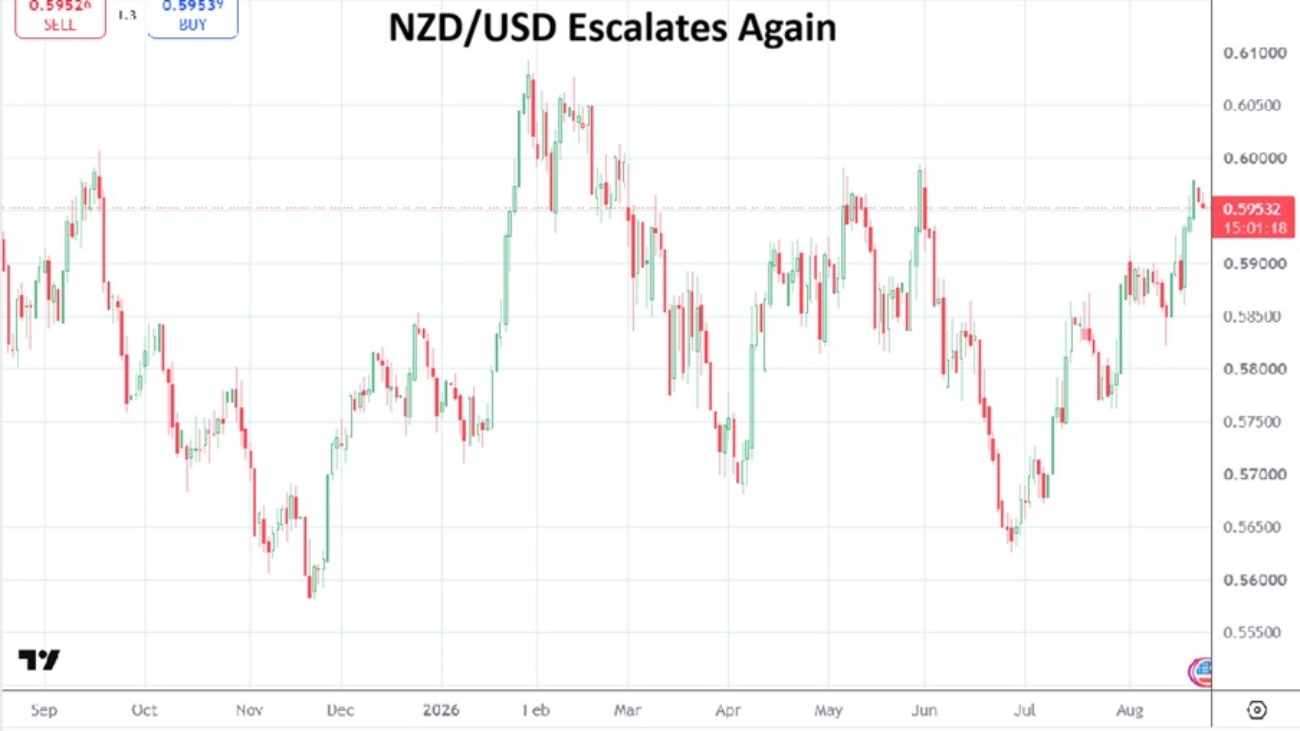
The NZD/USD is around 0.59550, last Friday’s highs near 0.59885 vicinity flirted with mid-term highs

The NZD/USD remains a speculative currency pair that offers fast results and velocity. The relatively low liquidity of the NZD/USD compared to the upper tier of major currency pairs allows for sudden bursts of movements which experienced traders may find tempting and inexperienced retail folks wagering could find exhausting and costly. The NZD/USD ranks typically around 7th per the size of its volume in Forex. Ahead of it at number six is the AUD/USD.

New Zealand’s growth rate of near 1.5% has been holding steady for the past half year. On the 8th of July the Reserve Bank of New Zealand raised its Official Cash Rate by 0.25% and the next decision from the RBNZ is next week on the 2nd of September. Because of inflation concerns some analysts believe another quarter of a basis point will be added. The current price of WTI Crude Oil is over $85.00, but it needs to be noted that New Zealand imports refined petroleum product most of which comes from Asia – like South Korea and Singapore. The current rate of inflation in New Zealand is around 4.1%.
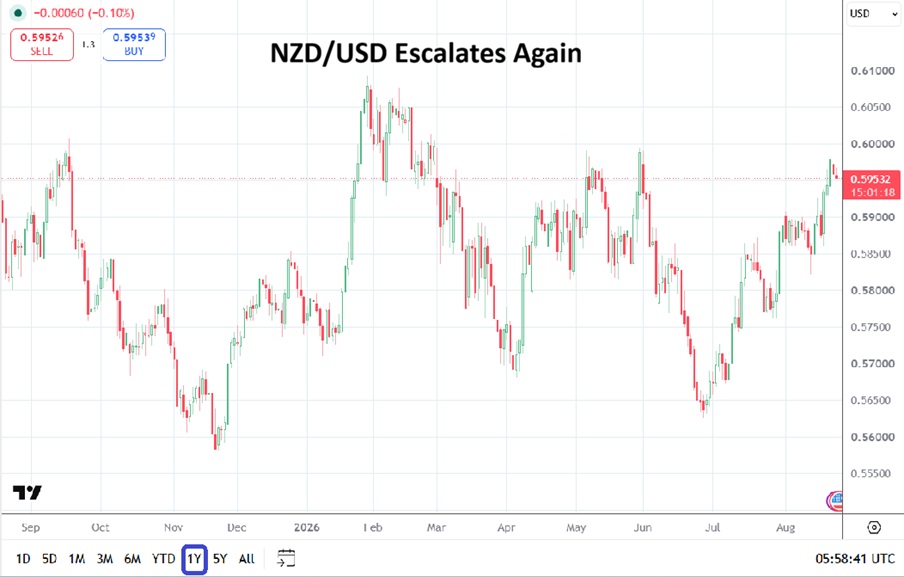
NZD/USD One Year Chart as of 25 August 2026

What will the RBNZ Do Next Wednesday

The Reserve Bank of New Zealand like other global central banks has a dilemma because of the sticky higher costs of energy due to the Iran and U.S conflict. The situation in the Middle East is unlikely to be resolved in the coming month. The conservative led New Zealand government would likely prefer not having to raise the Official Cash Rate, but the central bank may feel like it has no other choice. The U.S Jackson Hole Symposium led by the Federal Reserve starts this Thursday and a key speech will be delivered by Fed Chair Kevin Warsh this Friday, New Zealand officials will be a participant.

If the Official Cash Rate is raised in New Zealand by 0.25% to 2.75% it may supply the NZD/USD some additional reasons for greater Kiwi strength. However, what should concern day traders is the suspicion that part of the interest rate hike has already been baked into the value of the currency pair. Psychological support for the NZD/USD is easy to see at the 0.59500 mark for near-term traders. Those looking for upside may want to use slight moves lower to wager on potential reversals that they believe could ignite upwards if they are conservative.

Near-Term Wagers on the NZD/USD and Risk Management

The NZD/USD is a favorite for many Forex traders because of its volatility and often its ability to produce rather intriguing trends. The currency pair has seen upwards value since last Wednesday and has shown an ability to sustain it elevated status while correlating to the broad Forex market. On Wednesday the 29th of July the NZD/USD was near the 0.57650 ratio. The currency pair was flirting with 0.60000 rather consistently in February before the Iran and U.S conflict escalated into military action. 

Day traders tempted to look for additional upside in the NZD/USD cannot be faulted. If Fed Chairman Kevin Warsh somehow sounds dovish regarding U.S interest rates this coming Friday and talks about a strong U.S economy, and the RBNZ were to raise the Official Cash Rate next Wednesday this could bolster the value of the New Zealand Dollar. Risk management for retail traders is essential because sentiment shifts within the current higher terrain of the NZD/USD could attract more bullish perspectives that also include USD centric weakness, but if a sudden headwind blows – velocity in another direction could create volatility downwards if those leaning into a stronger NZD/USD were to become concerned about their outlooks and abandon ship.
Copy and paste the text from AMT that you want to share

Share:
30 Year Govt Bonds 20260820

Bond Yields: The Wheel Has Not Been Rediscovered

Unintended Consequences: USD and Gold will now get their turn in the casino because of Scott Bessent's QA

Treasury Secretary Scott Bessent’s decision to begin injecting money into U.S Treasuries needs to be looked at by Forex traders. There is reason to suspect USD centric weakness may prevail moving forward. 

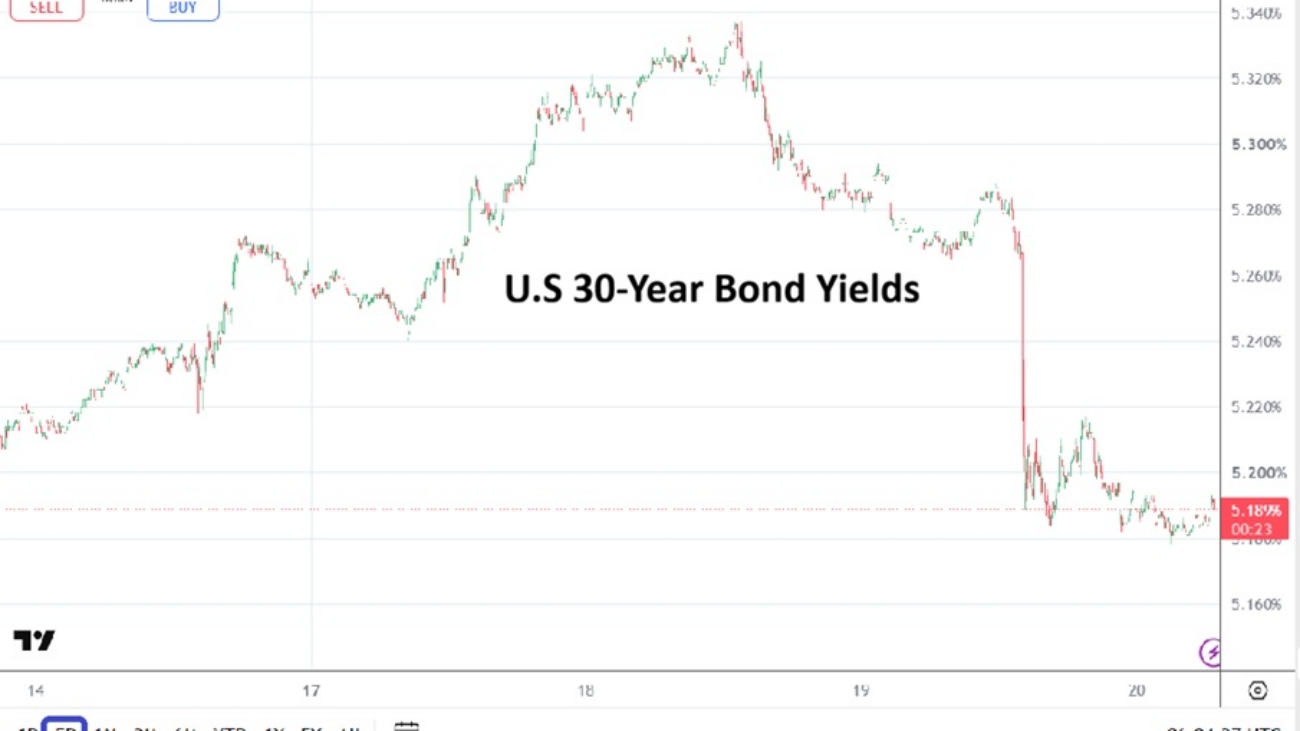
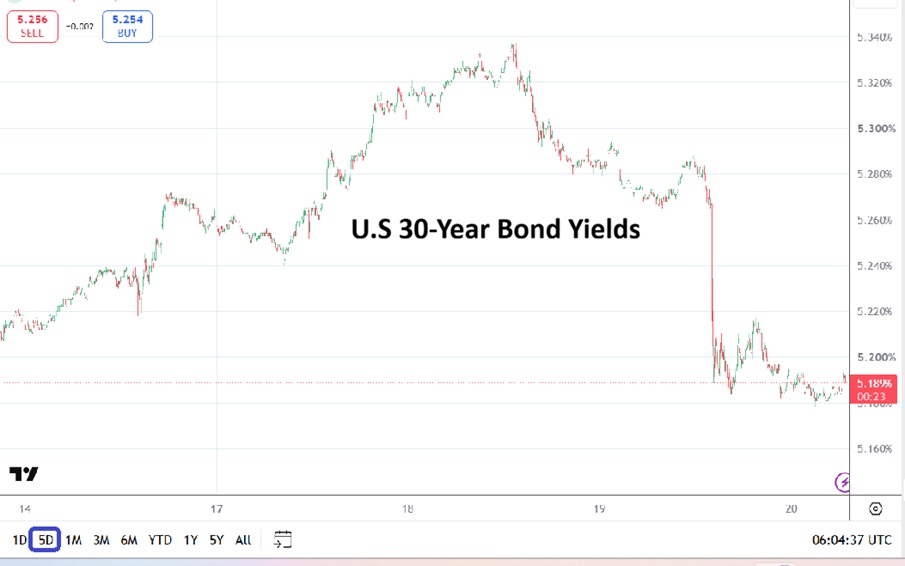
Yesterday’s bond news regarding Bessent’s actions to fight the higher yields in U.S 30-Year Bonds has brought rates down from almost 5.28% to nearly 5.18% as of this morning. 

U.S 30-Year Bond Yields 5 Day Chart as of 20 August 2026

Perhaps market results and dynamics can be quantified as math within a game, but at the end of the day it is behavioral sentiment that drives market forces and the way financial institutions react. Psychology can be looked at as the reaction via the marketing/influence of policy positions and presentation.

We have been down this road before. The decision to announce a round of quantitative easing yesterday via Treasury/Fed intervention should be compared to what the same team did a couple of weeks ago regarding its powerplay with the Bank of Japan in order to make the JPY stronger. We are now in a definite cycle in which government institutions are battling investors to stop momentum in certain assets when policies have gone bad.

The wheel has not been reinvented. It may seem like an unfair advantage to traders betting against government policies that are interpreted (correctly) as being misguided or unwise, but these are the rules of the game. Large players who have been betting on U.S Treasury yields to increase were likely not happy yesterday, but they should have known the U.S government would not sit idly and simply allow an implosion of the financial system to occur.

Having said the above, now we can look towards the realm of unintended consequences. The U.S Dollar Index dove yesterday with USD centric weakness and gold soared. And as long as folks refuse to buy U.S long-term Treasuries on the cheap and demand higher interest rates to protect their investments the potential of further unintended consequences will occur. 

Scott Bessent handled the situation perhaps correctly yesterday, but he is dealing with symptoms and not the cause of the virus. A lack of clarity clouds global central banks and monetary policies connected to their interest rates. Inflation concerns persists and so does the debate regarding how to battle this illness.

The U.S Fed and Chair Kevin Warsh have a major task ahead regarding interest rate policy.  And government’s – particularly the U.S – have to decide if they can actually stop the bleeding. For the moment this appears to be a tall order because by injecting digital money into U.S long-term bonds the U.S is spending money that it really doesn’t have, except to say that this is a game of chicken in some respects and financial institutions could be faced with the dilemma of cutting off their nose to spite their face. Where are Friedrich Hayek and Milton Friedman when you need them?

Copy and paste the text from AMT that you want to share

Share:
USDJPY 20260813

Sentiment Matters: Speculative Narrative and the False Promise of Data

Do Retail Traders Understand They Are Being Misled?

As day traders ponder what they should do next via their speculative wagers in the broad marketplace, now is a good time to remind small speculators stepping into the casino of global assets that a lot of the production value they are offered is part of a show. Entertainment is literally being produced to entice people to trade. A large amount of retail traders are constantly being misled. Your adrenaline high is being counted upon to keep you a participant. The thrill you get when you are trading should not be more important than the outcome of your trade.

Large money machines like the Nasdaq 100, S&P 500, U.S Treasury yields, Forex, commodities and even the cryptocurrencies have plenty of descriptive words and definitions trying to interpret and predict values, trends and outlook, but quite frankly a lot of the words are nonsense created to entice and fool. Making retail traders willing participants in the circus is important because it keeps a lot of the the entertainers employed. 

It should be remembered that a lot of the folks on the institutional side of financial markets do not care about day traders except as an example of what not to do. They use day traders as a touchstone to point to failures and convince you why you are out of your element, while hoping you will stick around to create volumes that are often needed in some speculative assets. Are you being taken advantage of as a small speculator? 

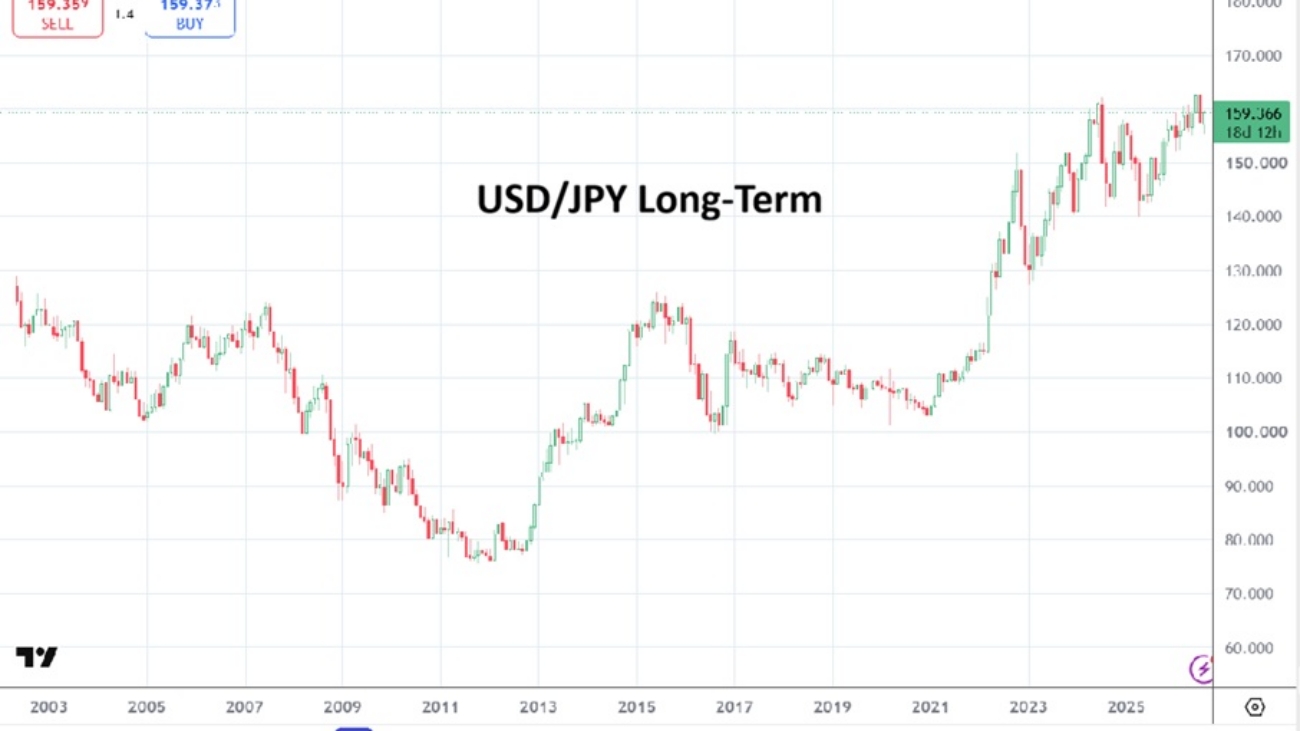
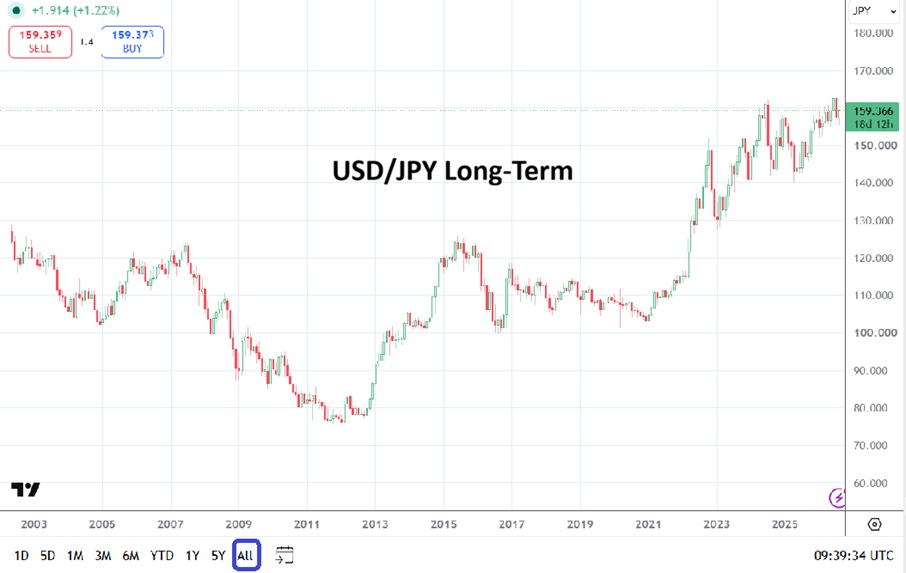
USD/JPY Long-Term Charts as of 13 August 2026

It is Much Better to be the Bank

A lot of people in the institutional financial industry know one thing for certain, while some make money investing by themselves or produce outstanding results for funds, many do not. There is an old saying among veterans in the arena, “it is much better to be the bank”. Transactional costs from commissions, carrying charges, exchange fees and taxes make money for the institutions and government regulators.

Many folks are involved in the financial markets because it provides a solid pay check, it remains a good career path for those who want the comforts of modern society. However, being a day trader while working another job as a blue collar employee, or business owner, or while being a professional in another endeavor and dreaming about wealth creation via speculation is alluring, but it frequently does not produce steady profits like it does for the people working in financial institutions collecting a paycheck. 

Confirmation Bias and Investment Outcomes

Economists for instance are relied upon to decipher inflation and decode data for devoted audiences. The believers are told why certain assets are reacting and what might happen in the future by the influencers. But this also can manifest into self-fulfilling prophesy that may not actually be connected to real economic outcomes, except that outlooks get fulfilled because of emerging behavioral sentiment.

For instance when yesterday’s U.S Core CPI was released and hit its expectation, what did markets do exactly, what were investors reacting to? The markets reacted to what the perception of mid-term outlooks will now do, based on how they think the Federal Reserve will act in September and the coming months. Reactions to anticipated results are a key factor in market dynamics. Large positions are shifted by financial institutions which have the ability to to absorb short and near-term losses of capital while they wait for their mid-term outlooks to be confirmed. Confirmation bias remains important in the marketplace as results get generated via intraday results as big players thrash violently with massive piles of cash causing technical perspectives to drive algo trading.

Inflation is Not a Joke

Btw, why did god create economists? To make weathermen look good. While that may fray the feelings of economists, the joke holds water. Because observable data and printed results often do not correlate. Just ask global consumers in various nations what they think about their government’s stated inflation data compared to what they are spending on a monthly basis and rising costs. People on the street often feel their national currencies feel like they are losing money no matter what central banks are proclaiming.

Inflation is an important measurement for consumers and investors. But real inflation is often not a desirable talking point for many governments. Often excluded data includes products like food, energy, and mandated medical and pension costs via payments to government social programs. Increasing rent or mortgages via rising interest rates inside of certain government inflation reports are frequently avoided too and would look atrocious. Central banks are supposed to fight inflation, but which inflation exactly? I am digressing I know, this may have nothing to do supposedly with everyday speculating in the marketplace, but actually it does.

Because the Forex market, gold, equity indices are reacting to sentiment generated by the second based on what outlooks will be in vogue in a few months and inflation effects. Our age of social media and fast communication makes the markets vulnerable to fear and optimism equally. Speed matters even if it sometimes causes pain for day traders via lightning quick results in the marketplace as outlooks change constantly.

Make no mistake, market forces are always in play as investors look for value. Sentiment caused by folks like central banks and their policies play consistently important and volatile roles as large players and financial institutions react to tea leaves being read. The USD/JPY is a case in point, the Japanese Yen has been dramatically weak and losing value long-term. 

The intervention by the BoJ and U.S Treasury which was coordinated a couple of weeks ago didn’t fix the problem that Japan has poor monetary and fiscal policy. What it did was serve as a warning to day traders and large players (including banks) not to bet too strongly against the JPY too consistently even if their perceptions tell them otherwise, because the Japanese and U.S government can wreck havoc and create unforgiving momentum which can kill the infectious trend upwards when they desire. 

The BoJ and U.S Treasury definitively put on a show for traders to watch and contemplate before they consider stepping into the casino again. Sometimes it is better to watch the entertainment instead of being an actor within the drama.

Thrill of Risks and Solid Tactical Strategy 

Why do speculators insists on chasing markets without having proper guidance? Why don’t these same smaller traders just let professionals manage their assets and put some money away when they can and accept the returns? Maybe because many speculators are skeptical about the real returns and know they are being made to endure a magic show of sorts. 

Day traders should only risk what they can afford to lose via a speculative allotment of cash. Fund managers for financial institutions, pension funds for example, are often mandated to put 2 to 3% of holdings into speculative assets in order to seek bolder returns. This is one of the reasons why hedge funds and speculative assets flourish in a cyclical manner. Large financial institutions allow for wagering on asset classes they know are dangerous in an extremely limited manner, but with a huge amount of money. Can you say Bitcoin? And it is widely accepted that these speculative positions can be wiped out and destroy capital. Institutions often do not mind losing on limited speculative positions, the same cannot be said for retail traders.

Smaller retail traders should not view themselves engaged in a battle against financial institutions which are filled to the rim with employees who are often unsympathetic about the outcomes produced. The world of speculative betting by retail traders is not about to change. Day traders should study momentum and behavioral sentiment.

Traders need to understand how to manage risks and emotions. While speculators can dream about making illustrious profits to impress friends and partners, if they do not take into the consideration the costs of the risks they are likely going to fall into a deep hole. Strategic tactics are necessary. Retail trading doesn’t have to be a game if it is conducted wisely.

Copy and paste the text from AMT that you want to share

AI Economic Flywheel 20260811

Anatomy of the AI Economy: Mapping Capital, Infrastructure and Value

Interlocking Parts of the AI Flywheel and Understanding the Multi-Trillion Dollar Engine

We are living through the largest, most aggressive capital deployment cycle in technological history. What began as a gold rush for silicon chips has rapidly evolved into a multi-trillion-dollar macroeconomic engine. 

The AI Economy operates as a tightly integrated flywheel: hyperscale physical capital flows directly into compute infrastructure, which powers foundation models, which are then distributed via cloud platforms to power end-user productivity. 

For investors navigating this shift, capturing durable value requires looking past individual stock picks and understanding this multi-trillion-dollar supply chain requires examining how capital moves across hardware, cloud orchestration, model intelligence, and commercial monetization.

Anatomy of the AI Economy: Mapping Capital, Infrastructure and Value 

A: Data Center & Physical Infrastructure Layer

The physical foundation represents the largest capital expenditure cycle in tech history, with combined hyperscaler CapEx projected to exceed $700 billion annually.

  • Space & Power Real Estate: AI workloads demand unprecedented power density (scaling from 10–15 kW/rack up to 100+ kW/rack).
    • Key Metrics: Global hyperscaler CapEx allocation to AI infrastructure is ~75%.
    • Key Players: Digital Realty, Equinix, CyrusOne, Compass Datacenters.
  • Machines & Systems: Custom server racks engineered for intense compute densities.
    • Key Players: Supermicro, Dell Technologies, Hewlett Packard Enterprise (HPE), Foxconn, Wiwynn.
  • GPUs & Accelerators: The core engine of AI compute, transitioning from pure GPU training dominance to custom inference ASICs.
    • Key Players: Nvidia (80%+ market share), AMD, Intel, Google (TPU), Amazon (Trainium/Inferentia), Meta (MTIA).
  • Networking & Interconnects: High-speed fabric connecting tens of thousands of clustered GPUs, required to prevent bandwidth bottlenecks.
    • Key Metrics: Rapid transition to 800G and 1.6T optical transceivers and Ultra Ethernet Consortium standards.
    • Key Players: Broadcom, Arista Networks, Cisco, Marvell, Nvidia (Mellanox InfiniBand/Spectrum-X).
  • Memory & Storage: Ultra-fast memory architectures and storage required for multi-terabyte dataset ingestion during training runs.
    • Key Metrics: High Bandwidth Memory (HBM3e/HBM4) consumes over 20% of global DRAM wafer capacity.
    • Key Players: SK Hynix, Micron Technology, Samsung, Western Digital (Solidigm), Seagate.
  • Liquid & Advanced Cooling: Air cooling reaches physical constraints past 40 kW per rack, making liquid cooling mandatory for next-gen clusters.
    • Key Players: Vertiv, Schneider Electric, CoolIT Systems, Submer.

B: Cloud & Model Software Layer

Cloud providers act as the primary monetization pipeline, renting the underlying physical infrastructure as a service (IaaS/PaaS) and serve as primary distributors for top-tier foundation models.

  • Cloud Providers (Hyperscalers & AI Cloud Specialists):
    • Overview: Hyperscalers host foundation models and partner directly with AI labs. The Big Three manage over 65% of global cloud infrastructure, with AI workloads serving as their fastest-growing revenue driver.
    • Key Players: Amazon Web Services, Microsoft Azure (OpenAI host), Google Cloud (multi-model distribution), Oracle Cloud (OCI), CoreWeave, Lambda Labs.

Cloud Provider

Market Share

YoY Growth (Q1)

Key AI Advantage / Differentiation

Amazon Web Services (AWS)

~31%

+28%

Scale lead, custom Trainium chips, Bedrock multi-model ecosystem.

Microsoft Azure

~23–25%

+40%

Strategic OpenAI integration, deep enterprise software lock-in.

Google Cloud (GCP)

~11–12%

+63%

First-party TPU infrastructure, native Gemini model integration.

Neoclouds / GPU Cloud

< 5%

100%+

Specialized bare-metal GPU clusters (e.g., CoreWeave, Lambda) renting raw compute to AI labs.

  • AI Models (Foundation & Frontier): High-cost capital investments in model weights that serve as the operating system for generative AI application buildouts.
    • Key Players: OpenAI (Chat GPT), Anthropic (Claude), Google (Gemini), Meta (LLaMA – open source), Mistral, xAI.
  • Software Platforms & Tools: Application layers that wrap foundation models into enterprise workflows via Agentic frameworks and Retrieval-Augmented Generation (RAG).
    • Key Players: Microsoft (Copilot), Salesforce (Agentforce), Databricks, Snowflake, ServiceNow, Palantir, GitHub.

C: End Users & Value Capture

The ultimate ROI of the entire $700B+ infrastructure buildout hinges on end-user monetization and operational productivity gains across three core tiers:

  • Commercial Users (Enterprise): Corporations deploying AI for automated software engineering, compliance auditing, automated customer operations, real-time analytics, and supply chain optimization.
    • Investor Value Capture: Margin expansion and labor productivity leverage (e.g., JPMorgan Chase, Accenture, Klarna, Walmart, Pfizer, Bridgewater Associates).
  • Government & Sovereign AI: Nation-states building localized cloud capacity and defense/intelligence models to secure technological sovereignty and data residency.
    • Key Initiatives: US Department of Defense contracts, sovereign AI funds in the UAE/Saudi Arabia, and regional EU sovereign clouds.
  • Retail Users (Consumers): Individual subscribers paying recurring SaaS fees for conversational AI, real-time search, personal assistants, and creative media generation.
    • Key Players: Anthropic (Claude), OpenAI (ChatGPT Plus), Google (Gemini Advanced), Perplexity, Apple (Apple Intelligence), Midjourney.

The Macro Narrative: How the Flywheel Interlocks

  1. User Demand Drives Cloud Revenue: Retail subscriptions, enterprise API calls, and government deployments generate recurring revenue for cloud providers and software vendors.
  2. Cloud Revenues Fund CapEx Expansion: Hyperscalers reinvest cloud cash flows back into physical infrastructure, purchasing GPUs, high-speed networking, and custom data center real estate.
  3. Hardware Scale Lowers Inference Costs: Manufacturing efficiencies in silicon/chip, cooling, and memory drive down the compute cost per token, making high-reasoning workloads economically viable.
  4. Lower Token Costs Unlock Mass Adoption: Cheaper, faster compute enables software providers to build more complex AI agent workflows, driving deeper enterprise adoption and restarting the economic cycle.

The Bottom Line: The AI economy is not a series of isolated technology bets; it is a self-reinforcing flywheel where raw compute and commercial utility endlessly feed each other. For investors, the winning strategy isn’t simply picking a single winner in hardware, cloud, or models but it’s identifying the key bottlenecks and value capture points as this multi-trillion-dollar cycle continues to accelerate.

Copy and paste the text from AMT that you want to share

Share:
SpaceX 20260810

With SpaceX IPO, Elon Musk’s New Problem is the End of Easy Money

Private Companies Can Raise Capital at Negotiated Valuations, Public Companies Have to Raise Capital at Market Valuations

For years, Elon Musk benefited from something most corporate leaders can only dream of: easy access to practically unlimited private funding at hefty valuations determined by himself. All he had to do was build the proper narrative and convince a few large investors that his own valuation was the right one.

The SpaceX IPO fundamentally changed the process. It doesn’t mean Musk can no longer raise money. Surely, he can. But what changes is the ease, flexibility, and discretion with which he can do so.

When SpaceX was private, raising billions of dollars was relatively straightforward. Musk could approach a small group of investors, give a valuation, issue new shares, and obtain fresh capital without having to expose every detail of the transaction. He didn’t even have to convince all of them. If only a few believed his narrative, the company could raise money at an enormous valuation even while showing continuously negative operating cash flow.

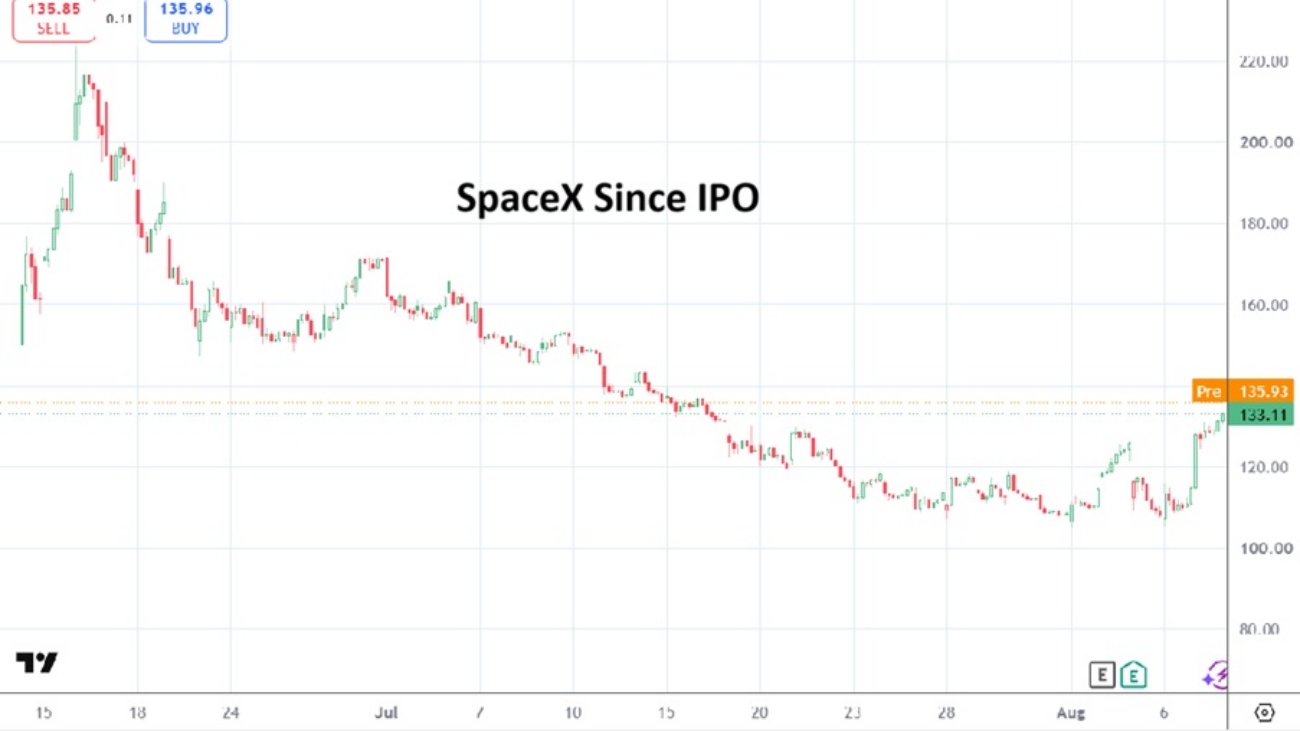
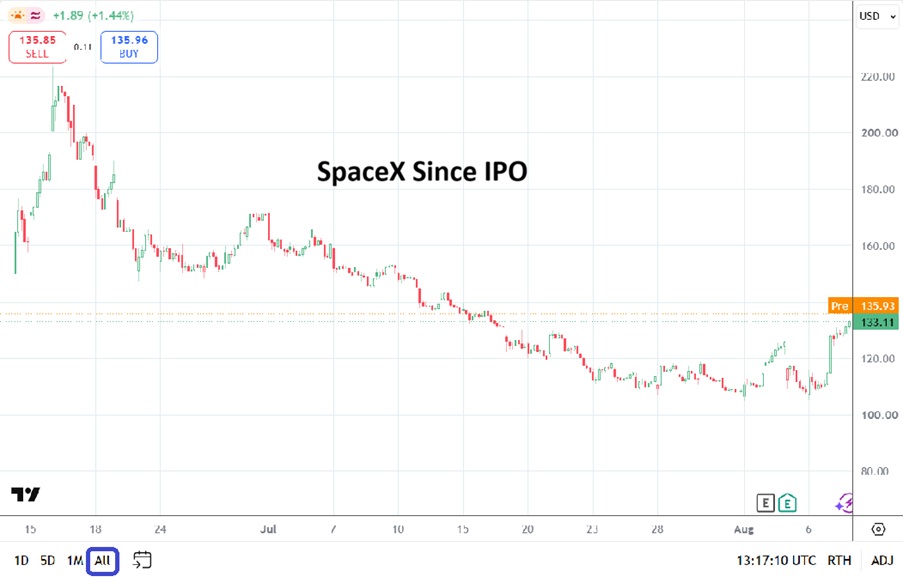
SpaceX (SPCX) Chart Since IPO as of 10 August 2026

That mechanism becomes much more difficult now that SPCX is publicly traded.

A public company has a market price every second of every trading day. Any new equity issuance is immediately visible. Investors know exactly how many shares are being created, at what price, and why the company needs the money. If the market suspects a company is raising capital because its existing operations cannot finance its ambitions, the stock can fall dramatically. And that creates a fundamental difference.

A private company can raise capital at a negotiated valuation. A public company has to raise capital at a market valuation.

The pressure on Musk is mounting. Every quarter he needs to deliver. Every quarter he needs to find a new narrative to prevent the stock price from collapsing.

Let’s imagine SpaceX needs $10 billion funding. When it was private, Musk could potentially raise the money from institutional investors at a valuation agreed upon with those investors. The transaction itself could even reinforce the perception that SpaceX is worth more.

As a public company, however, the calculation is completely different. If SpaceX is trading at a $1.5 trillion valuation and announces a $10 billion equity offering, investors immediately ask why the company needs the money, whether its cash flow is sufficient, and whether further dilution is coming. And if the stock falls 20% following the announcement, the company would have made its financing problem much worse than before.

This problem is particularly critical because SpaceX is a highly capital-intensive business. Its only profit comes from Starlink. But Starlink cannot finance all the other negative-cash-flow businesses by itself, mainly Starship launches and AI ambitions.

Starlink is the only cash-generating asset inside the group, and it cannot become the piggy bank for the entire group, including Tesla.

How can we forget that, earlier this year, SpaceX came to the rescue of Tesla by buying up all the unsold Cybertruck inventory, at hefty margins for Tesla, which then “beat expectations” thanks to the trick?

Would such a move be accepted by the market now that SpaceX is publicly traded?

When SpaceX was private, the boundaries between Musk’s various ventures were much less visible to the public markets. Capital could move through a relatively complicated ecosystem of private companies and investors.

Now that SPCX is public, the shareholders would question every move, knowing that they are not necessarily willing to see their company become a financing vehicle for every project associated with Elon Musk.

With the SpaceX IPO, Elon Musk played his last Ace card. Now he’s left with a handful of weak cards to try to win the game. He can still bluff that he’s got another Ace hidden in his sleeve, but it’s not clear the market will believe him this time.

Private markets gave Musk something extraordinarily valuable: financial flexibility. Public markets are now forcing him to operate without it.

But Elon Musk’s financing problems aren’t limited to the SpaceX IPO. Like any capital-intensive venture, he also has to contend with the Fed’s ill-considered policy of keeping interest rates high, supposedly to fight inflation that stems from supply shocks.

Because of the Fed, every additional percentage point of interest represents billions of dollars transferred from productive investment to debt servicing. Money that could finance AI chips, data centers, engineers, research laboratories, or new factories instead goes to creditors!

The Fed might believe it is fighting inflation, but it is in fact raising the cost of winning the AI race for companies like SpaceX. 

It’s surprising that Elon Musk isn’t openly denouncing the Fed’s absurdity of keeping interest rates high, when his own companies are among those suffering most from it.

SpaceX’s recent $25 billion bond offering is a perfect illustration. The company issued five tranches, including $3.5 billion of senior notes carrying a 6.65% coupon and maturing in 2056. If the Fed’s rate were closer to 2%, the company’s borrowing costs would be at least half their current level. This bond offering is costing SpaceX somewhere around $1.5 billion a year in interest expense, that could have been slashed by half had the Fed acted quickly in reducing interest rates.

And this is precisely where the Fed’s policy becomes relevant to Musk’s financing problem.

High interest rates make borrowing far more expensive for Musk. At the same time, restrictive monetary policy makes investors more demanding about equity valuations and makes long-duration growth stories more vulnerable to changes in discount rates. They also make car loans much more expensive for potential buyers, which significantly affects Tesla sales.

Musk therefore faces a particularly uncomfortable combination: Equity financing is more visible and potentially dilutive. Debt financing is expensive. Private financing is no longer available on the same scale.

The SpaceX IPO, on top of the Fed’s mistake of keeping interest rates high, is putting significant financial stress on the “richest man in the world” as he urgently needs to find new imaginative ways to fund his highly capital-intensive ventures.

And this is without even considering the probability of a 2008-like financial crash triggered by the bursting of the AI bubble. How would Elon Musk manage to sort himself out this time in case of such financial collapse?

Copy and paste the text from AMT that you want to share

Share:
Gold 20260805

Gold Looks Oversold in What Appears to be a Vulnerable Global Market

Quick Thoughts on Why Gold Should Remain a Friend

Did you stop paying attention to Gold after it stumbled from its record highs in late January? Was it no longer interesting because it wasn’t churning like an invincible machine upwards? Is Gold boring because it has produced sluggish results the past half year that doesn’t deliver the daily excitement craved to get you to wager in the marketplace? No, Gold isn’t WTI Crude Oil which has seen increased volume since late February due to the Iranian war and it might be a while before the precious metal regains a full fanbase.

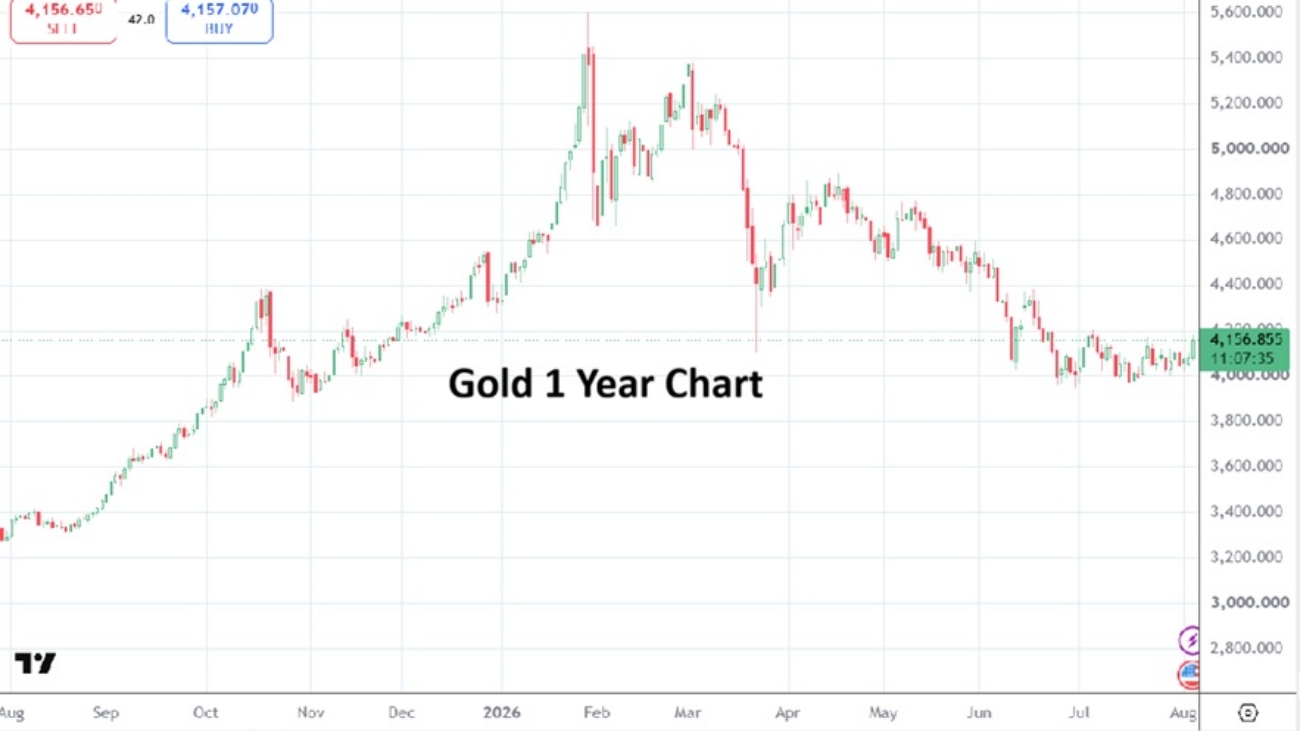
However, Gold still looks to be in oversold territory. Yes, Gold is near $4,150.00 as of this writing and in the middle of July was below $4,000.00. However, given the fragile behavioral sentiment that is being displayed in the global markets, there is a case for Gold being valued higher. Is the momentum produced upwards the past couple of days a signal that large players are starting to eye the commodity again?

Gold touched a high of nearly $5,610.00 on the 29th of January this year. Speculative fever was certainly ripe. Silver was near $120.00 too. Silver is now priced slightly above $61.00. I am not going to make a case for Silver here, so if you are looking for optimistic or speculative guidelines for ‘Argent’ you will not find it here. If you want to see a positive outlook for Gold please read on, and if you decide this means Silver may find another dose of increased pursuit that is your choice. 

Gold One Year Chart as of 5 August 2026

Via a one year chart Gold has lost plenty of value the past six months, but conditions may be turning favorable for the precious metal. Vulnerable sentiment in bonds, equity indices and Forex has grown loud and it might not vanish soon. 

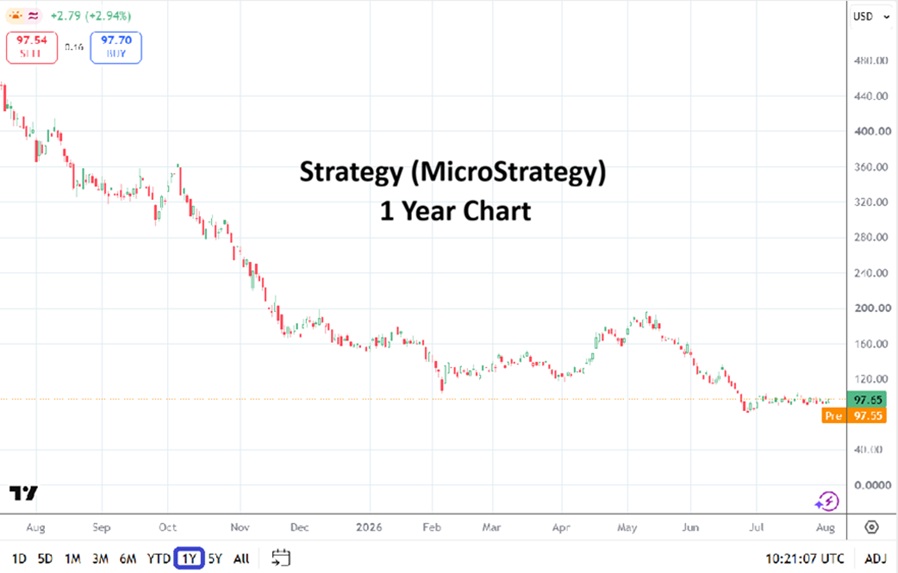
Yes, the Nasdaq 100 is once again back in its higher elements near 29,733.00, and has the 30,000 target lighting up again, but how long will it be before questions about the high cost of data centers, worries about AI revenues come back into vogue? What if interest rate worries continue to cause financial institutions to fear an increase in borrowing costs? What is going to happen if Bitcoin and Strategy (MSTR) implode completely? 

Allow me to say I am not saying Gold will go higher just because BTC/USD and MSTR are imploding, but it will not hurt the case for the precious metal either. Gold looks good because the over all health and sentiment of the marketplace doesn’t look particularly bright. 

If the price of WTI Crude Oil remains within sight of $74.00 and below that will be a positive development regarding inflation concerns, but will it be enough to generate a positive global economy? How will investors react if the Trump administration loses control in the House of Representatives in early November via the mid-term elections?

Strategy (MicroStrategy) One Year Chart as of 5 August 2026

The Case for Gold

Over the past year Gold has turned in a rather remarkable run from a speculative point of view and investment framework. One things stands out, Gold is not going anywhere. It will not disappear suddenly, meaning within the next 100 years and it will still be seen as a store of value. Gold remains a steady unit of secured capital for long-term investors having established a track record the past 3,500 years. Speculators who pursued the run higher, including hedge funds and large players likely lost money as values decreased the past six months, but let’s also note Gold has found rather tight support around its current price point since the middle of June.

Yes, gold lost value after the speculative storm subsided and people turned their wagering attention elsewhere, but the commodities loss of value in the past six months was froth being wiped away from a speculative market in which bulls ran wild.

The Fed may find itself in an increasingly difficult spot with the U.S Treasury reminding the U.S central bank about higher yield provisions. Japan is likely to continue to find it difficult to extricate doubts within financial institutions regarding the JPY. And if investment wheels struggle to produce gains steadily in the asset machines of the stock markets, some folks will turn their mid-term outlooks elsewhere for stability and potential profits.

Gold will continue to shine as it has always done. Fools Gold attracts the ignorant, real Gold attracts those looking to sustain value. I am not saying Gold needs to be $5,000, but Gold looks to be oversold in what feels like an increasingly nervous global market. 

Perhaps that is the risk manager in me taking on the psychological sentiment of nervous investors who do not feel comfortable with the higher yields being seen in U.S Treasuries, the weakness in the USD because of a Fed that many feel lacks clarity or proper policy guidelines, shadows from the Middle East which are unlikely to suddenly disappear even if there is a formal agreement achieved in the near-term…and yes even as Gold has gained the past few days in the midst of the sudden USD slump.

Gold back to the $4,500.00 mark might seem like a farflung wager perhaps, but from a mid-term outlook, one that I wouldn’t be surprised with if it occurs. From a perspective of where things will be within 3 to 6 months I would venture to say Gold should not be lower than it is now. I would be genuinely surprised if it was below $4,000 in November of this year, but would not be surprised if it is touching $4,500 or higher.

Copy and paste the text from AMT that you want to share

Share:
AMT Top 10

AMT Top Ten Miscellaneous Interjections on the 3rd of August

Narrative Storms, Complaints and Observations

10. Mo’ Money: The Los Angeles Dodgers surprised nobody when they acquired Detroit Tiger’s pitcher Tarik Skubol in an effort to solidify their chances of a World Series three-peat. Don’t blame the LA Dodgers for playing by the rules, even if many don’t like the results. Expect a MLB strike in the coming year when owners try to change the salary structure in baseball.

9. Staggered: SpaceX is below $110.00 as trading gets set to begin today. Financial institutions are likely bracing for the open window that begins the 6th of August via a large amount of unblocked initial equity from pre-IPO shareholding that will soon be given freedom to sell. 

AMT Top 10 Miscellaneous Interjections on the 3rd of August 2026

8. Fidel Castro: Mayor Mamdani and a gang of other U.S utopian (and sometimes bigoted) politicians continue to make headway. Authoritarian failures like Venezuela and Cuba are prime examples of the paradise offered to U.S voters who lean left for the coming mid-term elections.

7. Takeover: Citadel’s takeover of Situational Awareness – which seems to have proven it had none – this past week in the wake of multi-billion dollars of losses has put Leopold Aschenbrenner’s smirk on hold for the moment. Have no fear fans, Aschenbrenner is likely to land on his feet and extol his methods once again to those who love leveraged speculative ventures while embracing unproven hedge fund saints.

6. Fragile: The VIX Index appears asleep as it remains a hair under 16 as it measures the volatility of  the S&P 500 Index’s options. 10-Year U.S Treasury yields are around 4.68% and within sight of apex highs. The Nasdaq 100 futures are higher as of this writing as the cash market and a full week of trading awaits, having finished Friday’s session at 28,274. 

5. Anthony Fauci: Takes the Fifth and now hopes his pardon covers contempt.

4. Bitcoin: BTC/USD is near $62,850 in the wake of confirmed cold storage hacks via a generated random prediction onslaught using AI against Coldcard hardware. In other bad news Strategy’s MSTR value is around $93.35. And, yes, Michael Saylor has reportedly whispered he is thinking about buying more BTC soon. The ship appears to be sinking folks.

3. $80.00: WTI Crude Oil has shown price velocity lower today again, this after another flip-flop in behavioral sentiment was sparked by the announcement this weekend of a ‘rough framework’ agreed upon by Iran and the U.S. The Strait of Hormuz is seemingly quiet for the moment. At this point WTI Crude Oil price reversals are beginning to look like a well practiced dance routine. What will the next steps look like?

2. Forex Freakout: USD/JPY traders are listening to a myriad of narratives regarding the BoJ’s intervention. All experienced large players in the USD/JPY had to know an intervention was coming. While folks are pointing to the N.Y Fed and U.S Treasury selling of positions to bolster the JPY last week, they apparently need to be reminded the Treasury had the N.Y Fed start preparing the groundwork for such maneuvers earlier this year with steps including the ability to check on and counter USD/JPY Forex rates in January. 

While folks are accusing the Fed/Treasury of hurting the USD, they should note the move is to counter weaker JPY which Treasury Secretary Scott Bessent likely had been pressed by ‘higher ups’ to manage in order to make sure Japanese products didn’t become too cheap in the States. There had been at least two other interventions in the past handful of months from the BoJ, as of this writing the USD/JPY is near 156.600.

1. Unilateral: President Trump’s decision making has become bewildering entertainment as he practices a comedic like opera trying to convince people about his opinions which he seems to change relentlessly. President Trump should learn the Art of Sparse Talking. Will the Republicans harness the President after the mid-term elections?

Copy and paste the text from AMT that you want to share

Share:
Indian Rupee 20260729

India Insider: Real Story Behind the Rupee’s Weakness

Change of Policy Could Create a Stronger INR

RBI Governor Sanjay Malhotra says, Rupee depreciation doesn’t reflect weaknesses in the underlying economy. He says that the external factors due to geopolitical tensions induced by oil prices rising has created a Dollar demand and created Rupee weakness. 

While it’s true the Rupee has depreciated because of foreign capital fleeing and oil importers’ persistent demand for USD when buying oil and gas, this doesn’t answer the entire issue regarding INR vulnerability.

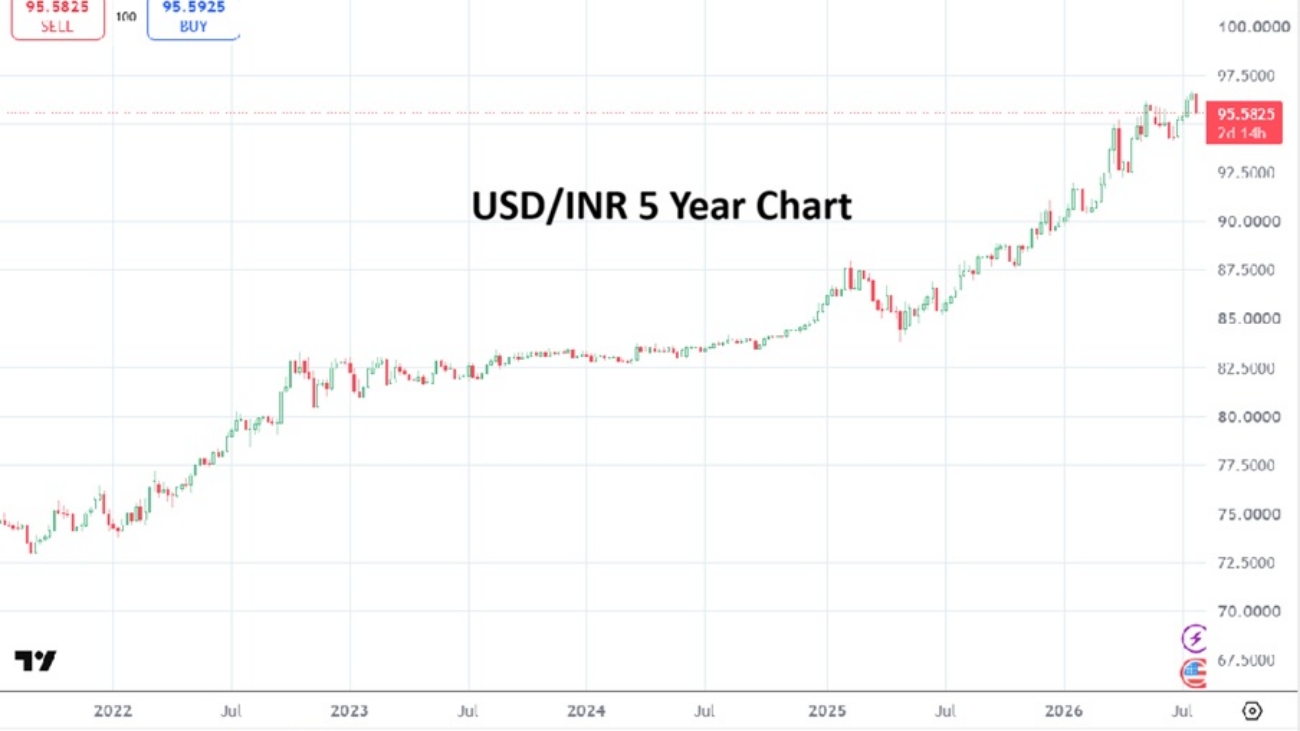
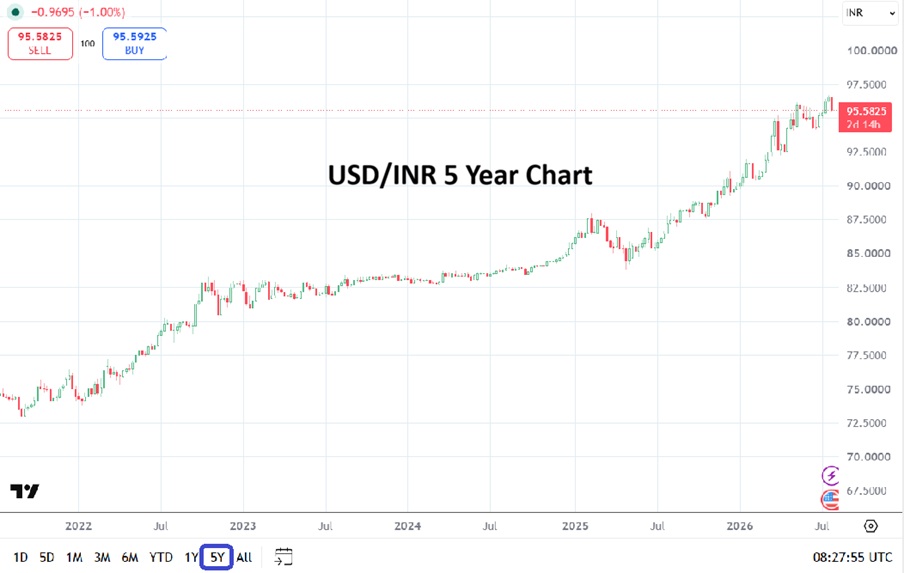
Questions surrounding the Rupee’s weakness should also focus on fundamental causes for depreciation. For instance, the Rupee has largely depreciated the past 5 years from 2021 – from 74.50 per Dollar – and into 2026, where its trading around 95.72 per the USD/INR now. Why?

USD/INR Five Year Chart as of 29 July 2026

Nominal depreciation has been 28%, and this is despite service exports growing healthier, and remittances flows that have been good in the last few years. Can the RBI governor say anything related to it?

Why Does the Rupee Remain Weak?

Economists point to the widening gap between India’s foreign inflows and outflows as a structural flaw that’s weighed on the Rupee and growth. A reason for this is India’s struggle to attract long-term capital through Foreign Direct Investment. Net FDI has declined from $28 billion in 2022-23 year to just $7.7 billion in the financial year that ended in March.

Foreign multinationals, venture capitalists and private equity titans have been taking advantage of high valuations to cash out. Despite recent pro-business reforms by Narendra Modi’s government, India’s shabby infrastructure and a bureaucracy that reduces Byzantium schemes to shame, puts off new arrivals. This is also a reason why tradable exports are not growing compared to India’s vast import needs. India’s exchange rate remains relatively overvalued, even though in purchasing power parity (PPP) terms, Indian products are inexpensive compared with those of the United States.

India could have allowed the Rupee to reflect it’s underlying market fundamentals in order to make it’s exports more competitive and restore external balance. Given the high supply of skilled India’s labor force and opportunities in small and medium scale businesses, especially in agricultural value added products where India holds competitive advantages, it’s not impossible to improve tradable export volumes. Instead, the Reserve Bank of India went in the opposite direction by managing the Rupee at 83/USD and made it overvalued, especially when Shaktikanda Das was the Governor of RBI.

If the RBI truly believes in India’s economic fundamentals story, then why did it intervene aggressively during the 2023-2024 period? Critics argued these known interventions may also have had the effect of supporting India’s GDP when measured in USD, although the RBI maintains that its objective was to reduce excessive volatility and preserve financial stability.

Even with respect to headline GDP growth numbers, many economists in India and around the world still believe that Indian statistical numbers overstate the actual strength of the underlying economy. To generate better growth data in India, the government has expanded it capital expenditures to compensate against relatively weak private investment. However, creating jobs and opportunities for linkages – opportunities in sector related industries, and enhancing India’s trade competitiveness via high value exports are important and urgent, rather than depending on foreign capital flows. In this regard, private capital expenditures still need to increase substantially.

Relying on short term capital flows for managing the current account deficit is a difficult strategy. Even if the RBI believes a de-escalation in the US and Iran War will occur, and believes that global liquidity conditions will allow the RBI to accumulate higher Forex reserves, risks remain skewed negatively to the upside without meaningful changes to improve long-term net Foreign Direct Investment.

David Lubin of Chatham House argues that countries should not rely only on high Forex reserves to protect themselves from volatile capital flows. The best strategy in his view is to reduce the potential problems at its source by discouraging unstable, short term inflows, and ensuring banks do not accumulate excessive foreign currency risks.

However, this is exactly what India is doing by mobilizing leveraged foreign currency deposits from non-resident Indian’s and offering hedging for these inflows until September 2026. Reserve Bank of India Governor Malhotra has stated that the RBI has attracted around $32 billion worth of USD inflows via this route.

Arguably, another side of the equation should be examined. If central banks were to accumulate FX reserves for the sake of paying for their imports, without meaningful reforms in their own economy and not creating conditions for capital to be deposited long-term, no capital controls can ably solve the underlying deficits or surplus nature for those respective economies.

In India capital account surplus has created deficits because the net Foreign Direct Investment has been weak resulting in funding costs for transactions in current accounts to increase. Apparently, this dilemma goes beyond the RBI balance sheet capabilities and exposes flaws in the fundamental reality of economic internal policies. The ensuing crisis hits the Rupee faster as capital leaves and damages the exchange rate.

Copy and paste the text from AMT that you want to share

Share:
10Y Treasury Yields 20260728

Thoughts on Kevin Warsh, the Fed and USD, Energy, Nasdaq 100, USD/JPY and Bitcoin

Fed’s Rate Announcement Tomorrow and Underlying Market Conditions as Folks Talk

Tomorrow’s FOMC rate decision from the Federal Reserve continues to cause some angst in the investment community as folks try to decipher Fed Chairman Kevin Warsh’s disdain for tea leaf reading. What is being missed by seemingly a lot of the crowd is the open signal from Warsh that he prefers to keep his outlooks rather muted, this because he appears to be focused on the mid and long-term economic picture.

Simply put, I do not think the Federal Reserve is going to raise interest rates tomorrow, nor will the Fed Chair give too much indication about his thoughts for mid-September. It might be stated in the Fed Press Conference afterwards that the costs of energy is being watched, but that is too obvious. Count on it being recorded that the Federal Reserve will watch data and react accordingly. In the meantime, financial institutions may demonstrate volatile overplayed USD centric positions which look overbought looking into the mid-term, as they still worry about the near-term.

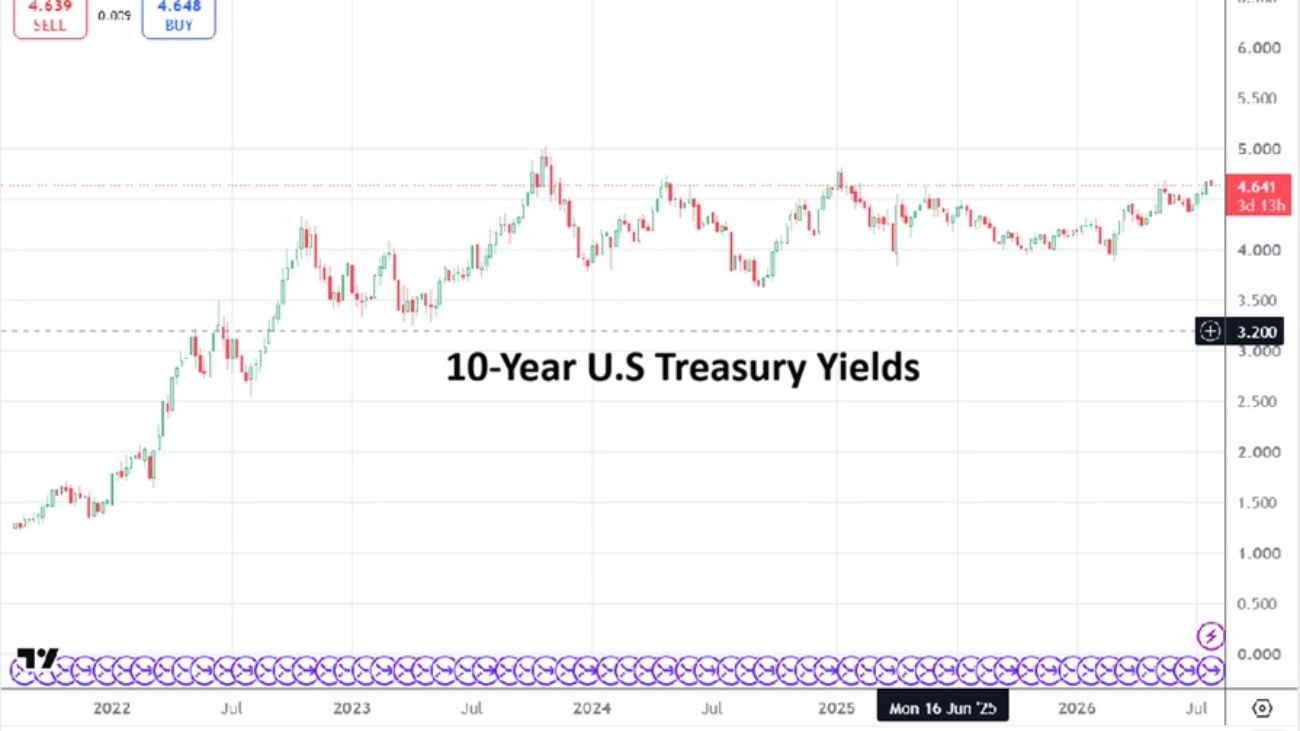
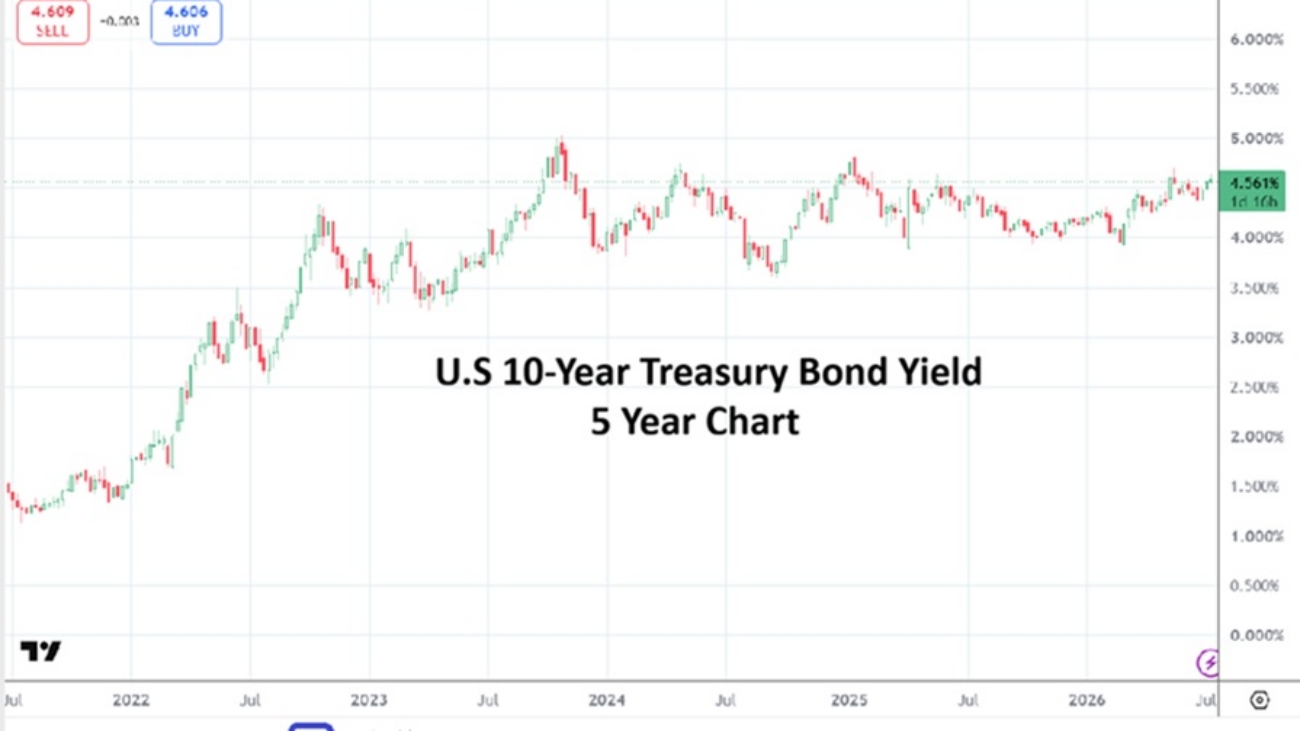
10-Year U.S Treasury Yields Five Year Chart as of 28 July 2026

Political Questions and the Cost of Energy as the Fed Reacts

Let’s for a moment dive into politics. Does anyone think that Kevin Warsh doesn’t speak to Treasury Secretary Scott Bessent who has been a long-time associate? And does anyone think Bessent doesn’t have the constant voice of President Donald Trump in his ear? 

The mid-term elections are nearing ladies and gentlemen. The de-escalation in the Iranian situation certainly has something to do with nations expressing wishes for less military action to the White House. Israel, the UAE, Kuwait, Bahrain, Iraq, Qatar, Saudi Arabia, Pakistan and Turkey are trying to influence positions as President Trump considers his next moves regarding alliances and resources. However, the situation may have something to do with the price of WTI Crude Oil too and its effect on U.S manufacturing and surprise, surprise the Federal Reserve. 

Does anyone else remember that the last de-escalation also started just before the Federal Reserve’s last FOMC meeting in June? I am not being a conspiracy fanatic, just pointing out that lower WTI Crude Oil prices do help the case for a Fed outlook which looks at the costs of energy in a pro-active manner, one which might include the U.S economy and internal White House discussions with politicians who represent voters who have the power of creating a backlash. Lower interest rates equate into lower borrowing costs for consumers.

The Fed’s Impact on Equities and Forex (and the USD/JPY)

So if the Fed does not raise tomorrow, nor gives an indication of what it will do in September and offers a stance of ‘we are vigilant and will watch the economy’ will that help sentiment on the Nasdaq 100 which is starting to have the look of a patient with a bad cold who can’t quite seem to get rid of a cough? Microsoft and Meta step into the limelight tomorrow with earnings reports, Amazon and Apple follow on Thursday.  The combination of the Fed and important quarterly earnings will impact Nasdaq sentiment and other equity indices.

It appears analysts of financial institutions are starting to discuss CAPEX – capital and expenditures – openly. And this is creating shadows as investors weigh the costs of energy and infrastructure against stated profit projections. However, let’s not throw the baby out with the bath water, the Nasdaq 100 has a gain of 20%+ over the past year (July to July), and since March the index has still gained 12%+. The war in Iran (excuse me, conflict) has not had a meaningful impact it appears on the outcome of the Nasdaq 100 via sentiment generated. But the shadow of expenditures, debt and revenue is getting louder bandwidth and speculators need to remain cautious in the indices.

Back to the Fed and Forex, the USD has been strong, you are allowed to say extremely strong if you have been betting on downside incorrectly. The USD/JPY is almost in nosebleed terrain, currently 163.830. The Bank of Japan will announce their interest rate policy very early Friday (for those of us not in Asia) and let’s see if the ‘independent’ Bank of Japan is taking a cue from their government which is clearly interested in continuing to build stronger export ratios. Has the Bank of Japan given up the so-called stated fight to keep the JPY within a solid stance? This is doubtful externally, and Japan is certainly not going to allow the USD/JPY to traverse wildly higher, but it may not consider the 165.000 mark as the end of the world. Beware of saber-rattling from the BoJ in the coming days.

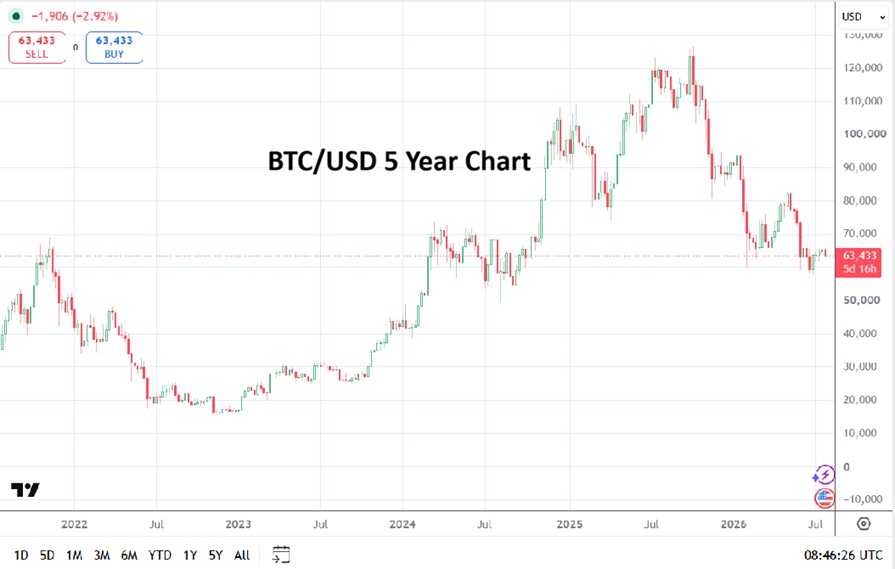
Bitcoin Five Year Chart as of 28 July 2026

Doubts and Remarks Regarding Bitcoin Below $64K

On a last note, the world of cryptocurrency remains interesting and stormy. It appears from watching the awkward statements from influencers and crypto (including Bitcoin) media outlets the past couple of months, as they attempt to explain their pain and convince others that everyone should buy at these lower values that more troubles are coming. 

What are the influencers, crypto media’s and importantly financial institutions’ actual skin in the game relative to those who have lost interest in Bitcoin and the digital market worth? Are influencers and large institutions like BlackRock hoping to pawn off their suffering ‘asset’ holdings to the public, while trying to convince us that today’s cheap prices represent buying opportunities? Is the wave of slanted influence and panic-like banner waving a hope to save themselves in order to cash out of a sinking market, this while hoping someone else takes their place in lifeboats that face a difficult voyage to safe harbors? 

BTC/USD is near $63,4000 now. Yes, we know, we have been told plenty of times before that all the Bitcoin winters eventually turn into summer again. Blossoms will create the sweet scent of profit we are assured, but what if the winter becomes an ice age? What if Michael Saylor and his ability to produce complex financial statements and instruments for MicroStrategy and Strategy equity shares continue to make little mathematical sense? What if all the investors into Bitcoin and cryptocurrencies are left holding the bag and find themselves covered by permafrost? The tundra currently looks harsh. Will the Bitcoin crowd who has been so adamant about being free of regulatory controls and mismanaged central banks cry openly for bailouts from the U.S Treasury with USD? Now that would be entertaining.

Copy and paste the text from AMT that you want to share

Alphabet 20260724

The Not So Coincidental World of Google and WTI Crude Oil

Energy and Commodities in a World Where Legacy and Infrastructure Collide

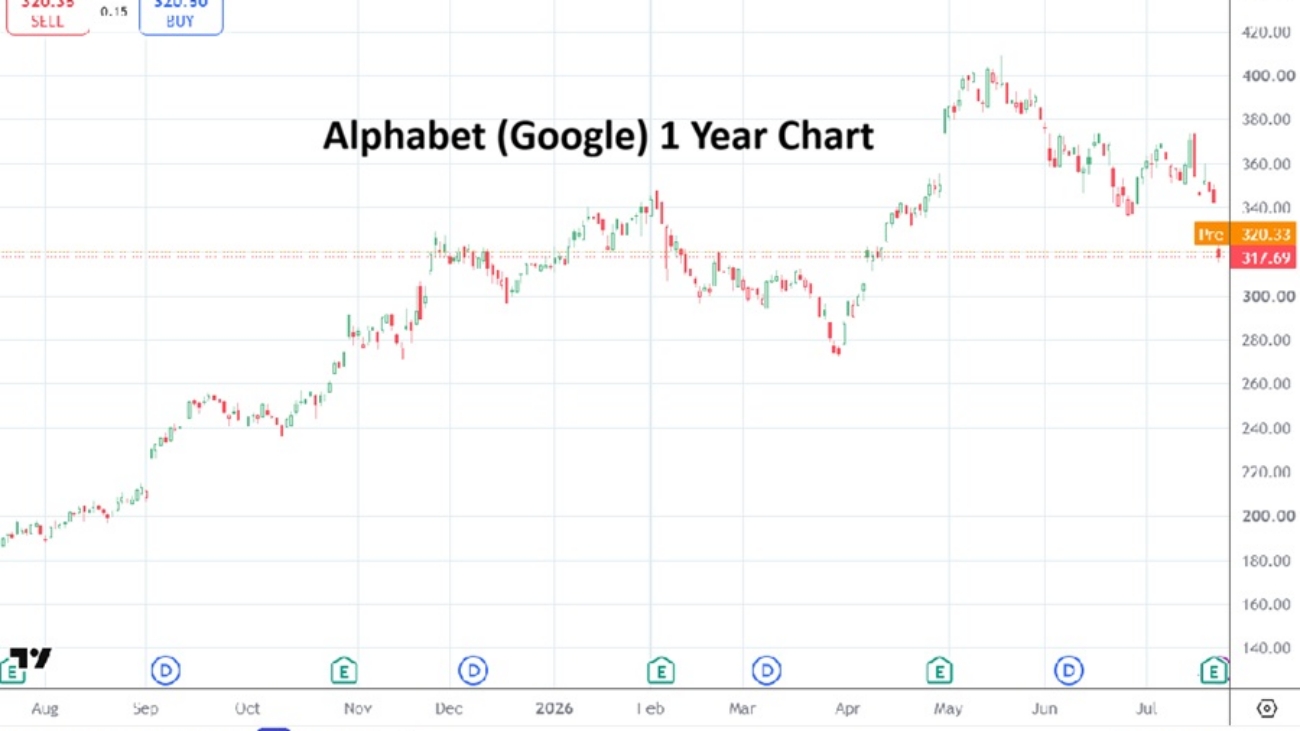
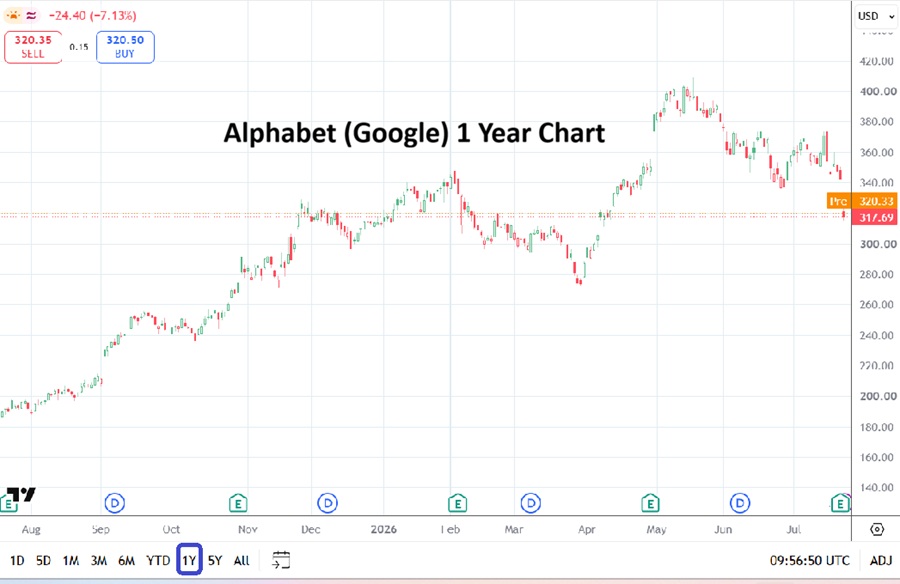
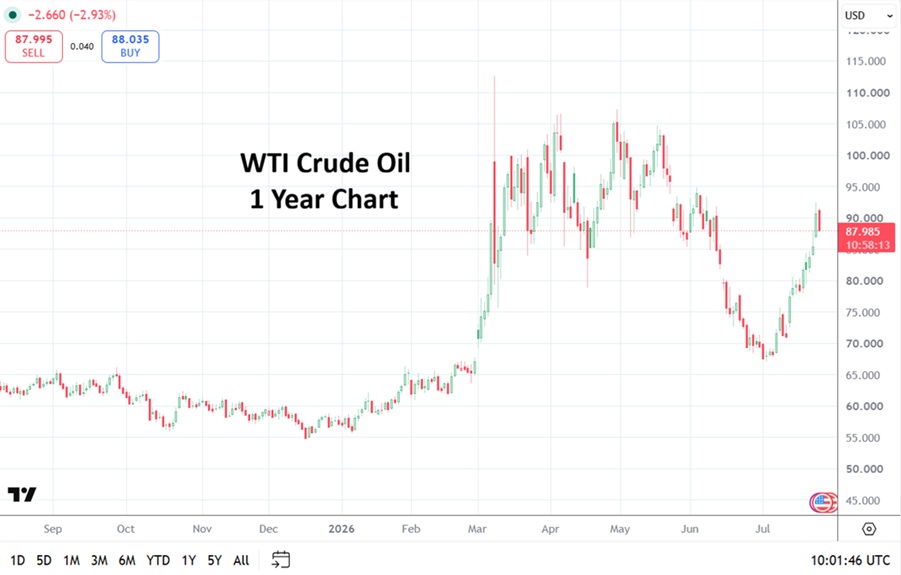
Google (Alphabet) finished yesterday’s trading near $ 317.69, as of this moment WTI Crude Oil is around $88.50. It might seem rather odd to pair the two into the same paragraph, but this is not a coincidence. Both are now relevant regarding energy costs for consumers and produce an abundance of legacy products the world over. And oddly enough their one year charts almost look as if they are dancing in step.

Google is facing headwinds in recent trading as questions surround its capability to produce revenues because of its push into Artificial Intelligence and always growing need for more data center power. AI which has been an abundant source of bullishness in the Nasdaq 100 and had a knock-on effect into the S&P 500 the past couple of years has become shadowed by concerns of turning into a commodity. 

Alphabet (Google) One Year Chart as of 24 July 2026

As competition in the AI sector increases this is creating pressure on prices in order to allure customers away from competing brands. China is also stepping into the world of Artificial Intelligence and it will certainly use its ability to produce less expensive products moving forward. Profit margins are being fought over by competing companies

Google is not a poor company, but there are growing doubts about its debt and revenue ratios. The costs to power its worldwide data ability for its users and its investment into AI via Gemini and its DeepMind technology does not have a particularly easy solution. Estimates from a variety of sources claim that Google has reduced its staff between 1,500 to 3,000 through employee reductions and reorganization, this as the company needs to pile more cash into infrastructure.

The onslaught of other companies able to produce AI which is seen as more robust and capable have also caused a marketing headache for Google, which has an effect on behavioral sentiment. GOOGL was trading at apex levels only two months ago when it was traversing above the $400.00 mark. The downturn thus far has been bad, but not catastrophic. 

WTI Crude Oil One Year Chart as of 24 July 2026

While nervous sentiment can be blamed on the situation in the Middle East the past handful of months, the downturn which has occurred for Google and other important companies on the Nasdaq 100 involved or seen as having an ancillary association with AI needs to be considered a legitimate reaction because of worries surfacing regarding the ability to simply pay for all of the research and infrastructure. 

In order to power AI it is becoming clear that energy costs are part of investing frameworks. Concerns about an AI bubble started to gather an audience last fall and the rumblings have grown louder, yet it can be said the ability of Google and many other companies to gain the past year in value still outweighs this current downturn experienced the past couple of months.

The Iranian war which is ongoing, appears to be entering a phase in which financial institutions are having to succumb to the notion of higher prices not only for WTI Crude Oil but other energy resources with a mid-term viewpoint. While there is abundant supply of Crude Oil worldwide, the current problems surrounding navigation and logistics are causing pandemonium in a consistent manner via WTI’s price as Middle East nations try to ship to their clients. This is causing many Asian nations to look elsewhere for their energy, Brazil has seen an increase in orders. And because of the upwards trend in fuel costs again, the Federal Reserve will have to look hard at inflation data and play a game of interest rate mania, which investors will have to calculate into their outlooks regarding debt ratios.

What does this have to do with Google and AI?

People like nations will search for the easiest and most cost efficient pathway to access their needs. Anthropic, OpenAI, Kimi K3, Microsoft Copilot, DeepBlue Technology, Meta, Sakana AI, IBM, Nvidia are only some of the companies involved in sourcing software and providing hardware to users. Many nations are involved in this AI chase and understand the importance of cybersecurity, data sharing and the problems surrounding the costs to power all of these machines.

Many of these companies above including Google are searching for a holy grail via energy supply and discussing the financing and building of energy infrastructure including nuclear capabilities. But as Google and other companies search for more energy to fuel their dependence on powering their systems for clients, they continue to be confronted by a growing wave which will eventually drown some of the companies in debt that they will not be able to recover from.

I am not forecasting an apocalypse, but I am suggesting not all of these companies which we think of as part of our everyday lives will survive this fight. Legacy companies eventually parish, just like many start ups. The realization that many companies are merely providing what the public is starting to see as necessity is a simple competitive evolution. BlackBerry, Nokia and Motorola are examples of giants falling.

It appears many investors are starting to ask hard questions about costs compared to future earnings in AI. The allure of the next big thing, which AI has been part of the past couple of years, is running into well-practiced investment cycle as froth erodes and financial institutions start to look at the accounting of the companies they are being asked to consider as long-term endeavors. Not all that glitters is gold will certainly start to create a patina on many of the so-called AI companies as they are forced to prove their worth as suppliers of a commodity.

The AI world has run into the time honored financial realization that many exotic tastes soon turn into another form of vanilla. The next big thing is always being anticipated and hoping to attract the deep pockets of investors. Certainly many of the big companies including Google are going to survive the current headwinds. but real profits could become harder to attain. Investors and speculators should not be surprised that reality has a tendency to reduce momentum.  Entropy is part of the investment world, investors and speculators always have to be ready for new disruptions and systems to emerge.

Copy and paste the text from AMT that you want to share

Iceburg Rose 20260722

India Insider: What Do Rural Areas Say About the Nation’s Fast Growing Economy?

Reflections on a Disappearing Workforce and a Long-Term Strategy

Tamil Nadu is one of the fastest growing States in India with an impressive Gross State Domestic Product result of 11.9% in financial year 2024-2025. Despite the former Dravida Munnetra Kazhagam’s (DMK) government being unseated by the new party Tamilaga Vettri Kazhagam’s (TVK) in State elections recently, Tamil Nadu has continued to attract billions of USD. Automobiles, information technology (IT), electronics, and high-end engineering from global investors continues to be alluring.

As a student of economics, I have looked at and questioned how far this growth has helped raise wages and create jobs. In other words, will these investments help create linkages across the Tamil Nadu economy and generate deeper opportunities? Tamil Nadu may have higher GDP growth than any other State economy in India, but its growth is highly skewed towards a relatively small number of sectors.

India Insider: What Do Rural Areas Say About the Nation’s Fast Growing Economy?

As noted, some of these sectors that attract investment generate high output, but employ a relatively small share of the workforce. As a result the gains are not spread evenly across the labor force.

Since the informal workforce constitutes a large share of employment in Tamil Nadu, many companies rely on contract labor that has created limited individual bargaining power. This is evident in many automobile, textile, and mobile phone assembly plants in Chennai. 

I knew a friend who worked in a mobile phone assembly plant in 2019 and despite completing a Bachelor of Engineering degree, he earned only around USD 150 per month. Since employees have weaker bargaining power, wages do not rise even as inflation increases every year. 

Many people leave these companies within one or two years. However, companies do now worry, because these firms can recruit replacements because the supply of educated workers remains high relative to demand. Tamil Nadu produces a higher number of graduates every year, and it knocks down the wage bargaining power of workers, allowing the formal economy to employ a multitude of people without having to raise wages

In the 1990’s these conditions weren’t prominent because there were fewer people who had accomplished university studies and graduation. Getting into the formal economy became easier and capital started to flow after the end of the License Raj era controls in 1991, this when India opened up it’s economy for foreign direct investment.

In the last two decades, Tamil Nadu’s industrialization has become heavily concentrated in cities such as Hosur, Chennai, Tiruppur and Coimbatore. Despite strong outbound trade, the State records an overall trade deficit. This also means some districts are performing well, while others remain heavily dependent on agriculture or services to generate Gross District Domestic Product (GDDP).

Pudukkottai District as a Case Study

I was doing some field surveys in Pudukkottai district, especially in the town and surrounding rural areas. And since we have no clear up-to-date Census numbers, we have to rely on the 2011 Census to understand the composition of Pudukkottai district’s economy.

According to the 2011 Census, Pudukkottai district is heavily dependent on agriculture, accounting for roughly 45–55% of employment. An important parameter to examine in the next Census will be whether this composition has changed.

Because the census is not giving us clear answers, we need to conduct random surveys across multiple villages to understand the reality. And during my visits around Pudukkottai, I consistently saw people mainly below the age of 20 and above the age of 50. Why?

This was the case in numerous villages around Pudukkottai. Still, we need stronger evidence. I repeated this exercise across different time periods to understand whether the pattern remained the same. The result was remarkably similar regarding ages.

Interestingly, the predominant working age population of India – between 25 and 40 years old – is largely absent from villages and even from Pudukkottai town, although I did see some from this age group employed in the service sector.

Where Did These Missing Workers Go?

The single reason lies in Pudukkottai district’s relatively high agricultural productivity. Since the service sector accounts for only around 30–35% of employment, the district still relies heavily on agriculture and allied activities for income generation.

That model has weakened over the last fifteen years. Lack of small scale manufacturing industries has crippled employment opportunities. Unlike Coimbatore or Tiruppur, Pudukkottai has attracted relatively few large manufacturing or technology investments. Economic growth has therefore remained dependent on agriculture, small businesses, and government employment.

Another important aspect is that many small businesses in the service sector are struggling or have closed altogether in Pudukkottai compared to 2016 because of weak local consumption. This is because people are migrating. That is clearly visible, and businesses cannot survive without a sufficient working age population. While Pudukkottai’s district’s population may have grown, much of the increase may have occurred in rural areas and been offset by outward migration of working age adults to Chennai, Bengaluru, Singapore, Malaysia, the Gulf countries and other employment centers.

The difference is also reflected in income levels. Recent district estimates place Coimbatore district per capita income at around ₹4.1 lakh, while Pudukkottai’s is approximately ₹2.4 lakh. The gap reflects differences in industrialization, labor productivity, and the availability of high value employment rather than population alone.

The next Population Census and the Periodic Labor Force Survey (PLFS) will be important in determining whether outward migration and changes in employment composition support these observations. Indicators such as graduate unemployment, labor force participation, regular salaried employment, and sector wise employment will provide a clearer picture of whether Tamil Nadu’s growth is creating quality jobs.

Limited industrial growth will become a much bigger challenge for Tamil Nadu over the coming years if unemployment among educated youth continues to remain high. Pudukkottai district is a classic example of that challenge.

India’s fast growing economy needs proactive business policies in small towns, together with the infrastructure needed to attract manufacturing and private investment. Depending primarily on IT hubs or remittances from the Gulf and Southeast Asia is not a sustainable long-term strategy.

Copy and paste the text from AMT that you want to share

10Y US Treasury Yield 20260716

Why the U.S Fed Should Lower Interest Rates Closer to 2%

Fighting Inflation with Higher Interest Rates is Totally Counterproductive

For nearly a century, central banks have relied on one dominant prescription to fight inflation: raise interest rates. The theory is straightforward. Higher borrowing costs discourage spending and investment, reducing demand and eventually slowing price increases.

While this approach may have worked reasonably well in the past, today’s economy is fundamentally different. Applying the same monetary formula developed in the past century by Irving Fisher is obviously creating more problems than it solves. In many cases, raising interest rates has become a counterproductive way to fight inflation.

  • The first and most obvious consequence is the impact on government finances. As interest rates rise, the U.S. Treasury must refinance its enormous public debt at increasingly expensive rates. The result is an explosion in annual interest payments, which now exceed $1 trillion. Those payments are in fact a direct injection of additional liquidity into the economy while simultaneously widening the federal deficit.

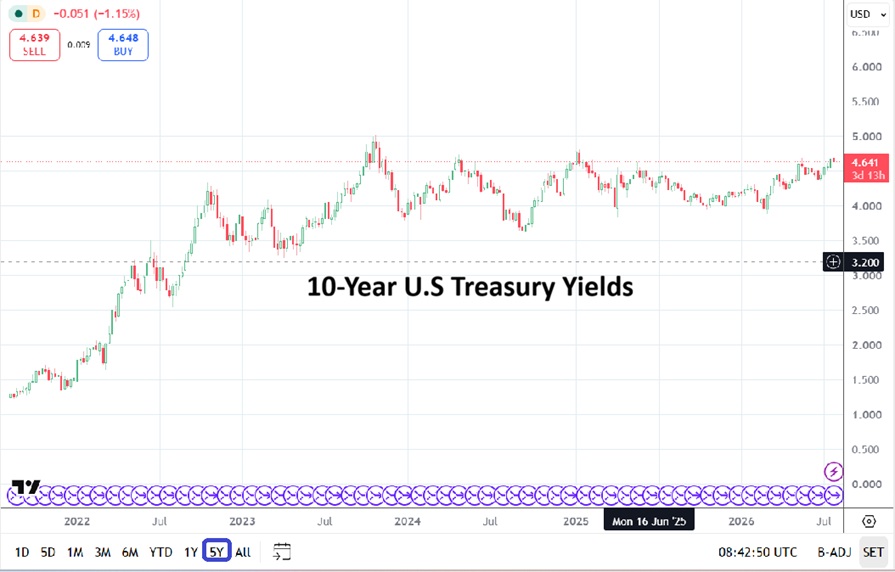
U.S 10-Y Treasury Yields Five Year Chart as of 16th of July 2026

Ironically, a policy designed to reduce inflation is contributing to larger government spending through higher debt-servicing costs. Instead of easing inflationary pressures, excessively high interest rates may actually reinforce them through this fiscal channel.

  • Consumers also bear a heavy burden. Modern households depend far more on credit than previous generations. Credit cards, auto loans, and consumer financing have become an integral part of everyday life. When the Federal Reserve raises interest rates, millions of Americans see the interest on their credit card balances climb to 20% or more.

Many families attribute their declining purchasing power entirely to inflation, when in reality a significant portion of the financial pressure comes from soaring interest payments.

  • Businesses suffer as well. Higher interest rates increase the cost of financing, while the same capital could be dedicated to investment, expansion, innovation, and research. Every additional dollar spent on interest is a dollar that cannot be invested in productive activity.

A recent example is SpaceX, which issued debt carrying a yield of approximately 6.65%. Given the company’s negative cash flow, investors naturally require a risk premium. However, if the Federal Reserve’s policy rate were closer to 2% rather than current levels, the company’s borrowing costs would be at least half their current level. The extra interest payments would instead be directed toward research, development, hiring, that would strengthen long-term economic growth.

In the current race for AI, that requires heavy investments, the Fed should lower the financing burden on U.S companies. Every additional percentage point of interest represents billions of dollars transferred from productive investment to debt servicing. Money that could finance AI chips, data centers, engineers, research laboratories or new factories instead goes to creditors.

The U.S cannot simultaneously declare China its principal strategic competitor while maintaining a monetary policy that systematically makes capital more expensive for American businesses than for their Chinese rivals, that benefit from much lower rates. The Fed may intend to fight inflation, but it is also making it more costly for American companies to invest in the industries that will determine economic leadership over the decade. The Fed may believe it is fighting inflation, but it is simultaneously increasing the cost of winning the AI race.

Perhaps the greatest weakness of relying on high interest rates is that much of today’s inflation originates from supply-side shocks that monetary policy simply cannot fix.

How does raising interest rates reduce the price of oil when energy prices are driven by geopolitical tensions such as the war with Iran?

How does raising interest rates lower egg prices when shortages stem from productivity issues in the poultry industry?

How does raising interest rates lower the prices of wheat, corn, or cocoa when inflation is due to droughts, floods, or other climate-related events?

How does it reduce insurance premiums that are rising because natural disasters have become more frequent and more costly?

In each of these cases, higher interest rates are totally inefficient to address the underlying cause of inflation. Instead, they merely increase financing costs across the economy while leaving supply constraints largely unchanged.

A more effective strategy would be to fight inflation where it actually originates. Governments possess fiscal tools that can be deployed with much greater precision than broad monetary tightening. Temporary subsidies, targeted tax relief, incentives for increased production, strategic investment in critical industries, and, in exceptional circumstances, carefully designed price controls can address specific inflationary pressures without unnecessarily slowing the entire economy.

For example, if geopolitical tensions cause oil prices to spike, temporarily subsidizing fuel or reducing fuel taxes is likely to be a far more direct and effective response than raising interest rates across the entire economy. Similarly, boosting domestic agricultural production is a better solution to food inflation than making mortgages, business loans, and credit cards more expensive.

The Fed should therefore focus on reducing the financing burden on both the federal government and the private sector. Maintaining interest rates closer to 2% would significantly lower debt-servicing costs, support productive investment, and allow fiscal authorities to intervene more effectively with targeted measures when inflation arises from specific sectors.

The doctrine of fighting inflation through higher interest rates was developed by Irving Fisher nearly a century ago, in an era with very different financial institutions, consumer behavior, and sources of inflation. Credit cards did not exist. Household debt was far lower. Global supply chains, geopolitical energy shocks, and climate-related disruptions were not defining features of inflation.

The modern economy requires modern solutions. Rather than relying almost exclusively on higher interest rates, policymakers should recognize that today’s inflation often demands targeted fiscal responses. Persisting with an outdated monetary framework risks imposing unnecessary costs on governments, businesses, and households while failing to address the real drivers of rising prices.

Supporters of high interest rates often argue that they are unavoidable whenever inflation rises. Yet international experience suggests otherwise.

Switzerland has repeatedly maintained policy interest rates close to 1%, or even below zero in previous years, despite being exposed to many of the same global shocks affecting other economies. Switzerland imports energy, is affected by fluctuations in oil prices, and faces the same geopolitical uncertainties. Yet the Swiss National Bank has generally preferred to tolerate modest inflation rather than impose unnecessarily high financing costs on households, businesses, and the government.

This illustrates an important principle: not every inflation shock requires an aggressive monetary response. When inflation is primarily imported through energy prices or supply-chain disruptions, forcing the entire economy to pay dramatically higher borrowing costs creates more economic damage than the inflation itself.

Copy and paste the text from AMT that you want to share