Bitcoin 20260730

Debunking Bitcoin Lies

The Paradox, Absurdity, Lies and Myths of Bitcoin

They say it’s an “asset”… but it has zero assets.

They say it’s decentralized… but the large majority of all transactions go through trading platforms.

They say it’s digital gold… but it has none of the physical attributes gold derives its value.

They say it’s immune to censorship… but countries like the US and China manage to be the largest holders without buying any Bitcoin.

They say it’s scarce… but there are 2.1 quadrillion Satoshi units that act exactly like a Bitcoin unit.

They say it’s a store of value… but it has witnessed several -50% to -80% drawdowns in its short history.

They say it derives its value from energy… but energy is a massive cost that someone has to pay!
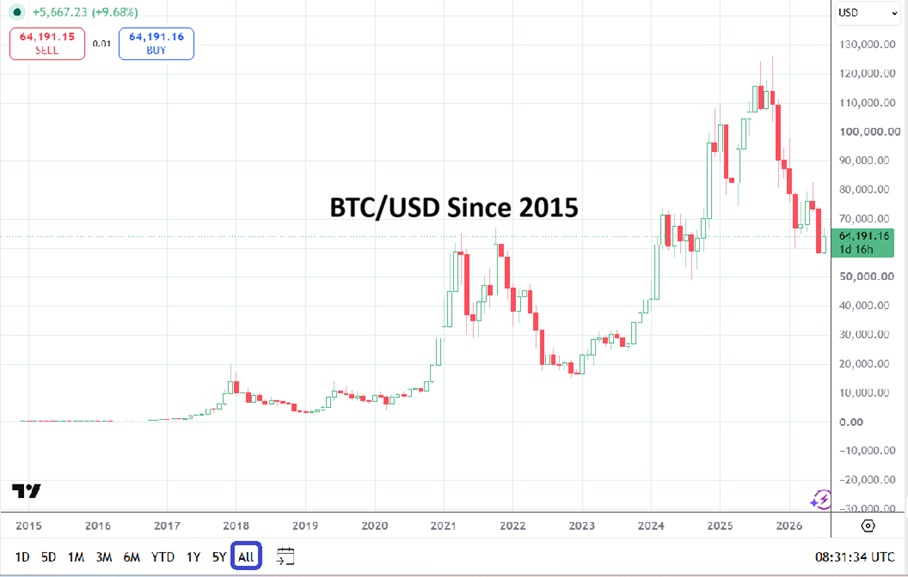
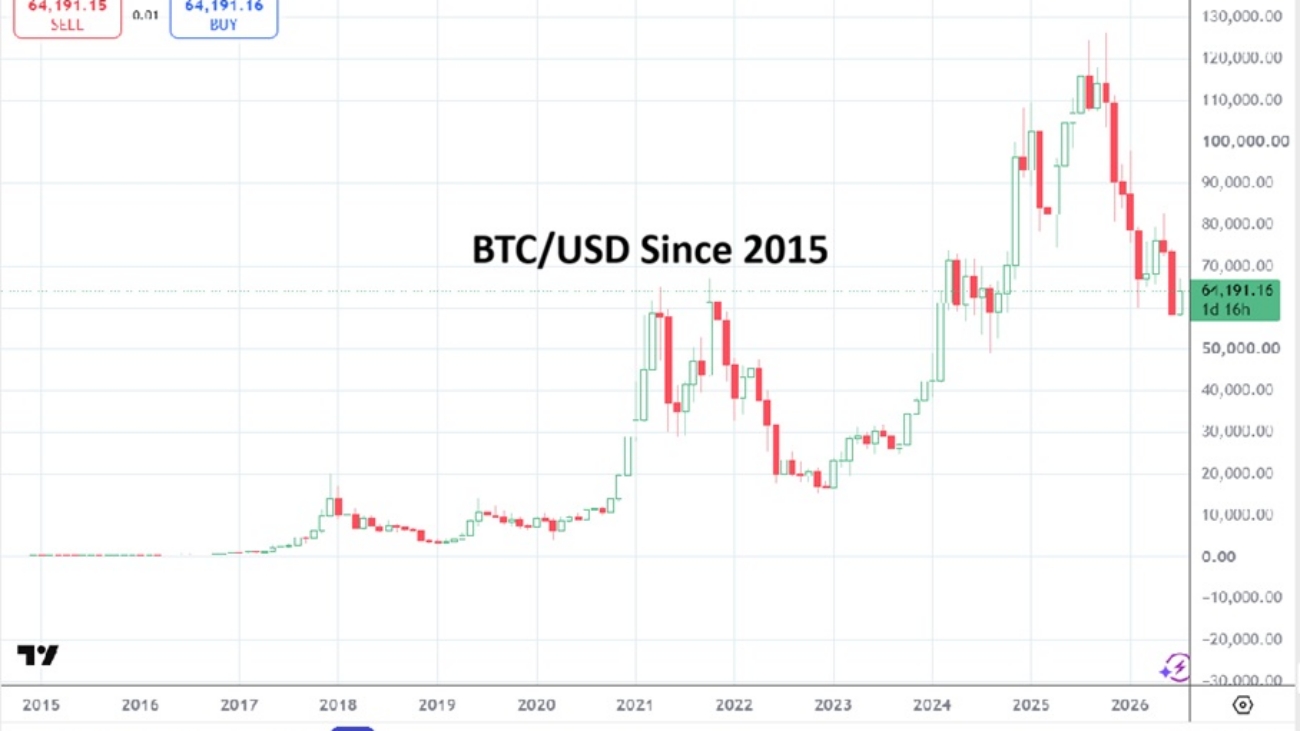
BTC/USD Chart Since 2015 as of 30 July 2026

The Bitcoin protocol was introduced as a new monetary system: decentralized, censorship-resistant, scarce, transparent, secure, and independent of governments and financial intermediaries. It promised to eliminate the need for trusted third parties and replace institutional trust with a code.

However, more than fifteen years later, Bitcoin has failed on all those fake promises…

Today, the Bitcoin ecosystem is increasingly dependent on centralized exchanges, custodians, mining companies, stablecoin issuers, institutional investors, and financial intermediaries. The supposedly revolutionary monetary asset has become deeply intertwined with the very financial infrastructure it was designed to bypass.

And beneath everything lies an uncomfortable economic reality: the Bitcoin mining industry must continuously spend real resources (electricity, capital, land, labor, and massive equipment that becomes obsolete very quickly) to generate a virtual token that is distributed randomly… with the reward being halved by design every four years! What business model can survive such a flawed system where revenues are distributed randomly and halved every four years while costs increase constantly with adoption? It is the exact opposite of an economy of scale. The more successful your product is, the deeper your losses are! Even Fried Thiel, MARA’s CEO, ended up admitting that Bitcoin mining is a “zero sum game”! With miners doomed to fail economically, Bitcoin’s network security is destined to failure.

1. The Decentralization Paradox

The word “decentralized” is perhaps the most important word in the Bitcoin vocabulary.

In practice, it is far from being the case. Most Bitcoin transactions go through exchanges, custodians, brokers, or institutional funds (ETFs). Even miners store their mined bitcoins with custodians like Coinbase.

Today, the entire ecosystem relies on the solvency of companies like Coinbase, Binance, Tether, Strategy… all of which are in a critical financial situation. Should any of them collapse, the whole house of cards will fall down.

The irony is striking. Bitcoin was designed to eliminate the need for trusted intermediaries. Yet Bitcoin users increasingly trust intermediaries to hold their Bitcoins. Even miners do! How absurd is that?

2. The 21 Million Fake Limit

The most used argument for Bitcoin is that there will only ever be 21 million bitcoins.

But the statement requires closer examination too. A bitcoin is divisible into 100 million Satoshis. Each Satoshi has exactly the same “shape,” the same function, and the same attributes as a Bitcoin! Dividing something into exact copies of itself acts like a multiplier! That means the real supply is 2.1 quadrillion units (call them Satoshis or Bitcoins, it doesn’t matter).

The immediate response from Bitcoin supporters is that this is no different from saying that one dollar consists of 100 cents… but the dollar was never designed to have an absolute monetary cap.

The question then becomes whether the 21 million cap creates meaningful economic scarcity or simply a narrative of scarcity for marketing purposes. Anyway, the scarcity of something useless doesn’t make it useful…

The “21 million limit” becomes even more absurd when we consider the enormous number of other cryptocurrencies and tokens that exist. If scarcity itself is the central source of value, why should Bitcoin’s scarcity be uniquely valuable? The crypto ecosystem has demonstrated that creating a new digital asset is technically easy. Anyone can create a token with a fixed supply. If we create another digital token with a 10 million limit, much lower than Bitcoin’s 21 million limit, would it be worth more than Bitcoin because it would be considered scarcer? How can something be considered scarce if it can be replicated indefinitely with exactly the same “unique” attributes?

3. The “Digital Gold” Absurdity

They say Bitcoin is digital gold. Yet gold has physical properties that have made it valuable for thousands of years: durability, divisibility, portability, resistance to corrosion, and usefulness in jewelry and industry. Bitcoin has none of those unique physical attributes. Take away those physical attributes from gold, and it loses all its value. Since Bitcoin is gold without its physical attributes, it is therefore worth nothing! It’s as if we created a virtual token and called it “digital water,” pretending it’s “liquid” and “essential to life.” Still, if we can’t drink it or wash with it, what value would it have? Not only does Bitcoin have no intrinsic value, but it also requires continued investment in heavy infrastructure and massive electricity consumption to stay alive. It is like having a car parked in a garage, continuously consuming gas to remain “alive,” while you pretend it has value because it is unique! Once gold is mined, it costs nothing to continue existing. When Bitcoin is mined, the network needs to keep running on heavy electricity consumption for the Bitcoin to remain “alive.”

4. The “Censorship Proof” Lie

Governments around the world have acquired Bitcoin through seizures, confiscations, enforcement actions, bankruptcies, and other means. That’s how a digital coin created as a challenge to government monetary authority ended up in government-controlled wallets.

Governments do not need to control the blockchain to influence the market. They can shut down crypto platforms and seize their assets. What happened to the promise of monetary freedom?

5. The Myth of Low-Cost Bitcoin

Bitcoin is sometimes described as a cheap way to transfer money. The comparison can be attractive. There is no need for a traditional bank to approve a transaction. The network operates continuously.

But the cost of the system is not simply the transaction fee paid by the user. There is also the cost of maintaining the infrastructure. Bitcoin mining consumes enormous amounts of electricity and requires heavy equipment that becomes rapidly obsolete. The economic cost of maintaining the network is simply unsustainable. All listed miners show constant negative cash flow with massive dilution of shareholders and collapsing stock prices. It is not a coincidence. It is simply a sign that Bitcoin mining is economically unsustainable. It is a fundamentally losing business that is doomed to fail. When most miners inevitably capitulate, they will sell their Bitcoin reserves and provoke a massive collapse in the price. With less than 5% remaining to be mined over the next 100 years, there will be zero incentive for miners to start all over again. Bitcoin is doomed to fail from within.

If Bitcoin were truly revolutionary, all large technology companies, like Apple, Google, Microsoft, and Meta, would have jumped in to get their market share (as they did for AI)… instead we have empty shells with no business model, like Strategy, Nakamoto Inc, and Metaplanet, turning into “Bitcoin treasury” companies while incurring heavy losses and permanent negative cash flow.

Bitcoin was designed as an alternative to financial intermediaries. Now collapsing “treasury companies” and unsecured crypto platforms control the ecosystem. We shifted the risk from banks like JPMorgan, Citi, or Morgan Stanley, supported by the US central bank, to entities like Coinbase, Tether, and Binance… some of which aren’t even audited! And all without any support from a central authority.

The user may distrust banks, but he is asked to trust an exchange. The user may distrust central banks, but he is asked to trust a stablecoin issuer. The system has not eliminated trust. It has redistributed it to a much weaker ecosystem!

Bitcoin will be remembered as the greatest bubble of all time and the largest misallocation of capital and resources in human history.
Copy and paste the text from AMT that you want to share

Share:
postN43

Alert: Important Support in View for Binance Coin Traders

Alert: Important Support in View for Binance Coin Traders

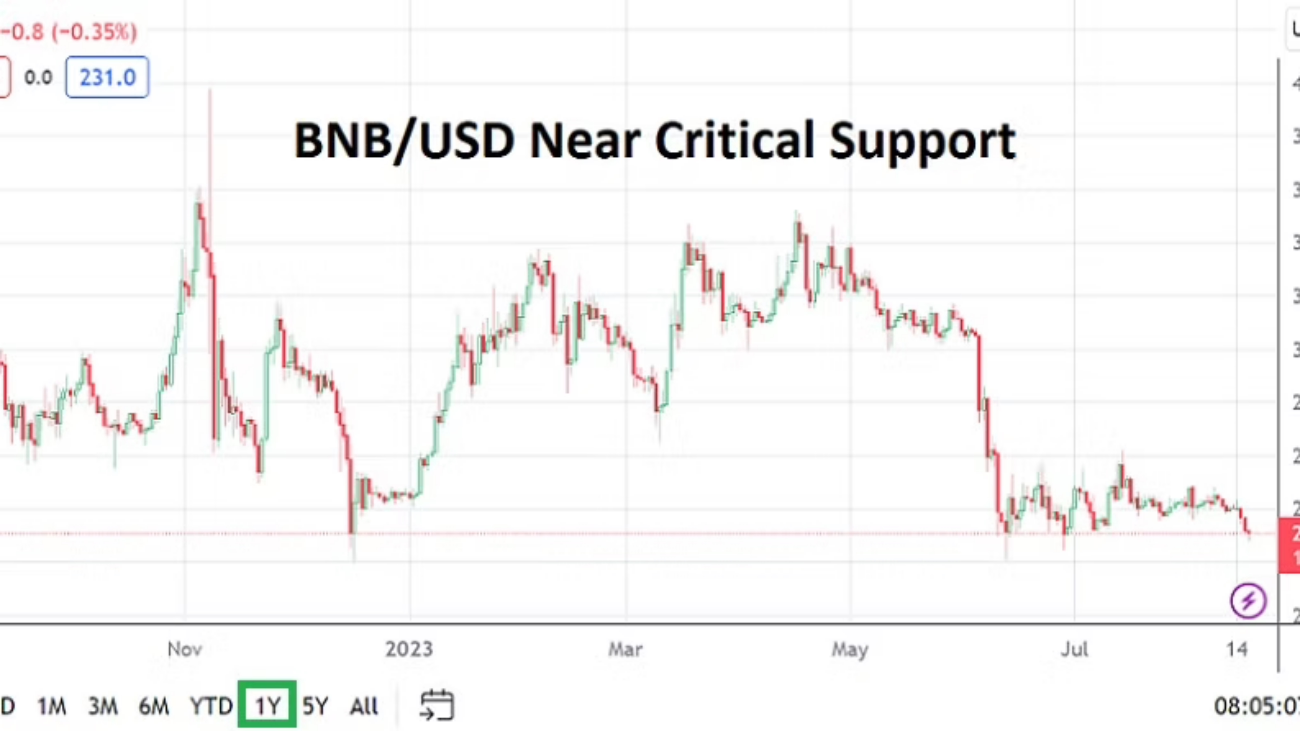
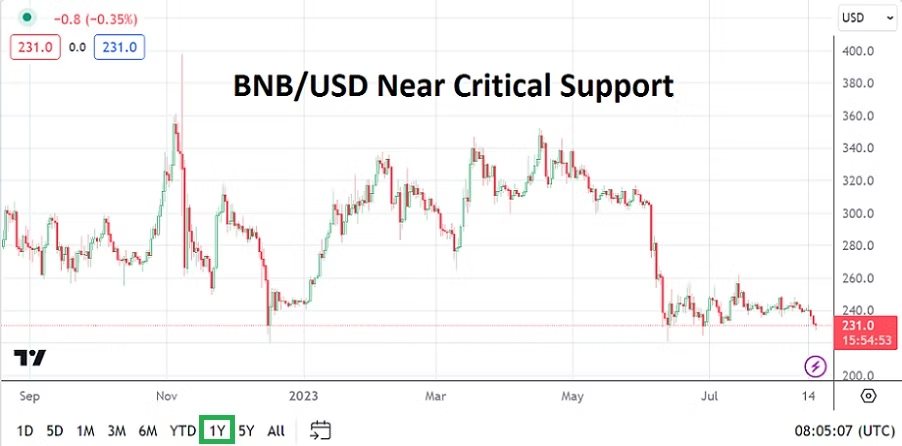
BNB/USD One Year Chart as of 17th August 2023

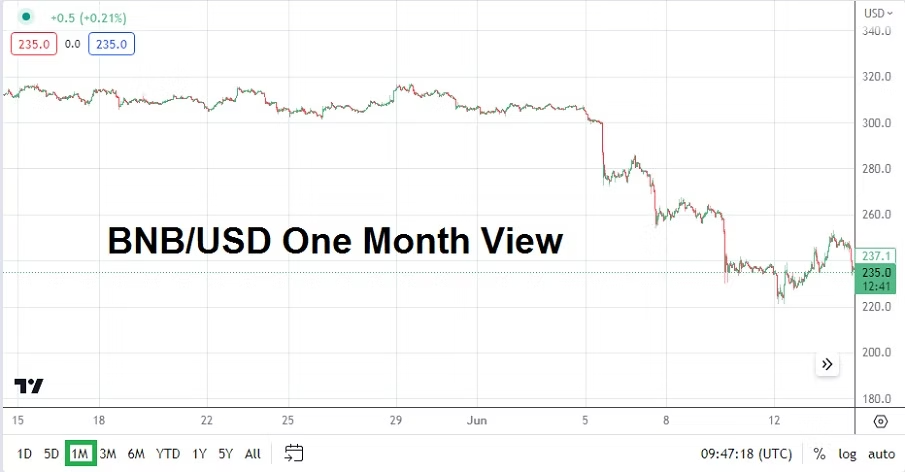
Important support for BNB/USD is now being battled. The price of Binance coin is near a key inflection value of 230.00 USD. The digital asset world including Bitcoin and other cryptocurrencies has taken on stronger selling recently. Legal issues surrounding Binance have not gone away, nor will they. If Binance starts to show stronger price velocity lower it could spook the broad cryptocurrency market in a large manner. Binance is still the biggest crypto exchange in the world, even as it has come under the investigative pressures of the U.S and some European nations.

Traders should pay attention to ‘stablecoins’ as a barometer of behavioral sentiment in the cryptocurrency landscape. Tether should be watched closely. If USDT sustains value below the 1.00000 USD level for more than a couple of days this would be a negative signal that ‘players’ in the cryptocurrency world are getting more nervous.

Bitcoin is also seeing steady selling early this morning and the price of BTC/USD is near 28,550.00 as of this writing. If BTC/USD were to break below the 28,000.00 this could also add to fear and noise in the cryptocurrency world.

The next seemingly important level for BNB/USD below is around the 225.00 USD mark if tested, if this level proved vulnerable and trading momentum continued downward stronger selling could develop if panic erupts surrounding Binance coin. Traders should be very careful in the cryptocurrency trading environment right now. Legal shadows hovering over Binance have existed for a long-time, and if selling pressure were to mount and values are suddenly tested from June of last year when the 200.00 BNB/USD level was last tested (this as FTX collapsed) this would clearly not be a good signal.

postN15.1

Tether’s Wobbling Should Set off Alarms for Crypto Traders

Tether's Wobbling Should Set off Alarms for Crypto Traders

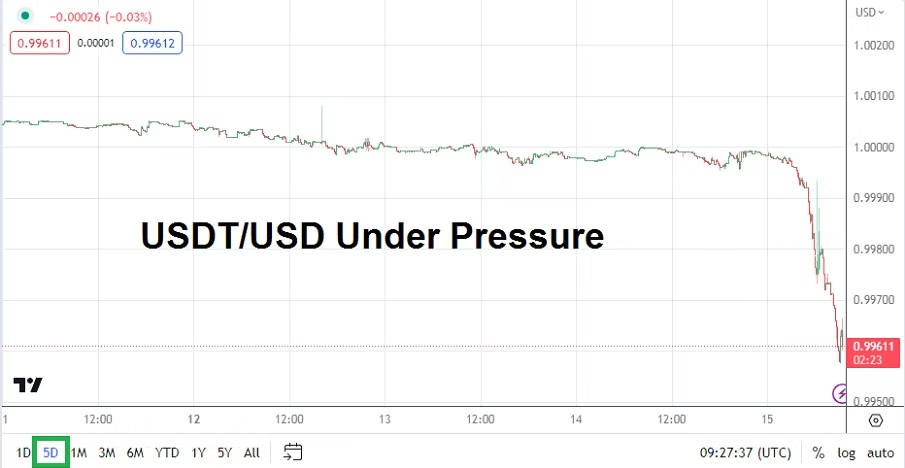
Tether is wobbling and this should not come as a surprise to cryptocurrency traders. While many speculators likely do not carry USDT in wallets or day trade the cryptocurrency, it does serve as a barometer in the digital asset world regarding behavioral sentiment. A sustained drop below the 1.00000 USD price tag should raise eyebrows and increase nervousness.

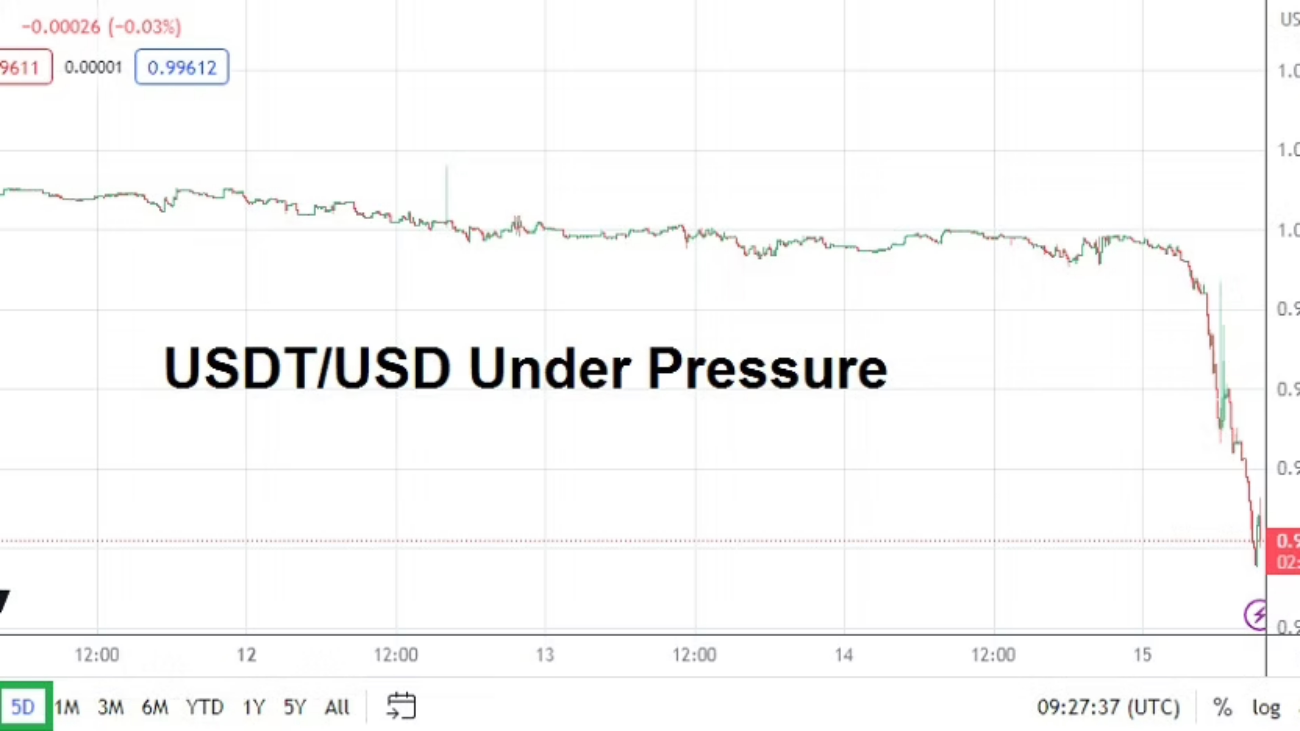
Tether (USDT/USD) 5 Day Price Chart as of 15th June 2022

This morning’s drop in value in USDT/USD comes on the heels of trouble with Binanace and Coinbase via civil suits brought forth by U.S government agencies that accuse both exchanges of wrongdoing.

Tether’s accounting practices have been under suspicion for a long time and transparency has been lacking. While influencers within the crypto world can came claim all they want the Tether ‘stablecoin’ has nothing to hide – just like Binance and Coinbase – plenty of suspicion remains. And in fact a lawsuit brought against Tether’s parent company which was settled with a payment of nearly 41 million USD in 2021 to the U.S government via CFTC charges should serve as a caution sign.

A simple look at a five day chart of USDT/USD above shows the ‘stablecoin’ has incrementally suffered selling the past handful of days (this before today’s storm lower). Yes, folks may claim this has happened before and recoveries invariably have always developed higher, and they may be proven correct again. Perhaps today’s selling has been a mere reaction to the ‘public’ finding out about recent Binance transactions which are being reported, but maybe it is something more important – like a lose of confidence.

Until now the cryptocurrency world hasn’t really seen a strong reaction to the allegations brought forth from the U.S against Binance and Coinbase yet, and the question that should be asked is when is confidence going to crack again in the cryptocurrency world. Because as sure as the sun comes up and sets, the cryptocurrency world is going to suffer another major crisis, perhaps not today, but one will occur.

If the price of Tether starts to stumble badly and shows signs of not recovering that would spark a major downturn in the value of cryptocurrencies across the board. The darling of the ‘stablecoin’ world certainly has its detractors and there are certainly folks lurking who have been making long-term bets against Tether.

Binance Coin (BNB/USD) One Month Chart as of 15th June 2023

Speculators in the digital asset world will be watching Bitcoin and Tether values closely. It has been reported that by many crypto media sources that Binance has recently made large trades involving USDT in an effort to boost their liquidity. What should concern traders in the cryptocurrency space is the ability of noise in the sector to turn into actual thunder which causes dramatic reactions to cryptocurrency prices.

Because while some people try to claim there are reasonable ways to value cryptocurrencies, in fact behavioral sentiment rules the jungle and a loss of confidence in the sector remains an extinction level threat for nearly every digital asset at anytime. The entire cryptocurrency space is vulnerable to fragility.

post5

Silence Of Tether a Loud Warning in Crypto Trading World

Silence Of Tether a Loud Warning in Crypto Trading World

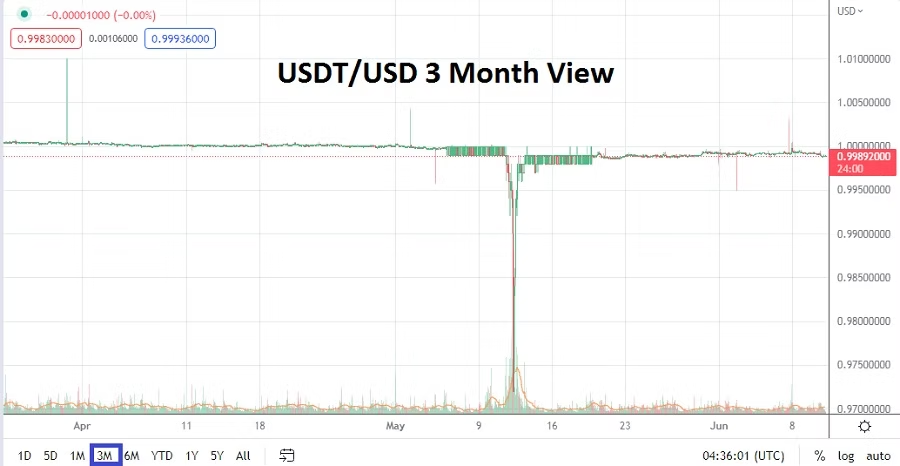
Tether continues to trade below its stated target value of 1.0000 via its stable coin ‘mandate’, and its failure to attain the target for nearly a month may be a loud warning.

Failure to Maintain 1.00000000 value in Tether

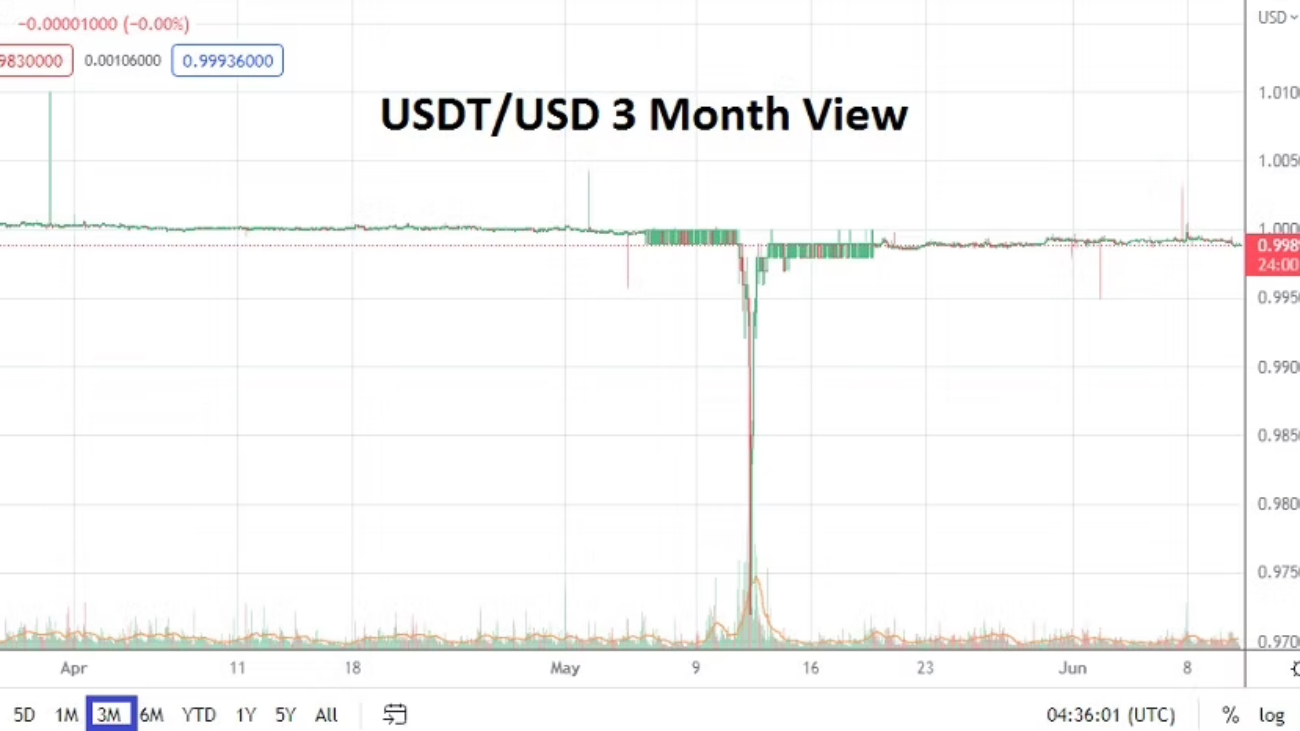
USDT/USD is trading near 0.99892000 via a Coinbase quote as of this writing. The last time Tether traded above the 1.0000 level in a sustained manner was in the last week of April. Since the destruction of TerraUSD, USDT/USD has not attained its objective as a stable coin in a month and a half.

One of the Tether functions in the cryptocurrency world is to facilitate transactions for digital asset businesses. If a tech firm, for instance, were to initiate an investment for a project in the crypto world, they might ask for the equivalent of 1 million USD. This transaction via the funding in the investment is often paid for via a stable coin. Tether is a mainstay of these investment deals.

Receiving Tether allows the business taking in the stable coin investments, to ‘know’ they hold what is supposed to be a nearly exact USD based exchange rate, if they decide to cash in their Tether if they need dollars to pay bills. The problem for USDT/USD currently is that the exchange rate is not meeting this need and expectation.

Yes, a crypto based business could say, ‘well, we know the rate is now 99 cents on the dollar, so we need to ask for more Tether to make sure we get the equivalent of our investment asking price in USD’. OK, good enough, but this creates complications that are unwanted.

The silence of Tether not trading at 1.000 speaks about a much more problematic possibility in the cryptocurrency world. What if USDT/USD is actually starting to show signs of fatigue? What if USDT/USD continues to incrementally lose a little bit of its value moving forward?

Where have the Speculators Gone?

Is it possible there are large speculative funds betting against Tether and shorting the stable coin with the belief it will continue to lose value? If funds are wagering against Tether and have the fortitude to maintain long term selling positions against USDT/USD, they could trigger big problems down the road if they are proven correct.

The cryptocurrency world is showing massive signs that speculators are not participating. While Bitcoin has been able to maintain some semblance of value, BTC/USD is still stumbling near lows and has not been able to create a large reversal higher. Bitcoin is struggling during this prolonged bearish trend. The mantra that cryptocurrencies are a hedge against inflation has proven brazenly false.

Even worse is that most of the other cryptos are struggling too. Ethereum continues to test lower values. As of this writing ETH/USD is near the 1674.00 ratio. Technical support levels are faltering and there appears to be no momentous wave of speculative zeal flourishing which is looking to buy into the digital asset world on the notion that cryptos are oversold. Cardano, Avalanche, Solana, Polkadot and Ripple are all struggling via their coins.

HODL mantra, Corporate Treasury and Hedge Funds

If speculators really have gone away, this leaves the folks who are die hard supporters known as HODL’ers (Hold on for Dear Life). It also leaves intriguingly major companies who have purchased some digital assets such as Bitcoin and cryptos such as Ethereum as ‘assets’ within their corporate treasury structures. There are also hedge fund companies that are holding cryptos as speculative investments. What if corporate treasury suddenly gets scared and decides to cash out of the digital asset world? Will the directors of MicroStrategy and Tesla get nervous and force sales of their digital asset holdings? Michael Saylor has repeatedly said no and that he will keep buying Bitcoin for MicroStrategy.

The lack of a rise in cryptocurrencies during this long bearish trend, and the notion that no massive reversal has been demonstrated during the large erosion of value the past two months is a potentially negative bad sign. Critical technical support levels have been tested repeatedly and their penetration lower is a loud screaming sign that something is going wrong from a short term speculative point of view. It doesn’t appear that we have reached the end of the downturn in cryptocurrencies yet.

If some deep pocketed folks are betting against Tether as a stable coin and believe its value will continue to dwindle without a fight upwards, the silence of USDT/USD recently in the digital asset world may prove to be vicious signal that worse is going to come for cryptos in the coming months.

Cryptocurrencies remain speculating. No matter what some folks say, digital assets over the long haul still have a questionable future via utilitarian capabilities and as their technology evolves. Corporate treasury and hedge funds who ‘invest’ in digital assets are speculating and they may pay a heavy price if they bet on the wrong direction.

The inability of USDT/USD to move back towards its 1.000 value is troubling. If speculators stay on the sidelines and do not participate in cryptos, corporations and hedge funds holding digital assets may be forced to start capitulating . Meaning they may start to sell. If directors of companies and speculative hedge funds start to get nervous about the long term outlook for Bitcoin, and Tether continues to loss value while it proclaims it is a stable coin – then darker days will come.