SIngapore Dollar 20260717

Thoughts on the USD/SGD, Cautious Broad Market Sentiment and the Weekend

USD/SGD: Currently a Hope and Prayers Barometer in Global Forex

The USD/SGD is near the 1.29110 vicinity as of this writing. Financial institutions apparently have combined their cautious outlooks in the broad Forex market as USD centric strength continues to leak into sentiment, while their instincts technically demonstrate that over the mid-term currencies like the Singapore Dollar should be stronger and the USD/SGD is supposed to show some bearish activity.

For dramatic purposes let’s call this current phase of Forex trading including the USD/SGD as the hope and prayers act. The Singapore Dollar has sustained highs, but it has traversed lower over the past few weeks. On the 24th of June the USD/SGD was near the 1.29940 ratio. Let’s be clear, for small speculative Forex traders broad market wagering on USD direction remains dangerous.
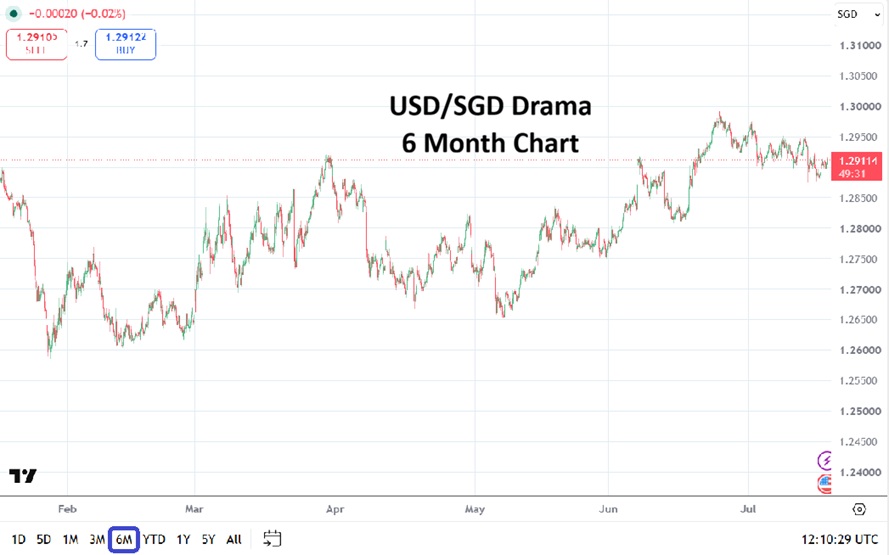
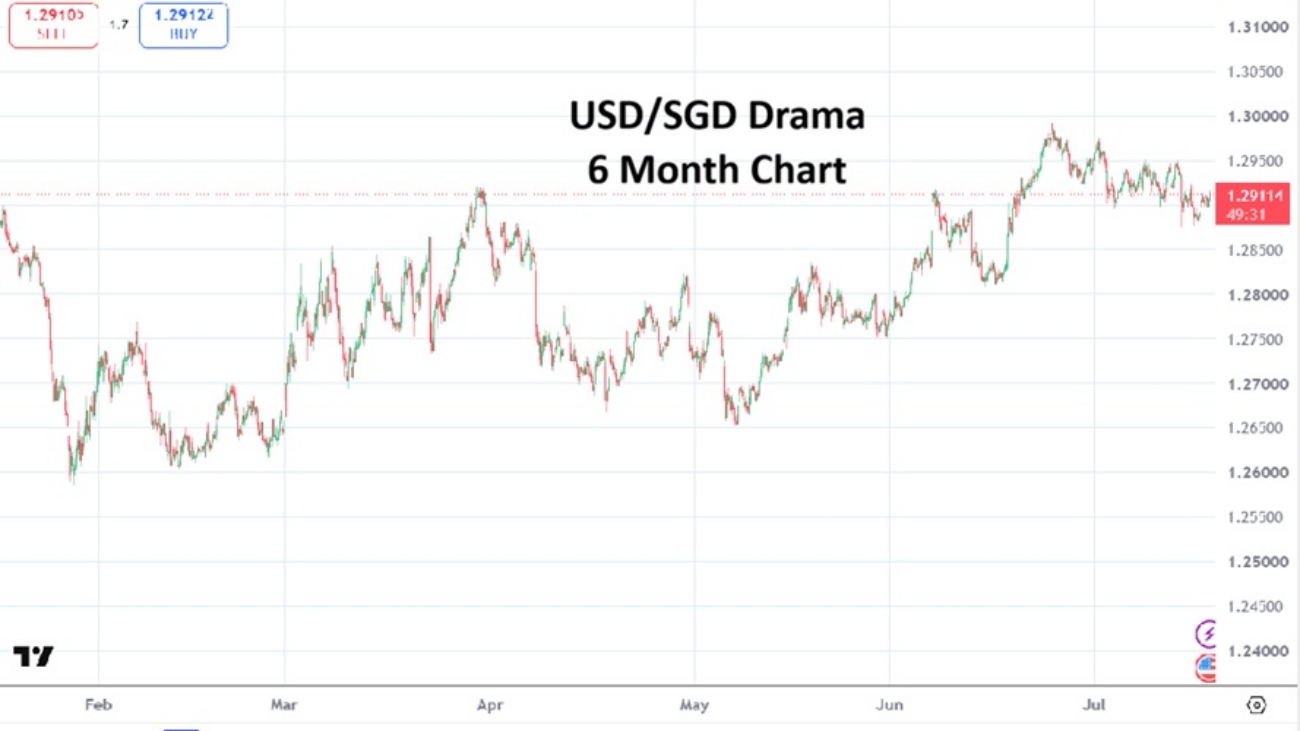
USD/SGD Six Month Chart as of 17th July 2026

Fed Chairman Keven Warsh and His Desire to Introduce New Data

During the recent testimony of Fed Chairman Kevin Warsh in Washington D.C he made it clear he is keen on introducing AI tools into interpretations regarding Federal Reserve policy. However, he also said that AI will not be relied upon alone. From a coding perspective, Warsh essentially said proactive data will become part of the Fed’s thinking with proper supervision: some of you may want to call this a stack developer’s job.

At the same time while refusing to tip his cards regarding his stance on interest rates too much, Forex markets responded by selling the USD in incremental bouts. Intraday trading flared in its usual manner, but started show a core belief that Warsh is demonstrating dovish sentiment regarding interest rates.

USD/SGD as a Forex Barometer and Near-Term Behavioral Sentiment

The USD/SGD serves as a solid barometer of the Forex market. It offers perspectives on Asian sentiment, but also shows how global financial institutions are leaning. The escalation of firepower in the Middle East the past week and into today has caused reactions in the USD/SGD, but somewhat politely.

Having been able to trade below the 1.29000 mark on Tuesday and Thursday of this week, the currency pair is trading near values seen on the 8th of June and 18th. A lack of clarity remains a theme in Forex. The USD/SGD is the 10th biggest Forex pair via transactional averaged volume, so traders should give it attention even if they do not pursue.

Wall Street Remains Nervous and the Tense Weekend to Come

Going into this weekend Forex traders have created downside pressure on the EUR/USD and GBP/USD. The USD/JPY remains stubbornly above the 162.300 ratio. Nervous selling on the Nasdaq 100 via futures trading has been seen today and it looks as if Wall Street will be in for another bumpy ride. The wishful thinking drama in the financial markets is being confronted by the reality of a potentially loud weekend of military conflict between Iran and the U.S, and a seemingly unconvinced marketplace that doesn’t want to demonstrate risk appetite.

WTI Crude Oil prices via futures trading are above $80.00. Having been able to sustain values above the 1.29100 mark in the USD/SGD signals that bearish mid-term perspectives still need additional impetus to create more selling, but this doesn’t appear a wise speculative bet going into the weekend.

A cautious stance over the coming hours should be anticipated as folks wonder what the coming weekend will bring. At least there is the World Cup championship on Sunday (New York time) to take our minds off of concerns. However, Monday will not react to the trophy being raised, but to behavioral sentiment that will takes its cue via today’s finish on Wall Street and noise generated via the Strait of Hormuz this weekend.
Copy and paste the text from AMT that you want to share

SP500 20260713

S&P 500: Short-Term Caution and Long-Term Ambitions

Speculative Opportunities Do Not Promise Immediate Profits as Cautious Outlooks Stir

The S&P went into this past weekend with slight gains made on Friday, but essentially finished where last week began. In early morning trading via the futures market the index has seen a slight decline. Retail short-term traders may decide that offers the potential to sit on the sidelines and watch what may be rather choppy conditions, this if they decide not to pursue.

Global markets including stock indices like the Nikkei and broad Forex have shown more discomfort early today. Short-term concerns and mid-term viewpoints are colliding and making momentum hard to sustain. The S&P 500 remains within its elevated realm, but there is a rather unpleasant taste many speculators have had to endure since the end of May, particularly if trading ambitions have been limited to near-term pursuits.

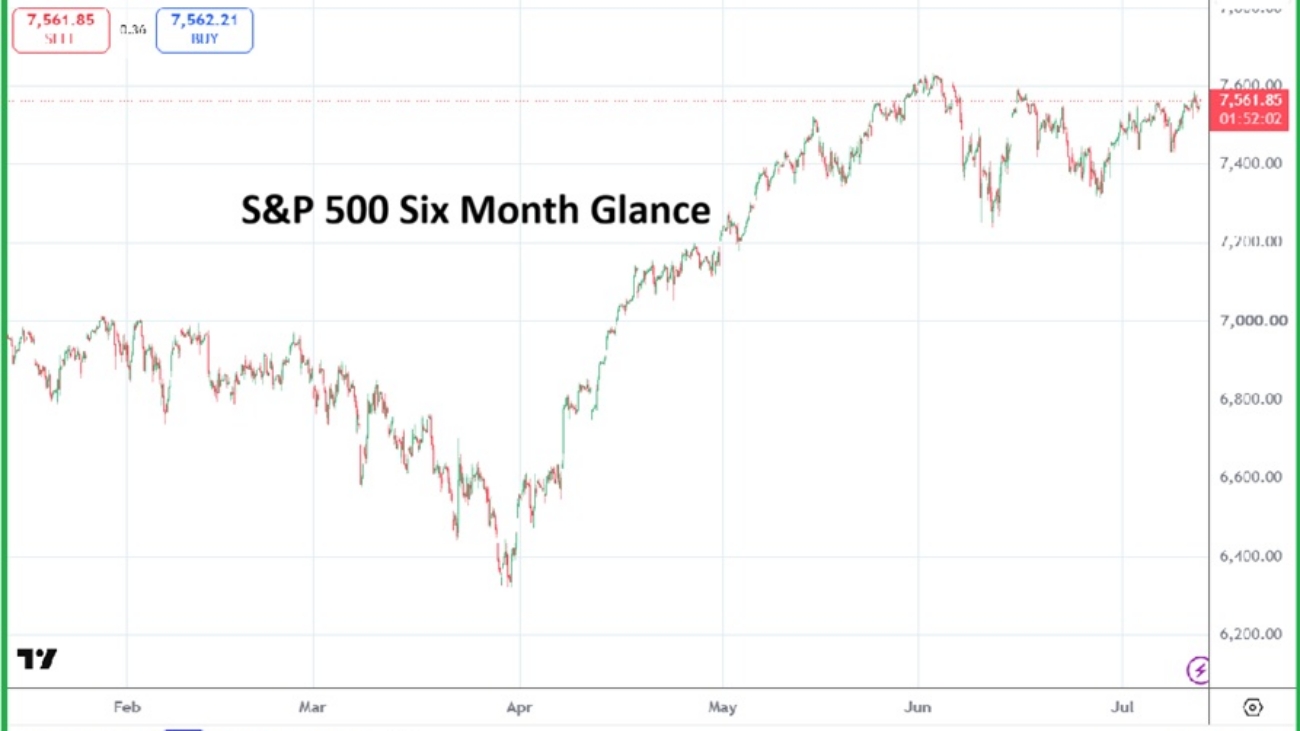
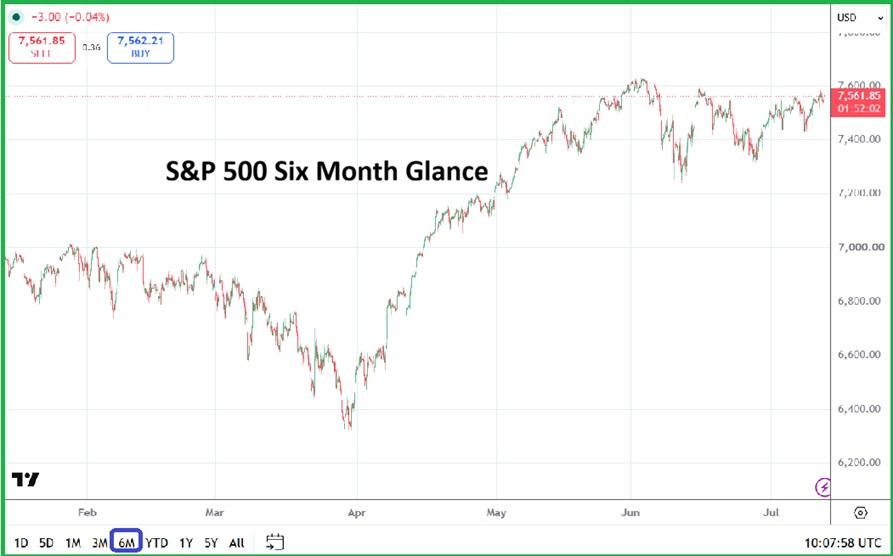
S&P 500 Futures Six Month Chart as of 13th July 2026

There will be a crowd of people at summer parties (or winter outings depending on which side of the equator you are on) discussing the gains made in the S&P 500 (and Nasdaq  100) since the end of March who will be quite keen to brag about their insights. However these same people have likely made their money via pension funds, mutual funds and other long-term endeavors guided by institutions managing their money. Because most short and near-term retail traders have likely been savaged by the results in the marketplace the past handful of months. 

Trading within the current markets conditions for those who have smaller accounts and are relying on leverage to create profits have likely been bled dry of their funds if they have not used proper risk management. It is one thing to want to make a thousand dollars a week in the markets as a retail trader and quite another to actually accomplish the task. 

Indices the past handful of months have been a churning machine in which volumes stir and create attractive chatter, but also deceive folks into believing they can win easily. The only folks winning consistently right now are brokers handling their clients’ retail accounts.

This doesn’t mean you have to stop and give up as a retail trader, but it should serve as a warning that not being overly ambitious and remaining patient are keys when trying to beat the markets. And again, let’s remember the average retail trader has about a 90% chance of failing when trying to speculate.

The S&P 500 did hit a record height in early June around the 7,620.00 vicinity. Its current values are well within sight of those highs too. Yet, headwinds continue to be seen via trading results intraday as financial institutions deal with wavering behavioral sentiment complicated by a myriad of concerns.

Yes, there will always be concerns in the marketplace, risk and reward are often compared to the potential of loss. If you are placing a bet in the markets that you believe can garner a thousand-fold profit, it is likely you are also risking a thousand-fold loss. And unfortunately the marketplace, nor your broker is going to lose sleep over your inability to understand what risks you are undertaking. You will hear that you have learned a tough lesson and the experience will help you become a better trader next time around by your broker, this as they offer you another opportunity to enter the markets on their platforms, but it still doesn’t guarantee you anything. 

The rumblings from the Middle East continues to mitigate sentiment in the global markets. As of this writing WTI Crude Oil is around $73.70. If military conflict between the U.S and Iran continues to incrementally escalate, perhaps experienced players will be able to handle the noise and worries regarding higher energy costs and threats of inflation. 

Equity indices are also running into problems caused by a realization that the costs of investing into companies working in the AI realm are now having to deal with rising costs, this as revenues do not meet expectations, and a lack of adequate physical resources to fuel growth in the sector are raised as concerns. And it is not a stretch to say the AI sector has helped drive more than a handful of equity indices higher. A legitimate fear regarding a downturn in AI related stocks and a possible knock-on effect is a sobering reminder that bullish trends do not last forever. 

And then there is the shadow that is overhangs the Federal Reserve and interest rate calisthenics being worked out by analysts who are trying to convince others (and themselves) that their outlooks are correct.

Yet, we return thankfully to a simple notion and question, one that has very little to do with economics that are taught in university classrooms – are there enough buyers in the marketplace to sustain the upwards trend in the S&P 500? The answer doesn’t have much to do with fundamentals, and often is driven by pure sentiment. Pushing aside day to day travails, wagering on long-term upside remains almost the only wager that can be made. Sure, you can bet on downside; you can short stocks, buy put options that look for lower markets. However, matching negative outlooks with the correct timeframe is just as hard as it is to bet on positive momentum. For the time being it is easy to say the near-term remains murky for day traders. It is harder to predict actual direction

Copy and paste the text from AMT that you want to share

Nasdaq100 20260707

Benefits of a Moderate Restoration While Threats of Growing Fissures are Heard

Sentiment: Financial Institutions and November Outlook Amidst Possible Gridlock

The Nasdaq 100 is clearly being driven by behavioral sentiment at this time. Few investors are paying attention to corporate data, instead many financial institutions are wagering on mid-term outlooks driven by a combination of algorithmic led coding mixed with wishful thinking and hoping they are not washed out to sea by dangerous tidal pools they know are out of their control.

On the 3rd of November 2026, the U.S mid-term elections will largely be held. President Trump’s hold on the House of Representatives looks as if it may come undone as a result of the coming vote if the Democrats take control as some polling suggests.

Perhaps that is exactly what investors are hoping for because historically when there is a divided Congress legislatively, stock market indices actually tend to gain. The reason for this is largely because a paralyzed Congress often finds it hard to pass measures which can hinder corporations and investors, because regulatory mandates are difficult to pass.

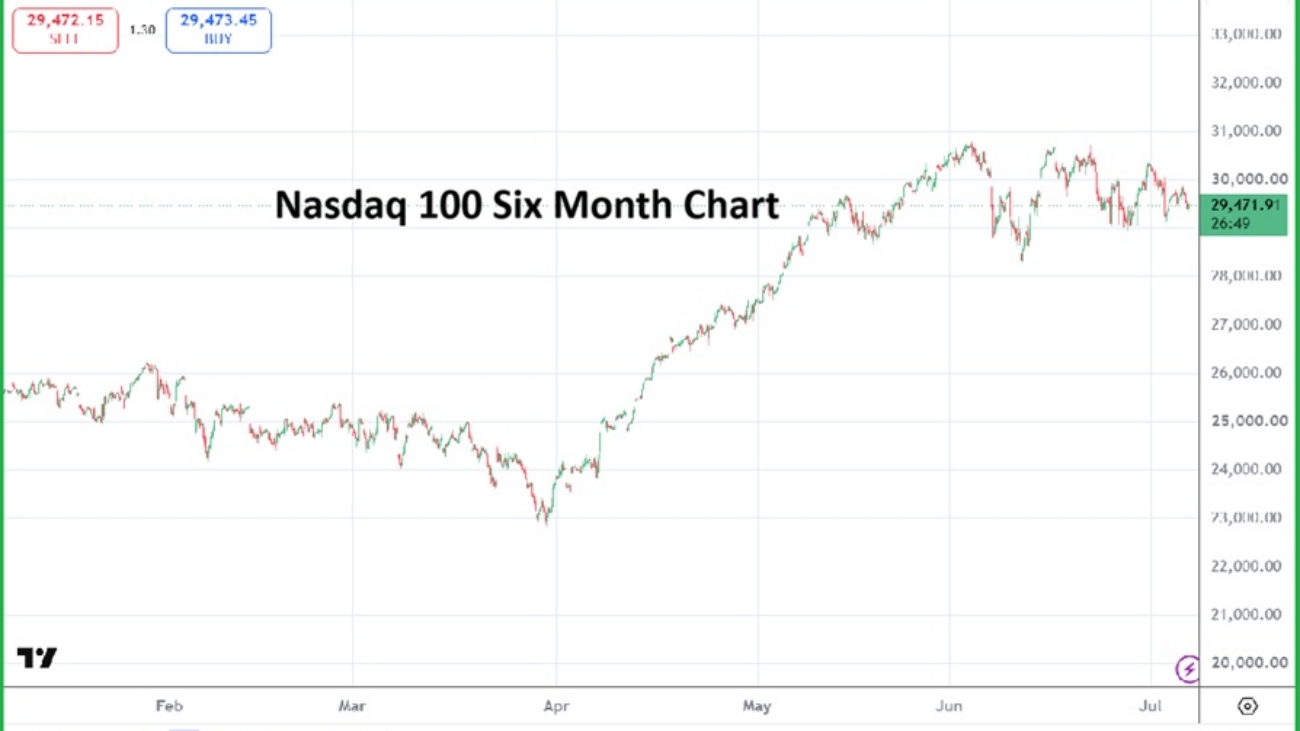
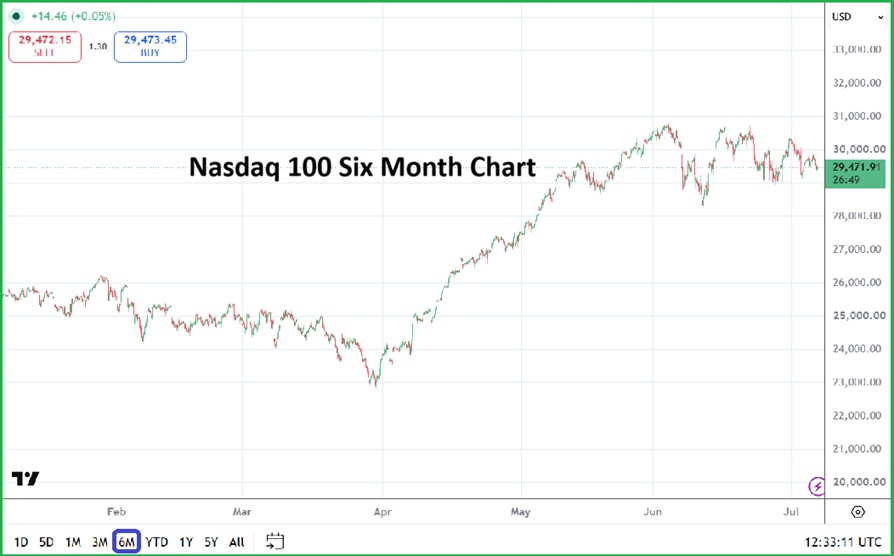
Nasdaq 100 Six Month Chart as of 7th of July 2026

If the Democrats win the House and President Trump is able to retain a Republican led Senate, this will lead to a deadlocked Congress which will make it hard to get work much done. Resulting in what may become one of the more memorable lame-duck Presidency’s of our time, one in which both sides of the U.S Congress openly disagrees with Trump’s ego driven rhetoric and instead turns to the backing of voters from their constituent state’s as a way to amplify their own policies.

While the Republicans appear potentially vulnerable in the November elections, the Democrats have problems of their own. An open fissure has been displayed as Socialists inspired candidates have won primaries in a handful of Democratic led Congressional districts and appear ready to splinter their political party regarding direction. What does any of this have to do with the economy and markets?

Perhaps this is exactly what crowds of investors in global markets, including Wall Street wants to happen at this point. Politicians forced to retreat to return their homes and become less vocal publicly may be a welcome remedy. Folks are starting to tire of political rabble, a crowded intersection of gridlock may be welcome at this point.

Unknowns: A Source of Concern for Investors

While it is certainly within the arsenal of the Trump Presidency to try and issue executive orders to try and get policies approved and acted upon. A split Congress, one in which Republicans can openly disagree with the White House without the fear of a political backlash may cause ruptures and positive outcomes for the GOP, if President Trump is weakened after the mid-term elections this November.

Democrats, particularly if they clash internally on their pronounced policies and have to spend more time trying to put out their own progressive internal fires may have to realign their thinking and walk more moderate lines. Activists on both sides of the political aisles may have to lessen their banter following election outcomes if they believe their voting public wants less noise.

A lame-duck President, could equate into a deadlocked Congress and debates simmering within each party which produce more moderate stances. However, if nothing is settled in November of this year this may lead to betrayals and revenge politically and potentially new leadership emerging which could be even more cynical, ignorant and insistent on false narratives.

Intriguingly, Wall Street will not be bothered by a deadlocked Congress and President who suddenly is limited by eroding power. In fact the conditions of withered post-revolutionary zeal and a slumber which could develop may allow corporations and investors to move freely about the ruptured political landscape with more liberty amidst the chaos. Investors will react to the sentiment that Washington D.C produces. A calm is wanted.

Within the ashes of Republican and Democratic turmoil a reconciliation may actually be able to take place. The question is if a restoration of moderate power will be finally be seen. Wall Street and most global investors would like a return of the centrists. No one is going to agree 100% of the time on policy, but a reality of transparent government without corruption would be a good start, one that many people actually would agree upon.

Copy and paste the text from AMT that you want to share

Nvidia 20260630

Nvidia Suffering From the AI Cold Bothering Investors and Speculators

AI: Exuberance and Threats of Fatigue

Has Nvidia now been oversold? While the Nasdaq 100 produces a casino like experience for day traders and large players, the velocity of value changes in the index should serve as a simple reminder that before stepping into traffic a speculator needs to acknowledge the road. A large collision is taking place before our eyes and it will generate more noise over the coming months. 

Nvidia is a solid indicator of behavioral sentiment being influenced by a mix of optimism and fears by speculators and investors competing, and trying to define terrain as turmoil swirls and a battle for profits rage. Day traders need to remember a lot of hyperbole is amplified to get eyeballs on opinions, hoping that your attention is grabbed. (Please buy me a cup of coffee has become a begging mantra).

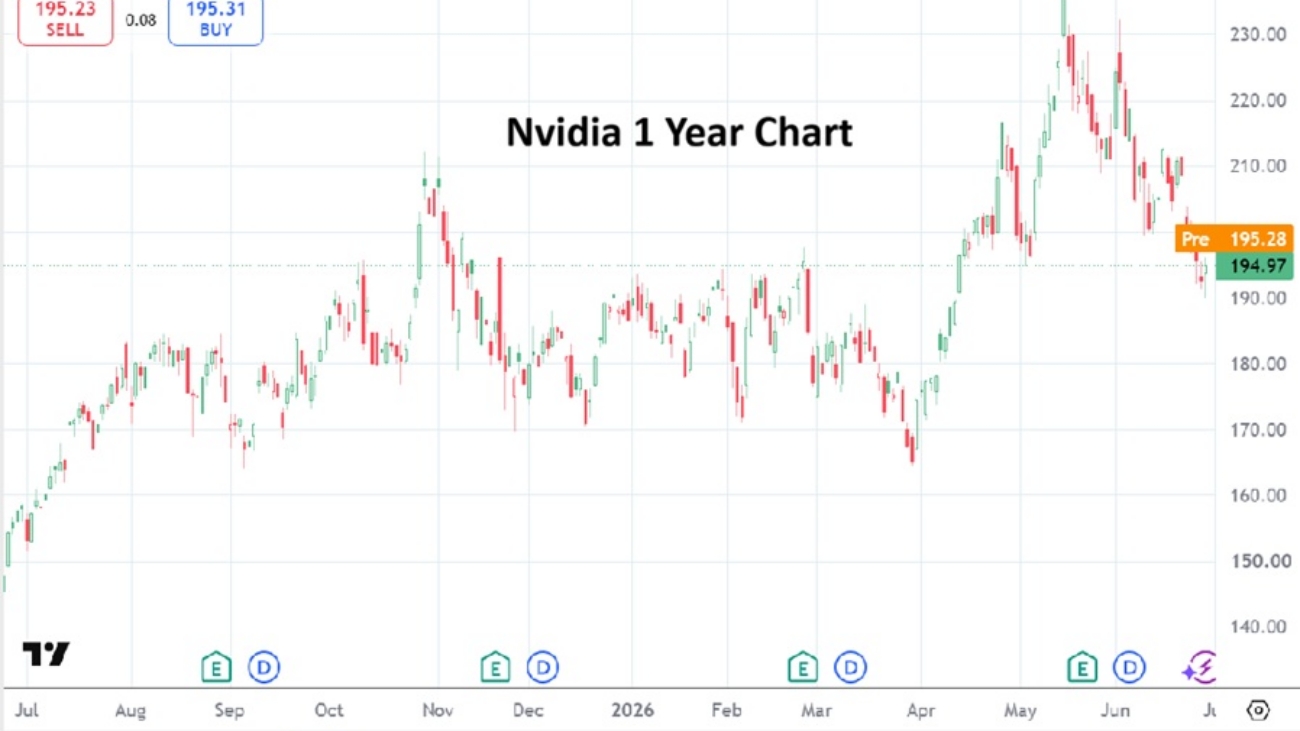
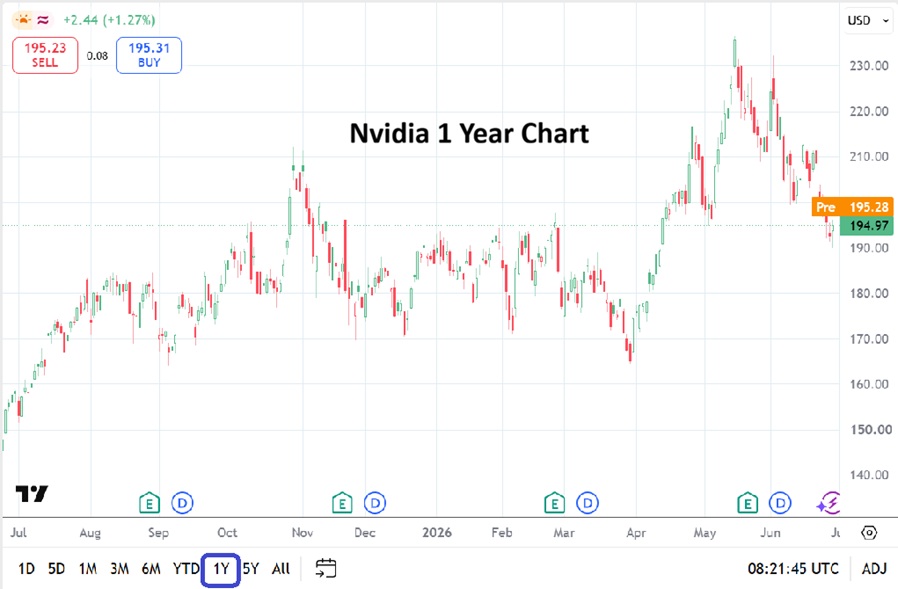
Nvidia One Year Chart as of 30th June 2026

Nvidia finished yesterday’s trading near $195.00, this after touching highs in May around the $238.00 vicinity. The fact that NVDA has lost a large chunk of its value indicates sentiment is not entirely rational. There is a vast difference between speculative hopes compared to long-term investing. 

Results in the stock markets do show symptoms of overbought conditions prevail, but over indulgent fears are taking hold as folks try to interpret every move in a haphazard manner and make correlations which often have no evidence. Nvidia is a solid company which will continue to produce product lines that will be needed long-term. Talk of Nvidia suffering from an AI cold is relevant because it has certainly lost value, but the patient is going to survive.

Others however may not. AI companies and their proclamations about being able to deliver substantial change for users has become tiresome. Supply of software is widespread. While there is demand for use, competitors are abundant and growing daily. Users can now question just how reliable and strong the products they are using are, and if promises meet the results wanted. Costs users are paying for services will also become more critical. If products don’t meet needs, other AI systems can be easily installed nowadays. 

Oversupply is Saturating the Marketplace

Because AI tools are widespread it means users will demand services get cheaper. At some point it is clear that consumers will gravitate to competitive pricing, because at the end of the day there is only a certain amount of time to verify all the products in the marketplace and understand what works best. Branding as always is important, but so is quality. Loyalty in the AI world is only a couple of years old and cannot be counted on, some early companies are already seen as legacies and allegiances will shift. 

Competitors and new ideas continue to be brought forth quickly. A lot of product is being rushed to the market that lacks proper Q&A and actually does not deliver what is promised. Proof of concept is fluid with Artificial Intelligence, along with many claims of superiority. A company can get a product into consumers hands first, but at some point value has to be delivered too.

Investors are growing wary from too many claims. Yes, a revolution has taken place, but a counter-revolution is certainly coming. A lot of AI products are simply poor. Day traders have seen chaotic results on the Nasdaq 100 over the past year. 

President Trump, tariffs, the war in Iran, Federal Reserve and interest rate uncertainty, fear of inflation (all headlines from only the past few weeks) and other complexities can be blamed for volatility as folks wager on values on the Nasdaq 100. However, the prime mover of the index has not only been investing by long-term players, it has come from speculation chasing momentum via the Artificial Intelligence boom. However, a genuine concern that a fear of missing out is turning into fatigue exists.

AI because of its abundance is going to eliminate competing systems which are seen as cumbersome and expensive. Chinese companies appear ready to confront American enterprises with cheaper products that consumers may not mind paying less for even if this means consumers are sharing intellectual property and data with unknown entities. 

Sakana AI from Japan has announced and shown the past couple of weeks that it has software, Sakana Fugu, that is comparable in a favorable manner to Anthropic and Claude services. Sakana testers claim their system is robust and offers a multi-integrated modeling system, meaning a user doesn’t have to toggle in and out of models to deliver efficient information. The data via Sakana’s system is brought together via coordinated agent forces for the user. What will this do to valuation of Anthropic moving forward?

There is also a South Korean company called Furiosa, which is not public yet, that stands in the shadows and makes outstanding AI infrastructure. Furiosa appears ready to become an important player in chips and software innovation. Nvidia is certainly keeping their eyes on Furiosa. Meta offered Furiosa 800 million USD and was rejected in March 2025. 

Investors and speculators should not discount the potential of an AI tech dump from global competitors into the U.S and elsewhere developing over the next year. Mobile phones became a rather boring commodity after their initial entry astonished first time users two decades ago, AI will undergo the same pathway.

Some AI companies will certainly struggle over the next few years, but other enterprises will succeed merrily and profit. There is a big difference between investing and speculating. Even mid-term forays into the stock markets remain only gambles if a person plans on cashing out profits when they have hit a price target, instead of long-term ambitions to own shares in a quality company. 

Nasdaq100 bubble talk which has recently reignited in a loud manner should be given attention but astutely. It is hard to argue that the value of the indices like the Nasdaq 100 and S&P 500 are not in over-inflated territory. Looking at historical p/e ratios seems to have gone out of fashion. Warren Buffet cannot be thrilled and his fundamental strategies should not be ignored. Speculative hype needs to be confronted by investment reality. Folks will continue talking themselves into stances that are comfortable, even if they make little sense. The markets will certainly survive and so will AI.

Copy and paste the text from AMT that you want to share

AI Aluminium 20260624

The Great Compression Part 2: The Intelligence Trap

AI Aluminum

On June 17th, the U.S. Air Force handed Anduril Industries a contract for its FQ-44 autonomous combat drone, making it the first new entrant to win a U.S. fighter aircraft program since the 1970s. The Silicon Valley startup beat Lockheed Martin, Northrop Grumman, and Boeing – companies that between them have defined American air power for generations – to the target. Anduril, a defense technology firm founded in 2017, did not win on relationship or on legacy: it won on AI-native architecture.

The shift this represents is psychological as much as commercial. Defense procurement is arguably the most bureaucratic, relationship-driven, clearance-protected industry on earth. If AI-native vertical integration can break this barrier, anything is now open for re-negotiation.

The Great Compression Part Two: The Intelligence Trap

The compression of the human intermediary layer across the economy – the subject of this series’ opening piece – raises a question that is both philosophical and financial: if the old middlemen are disappearing, and if the AI models replacing them are themselves becoming commodities, where does value go?

What made the Air Force announcement structurally significant was a detail that went largely unnoticed: the service deliberately separated the drone hardware from its AI software, specifying that the intelligence layer could be upgraded or replaced independently of the platform. By doing so, the Air Force drew a line that the market is still catching up to – and then immediately complicated it. The aircraft is the delivery vehicle. The intelligence tier is what matters, except that intelligence is also commoditizing fast.

The commoditization signal had already arrived earlier this month, when Google cut the price of its AI plan by nearly 40% overnight. OpenAI is reportedly considering steep token-price cuts as competition with Anthropic intensifies. The models themselves are beginning to resemble a capital-intensive utility more than a premium software business. As intelligence becomes cheaper, the investment question shifts to what models cannot easily access: proprietary data, regulated workflows, institutional trust, and the systems that turn AI output into real-world action.

The answer, in the most durable cases, is proprietary domain data combined with deep sector integration. Anduril is not a defense company that adopted technology: it’s a technology company that chose defense as its vertical. Palmer Luckey, who sold Oculus to Meta when he was just 21, founded Anduril alongside veterans of Palantir with a specific thesis: Silicon Valley had abandoned defense, leaving a widening gap between what the military needed and what the traditional primes could deliver.

Where Lockheed and Boeing run bid-led organizations optimized for cost-plus contracting cycles measured in decades, Anduril built a product-first company that moves at software speed, focused on cheap, autonomous, attritable systems designed to be deployed and lost without catastrophic cost. The competitive edge that results has nothing to do with which model runs underneath it. It is purpose-built architecture, mission-specific design, and the kind of deep operational embedding that no generalist technology company can shortcut and no traditional prime can easily imitate.

Palantir built the same competitive edge a decade earlier, at the intelligence level. Their forward-deployed engineers embedded themselves inside classified environments, building proprietary data structures around defense and intelligence that competitors cannot access, let alone replicate. The model is almost beside the point. What matters is the institutional trust above it and the data structure underneath it.

The same logic plays out in banking, and the psyche shift there is equally striking. JPMorgan Chase is not an obvious candidate for AI leadership – a 150-year-old Wall Street institution steeped in regulatory obligation and institutional conservatism. Yet it has become arguably the most digitally aggressive major bank outside the fintech world, spending north of $17 billion annually on technology and deploying AI across trading, risk, legal document review, and client services. JPMorgan’s AI advantage over any fintech competitor is not compute – it is 150 years of proprietary transaction data, credit history, and market intelligence, combined with the institutional will to deploy it at scale. Many large banks sit on comparable reserves; few have built the machine to turn them into a competitive weapon. The model commoditizes; the data does not – but only in the hands of someone with the commitment to exploit it.

The pattern across defense, banking, and every sector where this is playing out is consistent: the prize migrates to whoever owns the scarce position that generic models cannot substitute for. Right now the prize sits with domain data and deep sector integration. What’s forming above it is agentic orchestration – systems that coordinate networks of specialized AI agents across high-stakes workflows: routing battlefield targeting decisions, flagging fraud across millions of simultaneous transactions, managing the exception-handling that no single model can resolve alone. Palantir’s AIP platform is the most mature example of this emerging tier, and it is no coincidence that the same company that mastered domain-specific data is now positioning for that orchestration tier. Salesforce’s Agentforce is building toward the same position from the enterprise side. The race for this trophy is not yet decided, but the companies that already own those domain data advantages are the natural favorites to own the control plane above them.

The stack, in other words, keeps moving upward. Value migrates to the next bottleneck, then the next. And below all of it – the models, the sectors, the orchestration layer – something has to hold the weight. Every control plane needs a floor. What that floor looks like, who owns it, and why it may be the most durable investment thesis of the AI era is the subject of the next piece.

Copy and paste the text from AMT that you want to share

US Cash Index 20260617

Forex and the Fed Chair: Kevin Warsh in the Spotlight Later Today

New Federal Reserve Chairman will Cause a Reaction in Forex Today

I offer readers a ‘what if’ proposition ahead. These are my opinions and I am simply trying to give my perspective on what may happen in the Forex market in the coming hours.

The Fed Press Conference later today will be must watch television for Forex traders, including retail speculators, large players and financial institutions. Federal Reserve Chairman Kevin Warsh will make his first appearance after a FOMC rate decision. Dynamic conditions in the broad Forex market should be anticipated – that doesn’t tell day traders much I know, keep reading, please. 

U.S inflation has sparked higher this as energy prices have ignited upwards and caused logistics, manufacturing and agriculture to become more expensive. The Bank of Japan raised its interest rate by a quarter of a point yesterday to 1.00%. However, these two bits of evidence doesn’t mean the Federal Reserve will increase its interest rate today. 

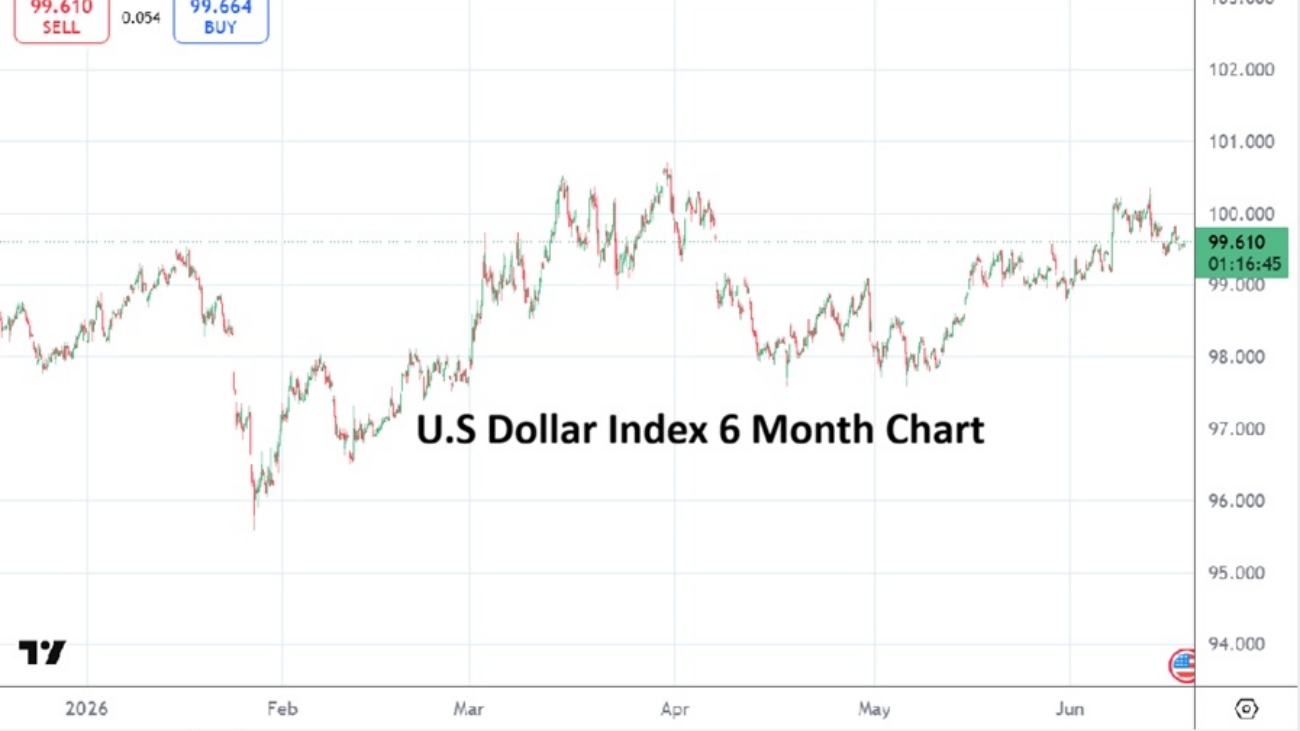
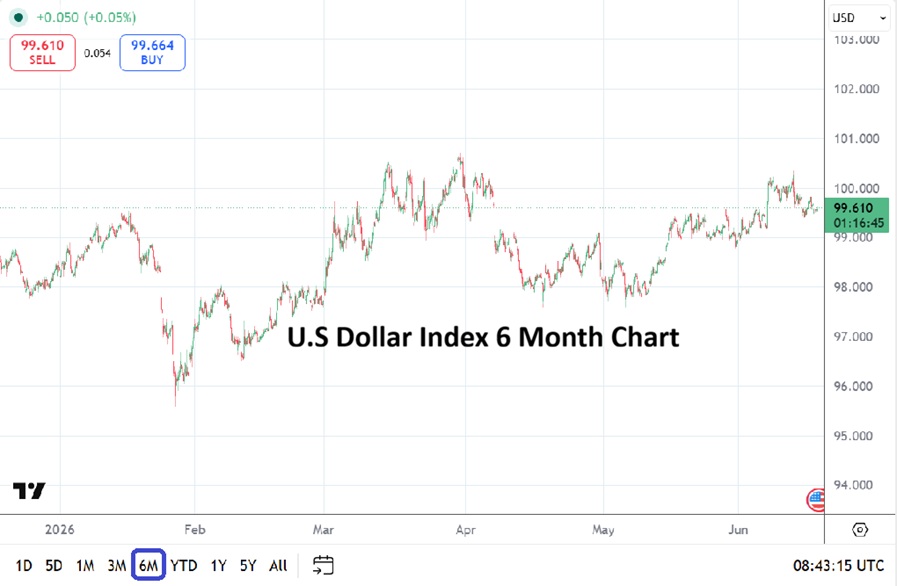
The U.S Dollar Index is trading near relative highs. The broad FX market is certainly cautious, but financial institutions may be leaning into the notion of USD centric weakness. Yes, the USD/JPY remains above 160.000+ for the moment, but the USD/SGD is flirting with its lower range and came within sight of the 1.28000 mark on Monday. So why is this important? Because folks are acting cautious before a potential storm.

U.S Dollar Index Six Month Chart as of 17th of June, 2026

Perhaps this will go down as an infamous egg on the face situation for me personally, but does Fed Chair Kevin Warsh really want to raise interest rates during his first FOMC meeting at the helm? Yes, Jerome Powell is still around as a voting Governor, but Warsh may find he has enough votes (and influence) to get a majority of other FOMC voting members to allow today’s decision to be a test case in favor of patience. 

If the Fed holds the Fed Funds Rate in place and announces it will use the near and mid-term as a trial period regarding their belief inflation will lessen, because it believes energy prices over the mid-term will erode rapidly, that may be enough to cause USD centric selling later today. The Fed will not use the word transitory I suspect, but an argument can certainly be made that now is the time to actually elucidate on the subject of transitory inflation.

Monday’s trading in the broad Forex markets showed that financial institutions bought into the optimism of an anticipated U.S and Iranian agreement and what it could deliver – a glut of Crude Oil, including lower costs for its ancillary products. Financial institutions were also relieved that U.S equity markets survived the launch of the SpaceX IPO certainly. While yesterday’s broad market trading turned cautious and demonstrated sideways action in Forex, many major currencies are traversing near curious values. Equities also went sideways for the most part on Tuesday.

The U.S Dollar Index is swimming within its higher terrain via a six month chart (per a look above), yet financial institutions – if they hear dovish sentiment from the new Fed Chair today could spring into action and sell the USD quickly. Day traders need to understand even if this occurs that it will still be ultra-dangerous to bet ahead of the Fed rate announcement and Press Conference. This because volatility leading up to and following the FOMC Federal Funds Rate decision will create large spreads in Forex and choppiness that small retail accounts cannot handle most of the time – particularly when too much leverage creates wildfires.

While the before and after of the Fed interest rate announcement will garner the headline news, and create a reaction on Wall Street for the S&P 500 and Nasdaq 100 immediately; it will be wise to pay attention to Fed Chairman Kevin Warsh a half hour later when he steps into the spotlight for the first time. There has been chatter that Warsh is not keen on trying to give too many signals regarding the Fed’s thinking regarding every move it is contemplating. 

This coincides with thoughts that Kevin Warsh and Scott Bessent believe in a more high-tech and pro-active approach to interest rate and monetary policy based on forward looking data. The consideration of a more dynamic approach to interest rates has not been widely considered by financial institutions quite yet. If the new Fed Chair surprises reporters and onlookers at the Press Conference today with a new philosophy on the way the Fed will work, this will set the stage for potentially large behavioral sentiment shifts that were not wagered on quite yet. In other words mid-term outlooks regarding U.S interest rate policy may change in a handful of hours more than many people think. 

Maybe I am wrong, maybe I am interpreting the political and financial landscape incorrectly, but these are my thoughts as a risk analyst – one who thinks the U.S White House would not mind seeing a weaker USD, a Fed that likely wants a different approach to interest rates – as they both hope for energy prices to lower (and may get their wishes fulfilled).

Copy and paste the text from AMT that you want to share

post245

Why No Major Panic in U.S Stock via Moody’s Downgrade?

Why No Major Panic in U.S Stock via Moody's Downgrade?

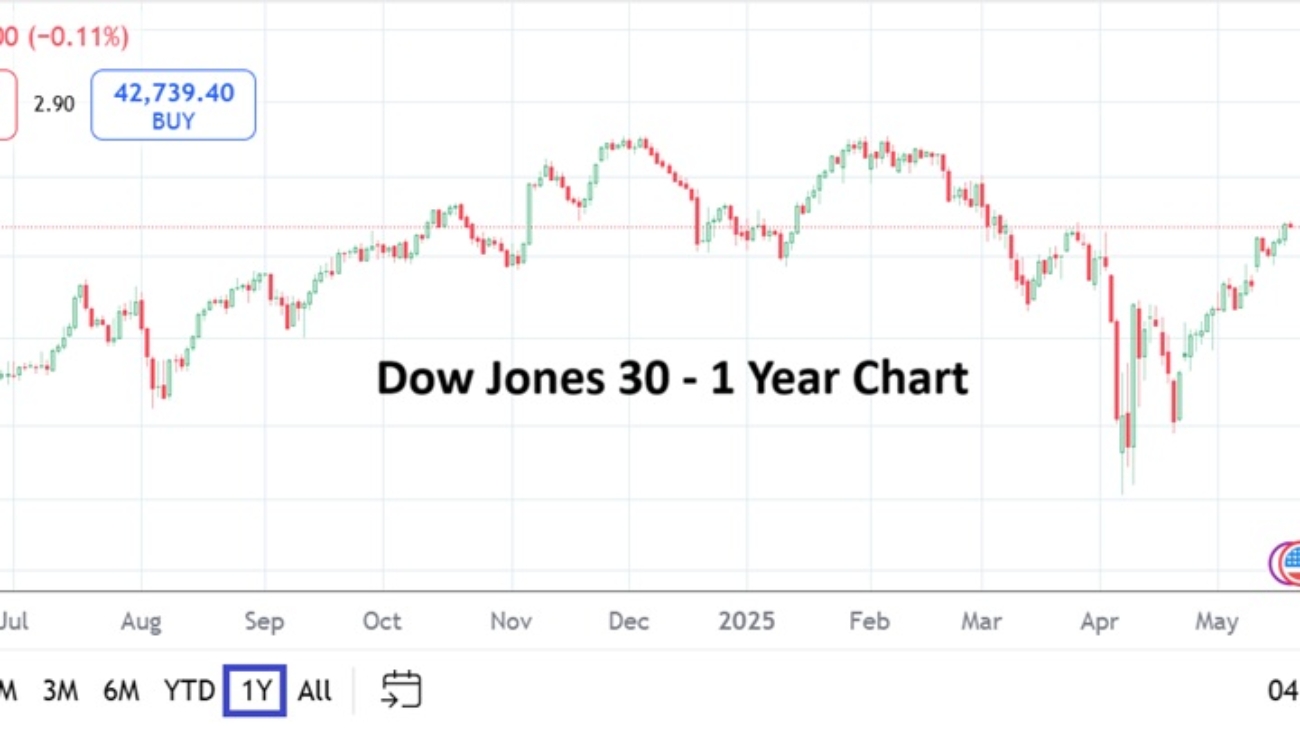
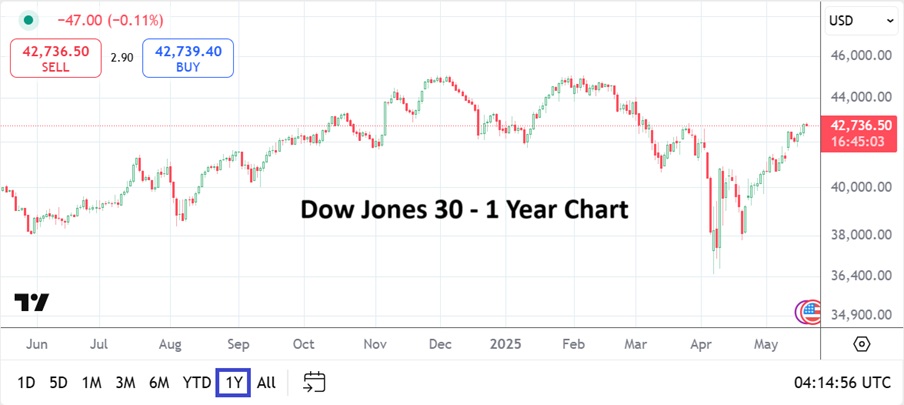
While Asian equity markets opened with initial nervousness yesterday after Friday’s late downgrade of U.S debt by Moody’s to Aa1. The U.S major indices did not respond with panic selling, By the end of yesterday’s trading the Dow30, Nasdaq100 and SP500 turned in rather mundane and positive results. Behavioral sentiment and knowing what experienced investors think remains important for people trying to mirror the actions of larger players while trying to take advantage of potential market action.

Dow Jones 30 One Year Chart as of 20th May 2025

What was NOT mentioned widely in the press yesterday were the facts that Standard & Poor’s had actually downgraded U.S debt in 2011 from AAA to AA+, also Fitch had been warning of a downgrade the past handful of years and did so in 2023 to AA+. U.S government debt remains a definite burden on the U.S economic outlook, but investment institutions have been discussing the dangers of the 36+ trillion USD deficit for years. Talking about something doesn’t mean it is fixed, but it does mean it has been acknowledged and this is where sentiment comes into play.

Wall Street remains in many respects the only game in town for large global investors looking for quiet steady returns. U.S exceptionalism – or at least the concept that the U.S economy remains a true safe haven compared to other investment vehicles worldwide – continues to spur on a confidence game that sees money pumped into it by global pension funds and long-term investors which seek yields that outpace inflation. It can certainly be argued that this endeavor is not always achieved, but the concept that the ability to grow money faster in equity investments via the likes of index investing compared to letting money sit in a bank is noteworthy. The ability of large institutions to place considerable amounts of money in more speculative pursuits like singular equities in sectors they are interested in like AI and quantum also creates a dimension to outperform benchmark indices., but is riskier.

The USD remains the world’s currency of choice for effective trade and protection against the dangers of volatile Forex. The Trump administration likely wants a weaker USD in order to spur on export from the U.S, but it certainly doesn’t want to see the greenback killed. Nor does the White House want to see U.S Treasury yields balloon too high. Day traders may not have been told to watch yields in the 10 Year U.S Treasuries by their brokers, but it is an open secret that should be used as a barometer for investor sentiment. The signals may not work everyday, but over the long-term if U.S yields on the 10 Year U.S Treasuries are soaring it likely means major U.S equity indices are struggling with anxiety – and when the yields are turning lower it can be expected that U.S equity indices are gaining.

An important piece of the confidence game that speculators should note regarding confidence in U.S markets is that 10 Year U.S Treasury yields yesterday declined, and are now lower than values seen last Friday after the ratings downgrade by Moody’s, and are testing values seen on the 14th of May. Traders should certainly stay alert, but they must remember the U.S investment landscape is resilient and is likely not going to perish suddenly. Investors like most humans tend to be optimistic and believe things will work out with positive results somehow developing. It doesn’t mean stock values will always go up, in fact they can move lower violently periodically, but a long-term vision helps when investing in U.S equities.

There has been no panic in U.S equities and the world continues to look at the SP500, Dow30 and Nasdaq100 as places to position investments. Yes, other spheres exists which can produce greater yields, but this also includes higher risks. International diversification is a solid focal point for investors, and day traders need to understand a complex game is being played. Reacting to every soundbite of developing news probably does more harm to speculators compared to good. A steady approach and conservative risk taking tactics are vital.

post228

Market Volatility Concerns While Deflecting Noise From Afar

Market Volatility Concerns While Deflecting Noise From Afar

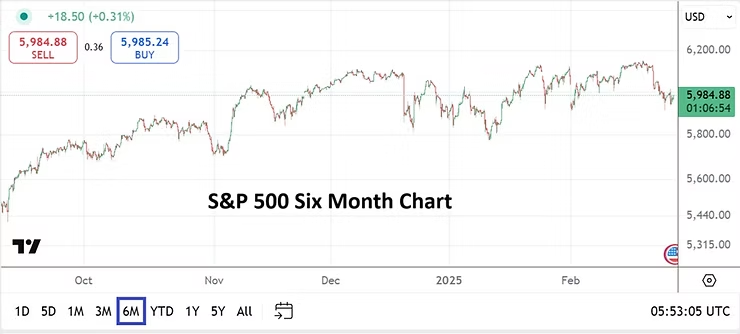
S&P 500 Six Month Chart as of 27th February 2025

The phrase if it bleed it leads is a fixture regarding the world of media. People and their companies want your attention. The addition of Donald Trump to the White House helps those that are content to see him in office, but it also helps those who oppose him because it gives his detractors a centerpiece to a lot of their ‘insights’. Perspectives abound and while watching the financial markets, we are bombarded with loud opinions formed by folks vying for our time. In many cases they are also trying to attract our money.

Wall Street has seen choppy results the past week, but speculators need to remain objective and not allow distractions to destroy their ability to gauge the marketplace. When looked upon with a mid-term reference it is rather easy to define the results upwards in the stock indices from the U.S have been rather good. There is no guarantee you are going to make money speculating. Losses occur and they do not only happen to speculators but they happen to investors too.

Timeframe speculative management and separating the noise from facts is difficult enough under normal circumstances. However, because of the notion if it ‘bleeds it leads’ which is dominating media for the moment, we are within a cycle when influencers can use headlines to catch our attention. Perhaps they believe what they say, perhaps they are trying to guide us towards a product, or perhaps they simply enjoy predicting misfortune.

EUR/USD Six Month Chart as of 27th February 2025

Yesterday during President Trump’s cabinet meeting when asked about the E.U, Trump stated a proclamation of love for Europe, but then added that the E.U was a special economic case and has been getting away with a lot of things like expensive tariffs on the import of U.S cars. He also said the E.U was created to compete with the U.S – though this needs to be taken into context and that Trump meant this only as a trade competitor.

Nearly as quickly as Trump made his statement, some began to use this loose remark as a narrative that the EUR/USD was struggling because of these new worries. Fears about a massive trade war were sounded from some legitimate but overly contrived media sources. Yet, a trade war between the U.S and E.U isn’t going to happen ladies and gentlemen.

The fact is that the EUR/USD has been struggling for a handful of months and is starting to show signs that support levels are durable. The greater likelihood is that financial institutions believe the EUR/USD is oversold and have a bullish perspective for the currency pair over the mid-term. Yes, Europe continues to produce lackluster economic data, but a lot of the value in the EUR/USD has had risk adverse concerns priced in already. Looking for upside from the currency pair around its current levels is not farfetched. Downside risks look limited compared to upside potential.

Once again the financial media who want your attention were given click bait material to get you to react. Day traders need to understand they are constantly being sold not only false narratives but false opportunities too. Speculators looking for profits with quick hitting trades can make money, but many times they lose money because they are working in conditions in which they do not have enough control of their emotions. Day traders should clearly understand they are operating within a gambling universe when they attempt to trade Forex, equities, Indices, commodities and needless to say cryptocurrency.

Traders must work on improving their decision making process. They need to take into consideration their perceptions of the financial landscape, but also understand what their counterparts are thinking too. Financial institutions certainly trade for short-term results, but they are also operating with mid-term outlooks. The likelihood that they are worried about an onslaught of tariffs from the Trump administration is contained by the realization that the current President of the U.S negotiates using tough methods. The bombastic hyperbole of President Trump’s business techniques are not loved by everyone, but they often get the job done regarding his intended desires.

So what should you do? First of all relax with a deep breath. The world is not coming to an end. The financial landscape is not facing a cataclysmic scenario. Many volatile financial events have been seen throughout time. Traders need to understand that the market action on the SP500, Dow30, and Nasdaq are vulnerable to selloffs occasionally that can last for unknown durations which makes daily speculative wagering prone to significant cash losses. This is why investors who have different perspectives regarding timeframes and take a slow and steady approach often come out better than folks who are merely gambling.

Day traders need to eliminate as much noise as possible. This is done with solid risk taking tactics using methods which involve knowledge gained through experience, and knowing that not everything they are hearing is meant to help. Practice a trading mantra by having realistic price targets, chosen timeframes, conservative leverage; using entry orders helps, adding stop loss and take profit orders to get out of positions are vital too.

The mid-term outlook for the EUR/USD and the stock markets likely remains bullish in the eyes of financial institutions. There are many factors in trading, and the virtues of patience and knowledge help considerably. Again, remain calm because while the financial markets often react to shortcomings via human fallibility, they frequently become optimistic once again.