SP500 20260713

S&P 500: Short-Term Caution and Long-Term Ambitions

Speculative Opportunities Do Not Promise Immediate Profits as Cautious Outlooks Stir

The S&P went into this past weekend with slight gains made on Friday, but essentially finished where last week began. In early morning trading via the futures market the index has seen a slight decline. Retail short-term traders may decide that offers the potential to sit on the sidelines and watch what may be rather choppy conditions, this if they decide not to pursue.

Global markets including stock indices like the Nikkei and broad Forex have shown more discomfort early today. Short-term concerns and mid-term viewpoints are colliding and making momentum hard to sustain. The S&P 500 remains within its elevated realm, but there is a rather unpleasant taste many speculators have had to endure since the end of May, particularly if trading ambitions have been limited to near-term pursuits.
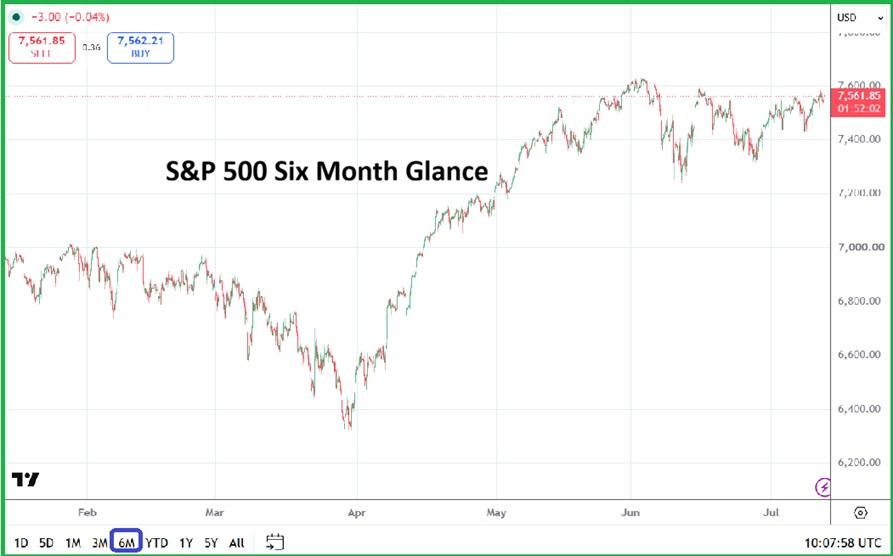
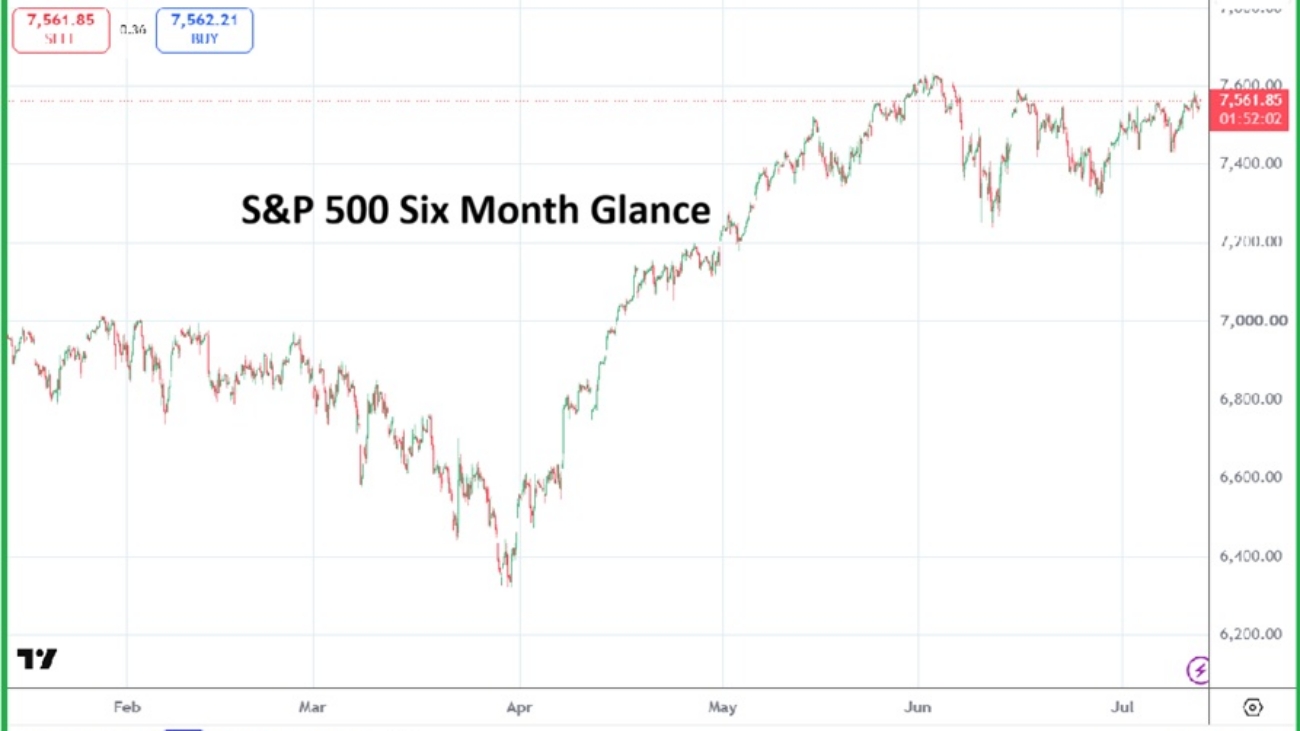
S&P 500 Futures Six Month Chart as of 13th July 2026

There will be a crowd of people at summer parties (or winter outings depending on which side of the equator you are on) discussing the gains made in the S&P 500 (and Nasdaq  100) since the end of March who will be quite keen to brag about their insights. However these same people have likely made their money via pension funds, mutual funds and other long-term endeavors guided by institutions managing their money. Because most short and near-term retail traders have likely been savaged by the results in the marketplace the past handful of months. 

Trading within the current markets conditions for those who have smaller accounts and are relying on leverage to create profits have likely been bled dry of their funds if they have not used proper risk management. It is one thing to want to make a thousand dollars a week in the markets as a retail trader and quite another to actually accomplish the task. 

Indices the past handful of months have been a churning machine in which volumes stir and create attractive chatter, but also deceive folks into believing they can win easily. The only folks winning consistently right now are brokers handling their clients’ retail accounts.

This doesn’t mean you have to stop and give up as a retail trader, but it should serve as a warning that not being overly ambitious and remaining patient are keys when trying to beat the markets. And again, let’s remember the average retail trader has about a 90% chance of failing when trying to speculate.

The S&P 500 did hit a record height in early June around the 7,620.00 vicinity. Its current values are well within sight of those highs too. Yet, headwinds continue to be seen via trading results intraday as financial institutions deal with wavering behavioral sentiment complicated by a myriad of concerns.

Yes, there will always be concerns in the marketplace, risk and reward are often compared to the potential of loss. If you are placing a bet in the markets that you believe can garner a thousand-fold profit, it is likely you are also risking a thousand-fold loss. And unfortunately the marketplace, nor your broker is going to lose sleep over your inability to understand what risks you are undertaking. You will hear that you have learned a tough lesson and the experience will help you become a better trader next time around by your broker, this as they offer you another opportunity to enter the markets on their platforms, but it still doesn’t guarantee you anything. 

The rumblings from the Middle East continues to mitigate sentiment in the global markets. As of this writing WTI Crude Oil is around $73.70. If military conflict between the U.S and Iran continues to incrementally escalate, perhaps experienced players will be able to handle the noise and worries regarding higher energy costs and threats of inflation. 

Equity indices are also running into problems caused by a realization that the costs of investing into companies working in the AI realm are now having to deal with rising costs, this as revenues do not meet expectations, and a lack of adequate physical resources to fuel growth in the sector are raised as concerns. And it is not a stretch to say the AI sector has helped drive more than a handful of equity indices higher. A legitimate fear regarding a downturn in AI related stocks and a possible knock-on effect is a sobering reminder that bullish trends do not last forever. 

And then there is the shadow that is overhangs the Federal Reserve and interest rate calisthenics being worked out by analysts who are trying to convince others (and themselves) that their outlooks are correct.

Yet, we return thankfully to a simple notion and question, one that has very little to do with economics that are taught in university classrooms – are there enough buyers in the marketplace to sustain the upwards trend in the S&P 500? The answer doesn’t have much to do with fundamentals, and often is driven by pure sentiment. Pushing aside day to day travails, wagering on long-term upside remains almost the only wager that can be made. Sure, you can bet on downside; you can short stocks, buy put options that look for lower markets. However, matching negative outlooks with the correct timeframe is just as hard as it is to bet on positive momentum. For the time being it is easy to say the near-term remains murky for day traders. It is harder to predict actual direction
Copy and paste the text from AMT that you want to share

Gemini3 20270711

The Great Compression Part 3: The Immovable Object

The Landlord Beneath the Cloud

There is an old paradox: what happens when an unstoppable force meets an immovable object? The AI buildout is the unstoppable force – the largest concentrated wave of capital spending in history. The immovable object is the physical world it is colliding with. Land, power, and water are the tangible bedrock that no balance sheet can conjure into existence. The paradox has a resolution the classical philosophers never thought of: the immovable object collects the rent.

Consider the scale of the force first. The four hyperscalers – Amazon, Alphabet, Meta, and Microsoft – plan to spend roughly $725 billion on capital expenditures in 2026, up nearly 80% from the year before. Add Oracle, the neoclouds, sovereign funds, and the rest of the AI heavy spenders – and total compute capex crosses $1 trillion in a single year, the first trillion-dollar year of its kind. Much of that money flows to the visible beneficiaries the market already knows by heart: NVIDIA for the GPUs, Micron for the memory, Dell for the servers, Cisco for the networking. Silicon, racks, interconnects.

The Great Compression Part 3: The Immovable Object 

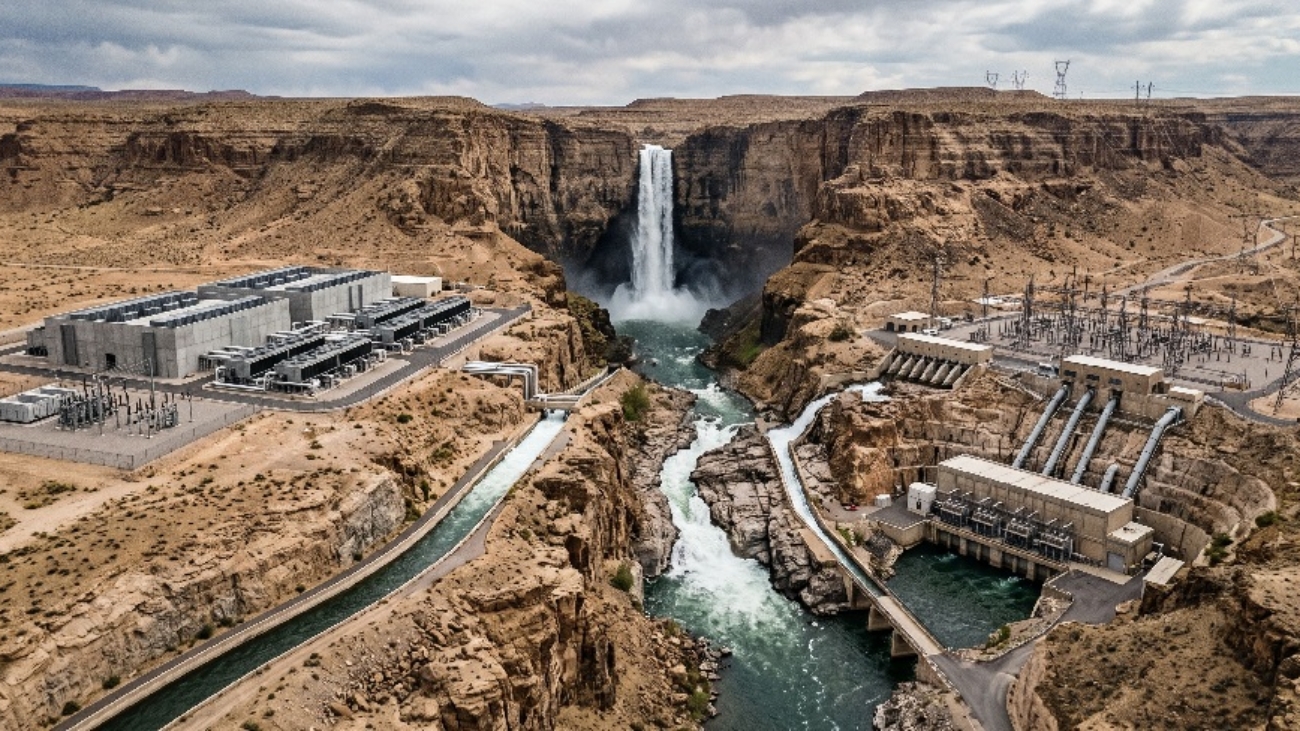
But every one of those chips has to be housed somewhere. It has to be powered. It has to be cooled. And this is where the unstoppable force runs into something it cannot simply outspend.

The constraint is no longer capital, and it is increasingly no longer silicon. It is the physical world. The bottleneck has shifted to power generation and grid interconnection, which take years to permit and build, and to the land and water that data centers consume at industrial scale. The richest corporations that have ever existed are discovering that a signed check does not produce a megawatt or a water right. The immovable object has begun to set the terms.

Nowhere is this clearer than in a deal signed on June 23rd. Texas Pacific Land Corporation, aka TPL, agreed to provide the surface acreage and brackish water for Project Kilby, a large-scale power generation facility Chevron is building to supply a Microsoft data center cluster in Reeves County, Texas. When the announcement crossed the wires, Chevron’s name led every headline – and TPL was a footnote.

Meanwhile, the framing should be exactly backwards. Chevron, for all its scale, is the replaceable party in that transaction. Exxon, Occidental, or any of a dozen major energy companies could have built that power plant. What none of them could have supplied is the specific land and the specific water rights in that specific corner of the Permian Basin – because those belong to TPL, and there is no substitute for them at any price. The company that got the headlines is interchangeable. The company that got the footnote is the immovable object.

TPL is the purest expression of the scarcity trade beneath the AI buildout. It owns roughly a million acres of West Texas and produces almost nothing itself. It does not drill. It does not manufacture. It collects royalties, easements, and water fees from everyone who needs to operate on its ground. It is a toll booth on the physical world, and the AI buildout has just become one of its largest new customers. For years the market valued it as an oil-and-gas royalty play. It is quietly becoming an infrastructure landlord for compute – and almost nobody has ever heard of it.

The same logic radiates outward through the entire physical layer. Power is the genuine bottleneck, and the companies that generate it are being repriced accordingly. Constellation Energy, the largest operator of nuclear plants in the U.S., has become an unlikely AI stock as hyperscalers sign long-term deals for the one thing they cannot build fast enough: reliable, always-on baseload power. The grid that carries it has its own set of indispensable names – Quanta, which builds and maintains transmission infrastructure; GE Vernova, which supplies the turbines and grid equipment; Eaton, whose electrical systems distribute power inside the data center itself. And as chip density rises, the heat has to go somewhere, which has turned Vertiv, a maker of cooling and thermal management systems, into a core holding of the buildout.

What is striking is that this category does not merely sit still and collect. Some of its members are actively repositioning to attack. Ford, unable to win the electric-vehicle war against Tesla and nursing a $19.5 billion writedown on its EV investments, has taken the same physical assets – its plants, its battery capacity, a century of manufacturing expertise – and redirected them. In May it launched Ford Energy, a subsidiary building grid-scale battery storage systems, with data centers named explicitly as the demand driver. The immovable object, it turns out, can also choose its targets.

This is the HALO trade: Heavy Assets, Low Obsolescence. Companies whose value rests on tangible, physical assets and established operations that are expensive, time-consuming, or regulated – and therefore very hard to replicate. Land. Power. Grid. Water. Steel and concrete and copper. The unglamorous inputs that no model can commoditize because they cannot be reduced to software, and no amount of capital can summon into existence overnight.

None of this is permanently fixed, and it would be dishonest to pretend otherwise. Innovation erodes scarcity: small modular reactors, advanced geothermal, and better transmission technology will, in time, loosen some of the constraints that look absolute today. But two things blunt that threat. The first is Jevons paradox – when a resource becomes cheaper to use, consumption rises to swallow the savings, which means more efficient power generation is likely to expand the buildout, not shrink the edge of the providers. The second is that not all heavy assets are equal. The manufacturers and equipment makers face real competitive pressure over time. The owners of irreplaceable location – the specific acre, the specific water right – do not. You can build a better reactor, but you cannot build another Permian Basin.

The value that fled the human middlemen, that commoditized in the model layer, that migrated up the stack toward proprietary data and orchestration – also flows downward, and at the bottom it stops. It settles into the ground, into the wires, into the water table. But the ground is not neutral territory: land is permitted, power is regulated, water is allocated, and the fabs that print the silicon sit inside country borders. The unstoppable force keeps accelerating; the immovable object keeps collecting. And the moment we ask who owns the immovable object, the scarcity trade stops being a matter of markets and becomes a matter of sovereignty.

Copy and paste the text from AMT that you want to share

Nifty 50 20260708

India Insider: Foreign Investors and Their Selective Choices

Return of Global Investors into the Indian Marketplace

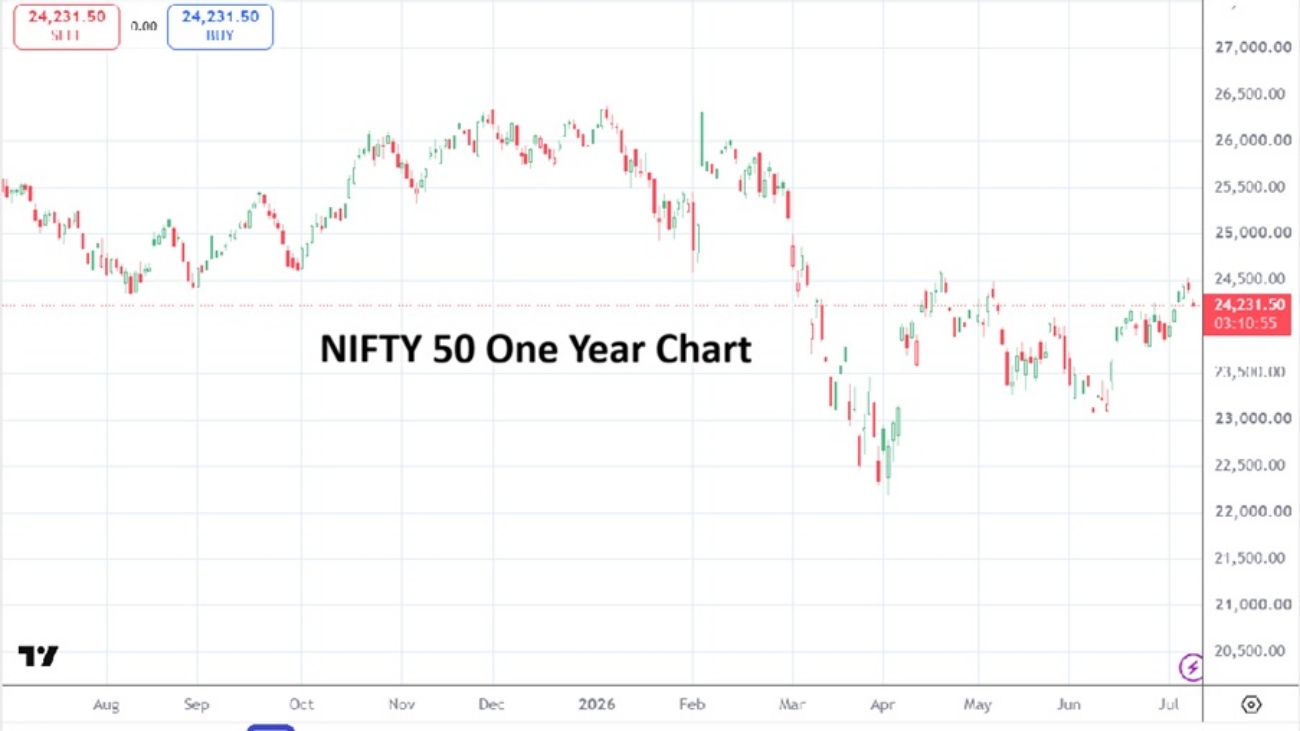
Global investors are gradually returning to Indian assets after months of persistent outflows as risk appetite sentiment has been ignited by an extended ceasefire between the U.S and Iran. Energy prices have moved in India’s favor, sparking favorable conditions. 

Despite recent flare ups in the Strait of Hormuz, Brent Crude has dropped about 30% in the past quarter, easing India’s fuel concerns as the world’s third largest Crude Oil buyer. AI trade rotation is gathering pace in Asia also, this as investors pull money from chipmakers that powered this year’s rally and hunt for cheaper ways to deploy their cash.

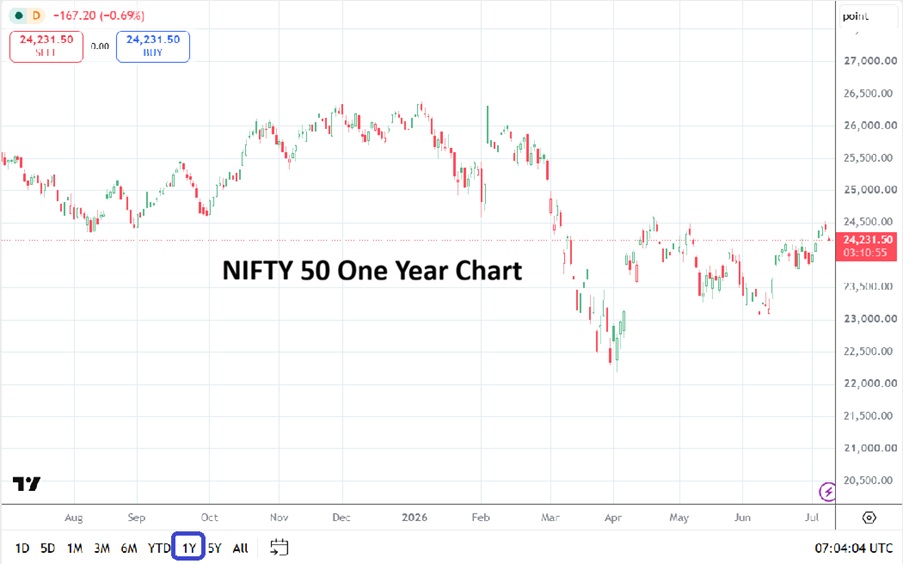
NIFTY 50 One Year Chart as of 8th of July 2026

Indian equities beat its emerging markets peers in June by its biggest margin in seven months. The Reserve Bank of India’s measures to attract foreign currency deposits and overseas capital have eased funding concerns for lenders, record foreign inflows into government bonds have helped stabilize the Rupee and improve liquidity conditions. According to Bloomberg, “Goldman Sachs favors 30-Year government bonds as lower oil prices allay inflation and fiscal risks”. 

Combined with resilient credit growth and improving asset quality, India’s banking sector is once again attracting global investors, this after trading at meaningful discounts to historical valuations for quite a while.

Second Opportunity May Be Information Technology

Indian IT companies have undergone a sharp valuation correction over the past two years. Unlike the post pandemic period, when large Indian technology firms traded at substantial premiums to global peers such as Accenture. These premiums have now narrowed considerably after earnings growth slowed, and enthusiasm surrounding Artificial Intelligence shifted investor attention towards US technology companies.

As highlighted in Business Line magazine, the sector is undergoing a healthy valuation reset, with investors increasingly questioning whether premium valuations remain justified without a corresponding acceleration in earnings growth.

However, the discussion extends beyond valuations. Artificial Intelligence is fundamentally reshaping the enterprise software industry. For decades, Software as a Service (SaaS) companies dominated enterprise technology by offering standardized cloud based solutions that were cheaper and easier than developing software in-house. That advantage is now beginning to erode.

Large AI companies such as OpenAI and Anthropic are building AI agents capable of operating across multiple enterprise applications through a single conversational interface. Rather than competing within individual software categories, these horizontal AI platforms could reduce the importance of stand alone enterprise applications by seamlessly connecting them. At the same time, AI native startups are targeting specialized business functions, while advances in generative AI are encouraging enterprises to revisit the traditional ‘build versus buy’ decision as they develop customized software internally at significantly lower costs.

For Indian IT services companies, this represents both a disruption and a new opportunity. Routine application development and maintenance may become increasingly automated, placing pressure on traditional outsourcing revenues. Yet demand for AI integration, cloud migration, cybersecurity, enterprise transformation, and customised AI deployment is likely to create an entirely new investment cycle. The winners will be firms that evolve from conventional software service providers into strategic AI implementation partners.

Risks ahead for Indian Markets

The near term outlook is not without risks for India. A weak monsoon could push food inflation higher. Elevated Crude Oil prices may widen India’s external balances. And a stronger USD with elevated U.S interest rate yields could moderate foreign capital inflows. The technology sector also faces a structural challenge as Artificial Intelligence reshapes the traditional software business model, requiring companies to adapt more quickly than in previous technology cycles.

Even so, the broader macro backdrop appears to be improving. Policy measures have eased liquidity conditions, corporate balance sheets remain healthy, and valuations across several sectors have become considerably more attractive after an extended correction. Rather than chasing expensive momentum trades elsewhere in emerging markets, global investors may increasingly look toward Indian sectors where fundamentals are strengthening while expectations remain relatively subdued.

Copy and paste the text from AMT that you want to share

Nasdaq100 20260707

Benefits of a Moderate Restoration While Threats of Growing Fissures are Heard

Sentiment: Financial Institutions and November Outlook Amidst Possible Gridlock

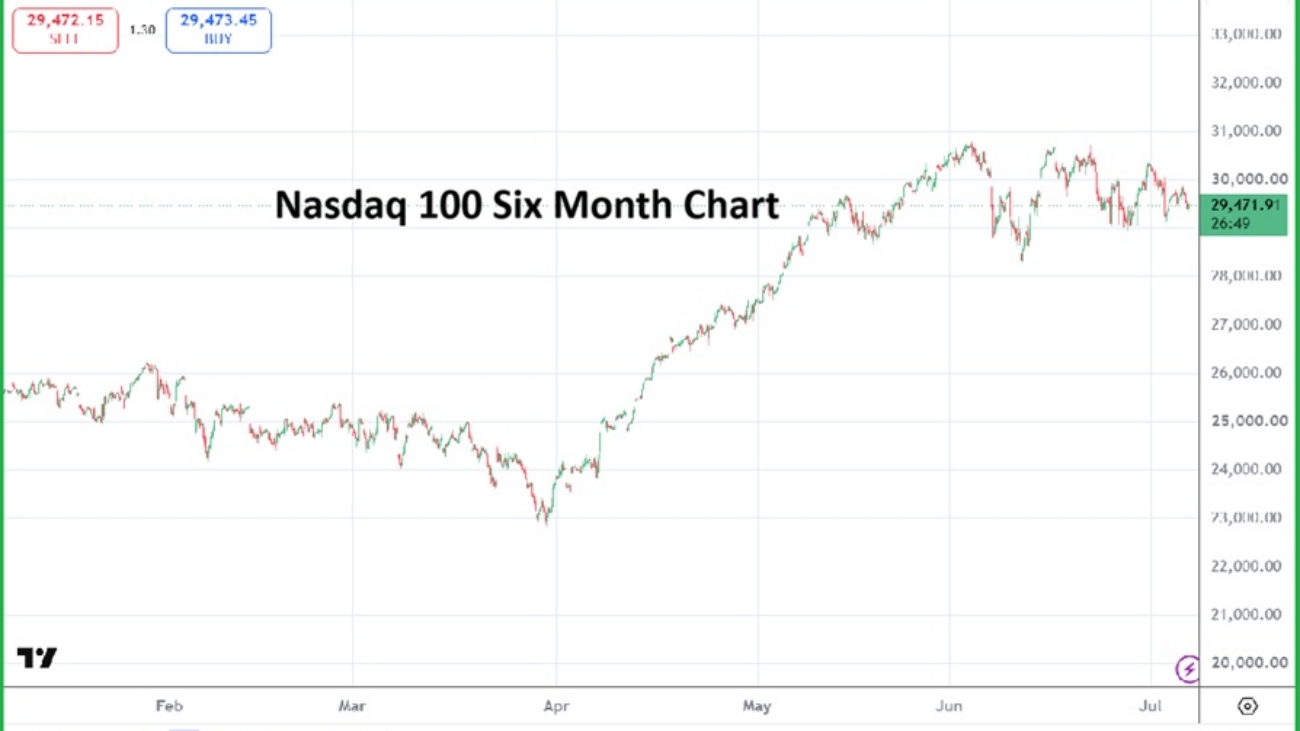
The Nasdaq 100 is clearly being driven by behavioral sentiment at this time. Few investors are paying attention to corporate data, instead many financial institutions are wagering on mid-term outlooks driven by a combination of algorithmic led coding mixed with wishful thinking and hoping they are not washed out to sea by dangerous tidal pools they know are out of their control.

On the 3rd of November 2026, the U.S mid-term elections will largely be held. President Trump’s hold on the House of Representatives looks as if it may come undone as a result of the coming vote if the Democrats take control as some polling suggests.

Perhaps that is exactly what investors are hoping for because historically when there is a divided Congress legislatively, stock market indices actually tend to gain. The reason for this is largely because a paralyzed Congress often finds it hard to pass measures which can hinder corporations and investors, because regulatory mandates are difficult to pass.

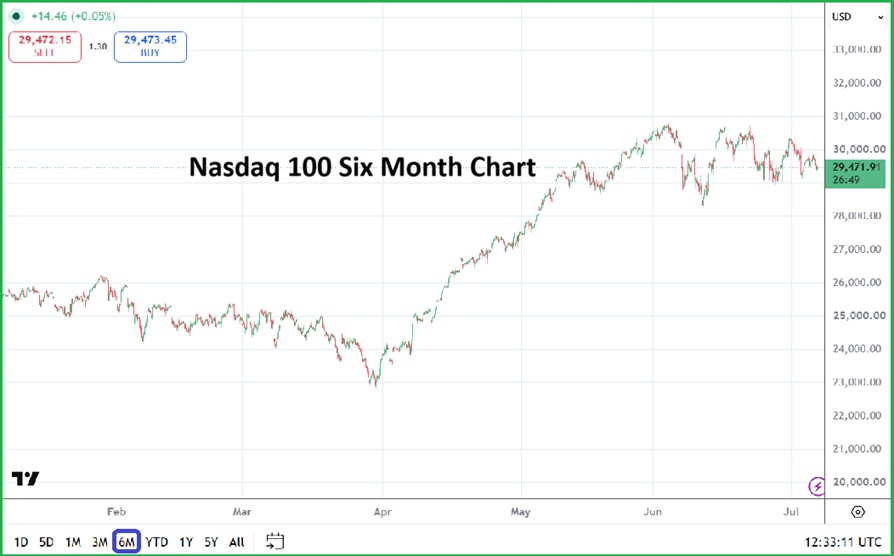
Nasdaq 100 Six Month Chart as of 7th of July 2026

If the Democrats win the House and President Trump is able to retain a Republican led Senate, this will lead to a deadlocked Congress which will make it hard to get work much done. Resulting in what may become one of the more memorable lame-duck Presidency’s of our time, one in which both sides of the U.S Congress openly disagrees with Trump’s ego driven rhetoric and instead turns to the backing of voters from their constituent state’s as a way to amplify their own policies.

While the Republicans appear potentially vulnerable in the November elections, the Democrats have problems of their own. An open fissure has been displayed as Socialists inspired candidates have won primaries in a handful of Democratic led Congressional districts and appear ready to splinter their political party regarding direction. What does any of this have to do with the economy and markets?

Perhaps this is exactly what crowds of investors in global markets, including Wall Street wants to happen at this point. Politicians forced to retreat to return their homes and become less vocal publicly may be a welcome remedy. Folks are starting to tire of political rabble, a crowded intersection of gridlock may be welcome at this point.

Unknowns: A Source of Concern for Investors

While it is certainly within the arsenal of the Trump Presidency to try and issue executive orders to try and get policies approved and acted upon. A split Congress, one in which Republicans can openly disagree with the White House without the fear of a political backlash may cause ruptures and positive outcomes for the GOP, if President Trump is weakened after the mid-term elections this November.

Democrats, particularly if they clash internally on their pronounced policies and have to spend more time trying to put out their own progressive internal fires may have to realign their thinking and walk more moderate lines. Activists on both sides of the political aisles may have to lessen their banter following election outcomes if they believe their voting public wants less noise.

A lame-duck President, could equate into a deadlocked Congress and debates simmering within each party which produce more moderate stances. However, if nothing is settled in November of this year this may lead to betrayals and revenge politically and potentially new leadership emerging which could be even more cynical, ignorant and insistent on false narratives.

Intriguingly, Wall Street will not be bothered by a deadlocked Congress and President who suddenly is limited by eroding power. In fact the conditions of withered post-revolutionary zeal and a slumber which could develop may allow corporations and investors to move freely about the ruptured political landscape with more liberty amidst the chaos. Investors will react to the sentiment that Washington D.C produces. A calm is wanted.

Within the ashes of Republican and Democratic turmoil a reconciliation may actually be able to take place. The question is if a restoration of moderate power will be finally be seen. Wall Street and most global investors would like a return of the centrists. No one is going to agree 100% of the time on policy, but a reality of transparent government without corruption would be a good start, one that many people actually would agree upon.

Copy and paste the text from AMT that you want to share

WTI Crude Oil 20260701

What Am I Missing About USD Centric Strength?

Being Wrong About USD Direction and Betting Against the Trend

Help me out here folks, I am perplexed. I seem to be missing something about the USD centric strength, it looks very overbought to me. Where is all the buying sentiment coming from? The FOMC meeting outcome on the 17th of June has certainly sparked USD centric buying stamina as financial institutions seem to have fallen into a strict line and priced in a Federal Reserve interest rate hike this year.

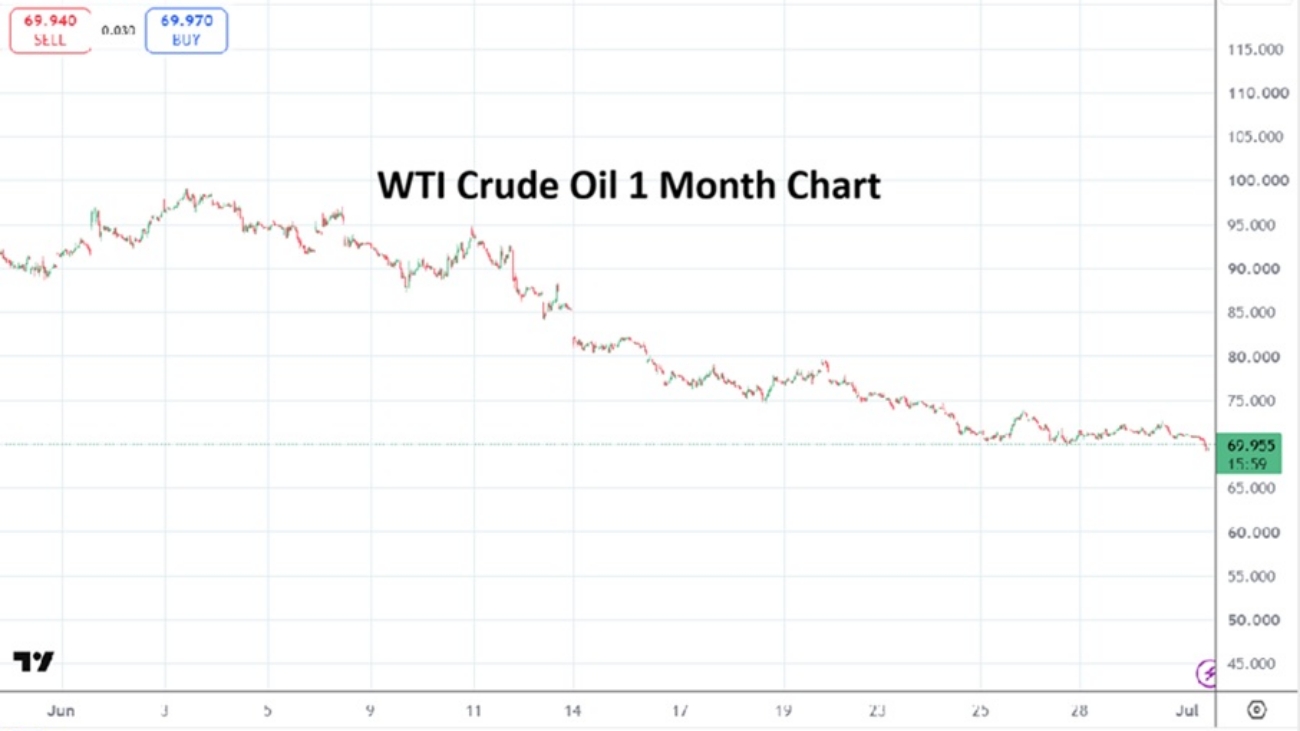
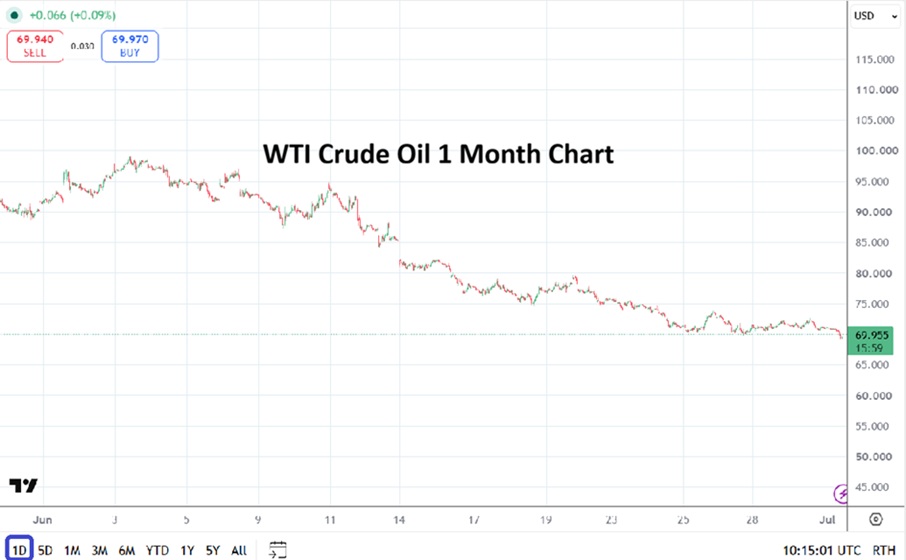
However, the price of WTI Crude Oil was near $80.00 on the 17th of June. And on the 3rd of June the price of WTI Crude Oil was within sight of $100.00. Meaning that we have seen the price of energy trend lower. The agreement between the U.S and Iran, although fragile, has held and the current price of WTI Crude Oil is close to $69.70.

WTI Crude Oil One Month Chart as of 1st July 2026

While concerns about inflation certainly remain, costs should actually start to erode for logistics, fertilizers for agriculture, and manufacturing. Job numbers are solid, growth has been rather steady and shown signs of improvement. If inflation starts to behave and financial institutions change their thinking about interest rates to come, perhaps they will ease off on their borrowing costs.

Also, let’s note that as expected the new Fed Chairman Kevin Warsh has made it clear he will take a more proactive stance regarding interest rates. Evidence for this comes via Warsh’s decision not to participate in the dot forecast that FOMC members use, his absence from the Fed’s ‘prediction market’ game was notable, but many analysts seem to have missed the importance.

In my opinion, Warsh’s decision not to participate in the Fed’s dot plot quarterly signal chart shows the new Chairman wants to create the capability of changing his mind regarding the Federal Funds Rate as needed. The decision not to ‘anonymously’ show what his beliefs are looking forward will allow him to steer the Federal Reserve per forward looking economic data points instead of being held accountable – and possibly blamed – for changing his mind if a shift of opinion is needed.

So again, why is the USD so strong across the Forex board? The USD/JPY is trading well above 162.660+, the EUR/USD is near 1.13900, the GBP/USD around 1.13247 and the USD/SGD is sustaining value at mid-term highs close to 1.29660. While financial institutions appear to have priced in an interest rate, and may also be nervous about volatility in U.S equity indices, the cautious approach has created in my opinion an overbought USD.

As the Independence Day holiday approaches, Forex traders should be careful. If ever there was a time for the Bank of Japan to intervene and cause chaos it might be when USD Forex volume is minimal. Large USD traders may start vanishing in the coming days before the long holiday weekend, and the absence of U.S banks this coming Monday will also factor into the markets.

Selling the USD looks like a speculative bet certainly, particularly because its trend has proven rather strong the past few weeks. Let’s see what happens, but I suspect some downside pressure via USD centric price action is going to be generated.

Copy and paste the text from AMT that you want to share