
Challenge Part 1 20260721

The Challenge of October 7: Part 1 – Introduction

Cynicism and Wake Up Calls: World War I, Vietnam, October 7th

Opinion: The following article is commentary and its views are solely those of the author. This article was first published the 20th of July via The Angry Demagogue.

Europe and the UK had WWI, the United States had Vietnam. Israel had the birth of the post-Zionist left in the wake up call that was the Yom Kippur War, and now (learning that the wake up call did not last) the events of October 7 have demanded that the country face new challenges – intellectually, politically and socially.

The Challenge of October 7: Part 1 – Introduction

World War I and Vietnam gave birth to the cynicism and inferiority complex to Europe and the United States respectively that has reached its nadir in the contemporary West. The utter lack of self-confidence in the traditions, virtues and ideas that moved the West forward from ancient Athens and Jerusalem to the Middle Ages to the enlightenment and on to the computer age. As technology moved forward, the ideas that underpinned it retreated to a nihilistic denial of the monotheistic idea that is the basis of all Western life.

Today’s engineers, physicists, humanists and social scientists miss the historical arc that moves from Plato and Aristotle’s break from paganism and the Jewish intellectual monotheistic heritage from late Biblical and post-Biblical times through the Church Fathers and the medieval Jewish, Christian and Moslem thinkers to our current times. The bits and bytes of the computer age didn’t just happen to be created in this cultural milieu. That is not to say that the monotheistic religions over the past 2,500 years have not held back important thinkers, caused wars and acted (shall we say, pagan-like?) over this time. They have. Each of the monotheistic religions have something to atone for, as do great Eastern religions – Hinduism, Buddhism and Confucianism in their various forms. And no one can deny that in addition to freedom and scientific advances, the Western tradition also created evils such as fascism, Nazism and communism.

Racism, slavery and misogyny existed throughout history in all cultures and while it was the Judeo-Christian tradition that finally ended at least the “acceptance” of these practices, they seem to rear their ugly heads again and again. We see that in the rebound of antisemitism in polite society.

The fundamentalists of all religions and ideologies unable to live with the belief that what they hold dear can be challenged and therefore we have before us various post-modern narratives instead of historical honesty. In my own religion, the fundamentalists go so far as to deny that a great rabbi ever visited a Jewish library and read the stories of a non-religious Jewish writer. The hagiography and insistence that “the greats” never sinned is part and parcel of the fundamentalist narrative and is due at least as much to the same loss of self-confidence that the secular world has endured as it is to blind belief. On the other side, we have “great” historians who create theories that belittle ancient truths with as much scientific proof as the ancient traditions themselves.

In Israel, as we stated before, the Yom Kippur War was the shock that told the elites that maybe they were mistaken in their Zionism and that a new post-Zionist, post-nationalist, European style country is what should replace the pioneering, self-sacrificing, idealistic country that had been built. They looked at Western Europe and saw a peaceful, prosperous continent and wanted to copy it. What they ignored of course was the beginnings of a demographic crisis, the total dependence for their defense on the United States, and most importantly a loss of creativity and energy that comes with the cynicism and exhaustion of a continent that went through two world wars and was free only because outside powers fought their occupiers and tormentors. Half the continent was still under occupation of course in 1945, but that did not affect the post-Zionist worship of the free half then under the nihilistic force of post-modernism.

After the Yom Kippur War, the Israeli establishment and not only the establishment was ready to move on from the Zionism and Judaism that formed the basis of the Jewish and democratic state in order to move it from its pariah-hood in its own neighborhood. The lure of peace and stability and the hope of a comfortable future was put in the hands of those who felt it was Israeli pride and self-respect that was the reason why the country could not live in peace with its neighbors. Shimon Peres, the tactician, par excellence, who was more responsible for building up the IDF than any other single person, decided to turn into a strategist and went so far as to oppose the study of history in schools. Only forward-looking people need apply.

October 7 has brought the country to another crisis of confidence, but the consensus that is being established is neither a return to the post-Six Day War euphoria nor the post Yom Kippur War depression. Over the coming few days we will examine the intellectual, political, military, diplomatic, cultural, social and economic changes that the post-October 7 country is forcing on the old leadership of both the left and right, the religious, fundamentalist and secular. The current election battle is being fought along the old lines, but the country is moving away from them. It could be that the change will come in this October election, but it may take more time until the leadership is changed and the discussion moves from the old battle lines to new, unknown disagreements.

Over the next few days, we will examine the changes that need to happen in order for Israel to deal with the trauma and, dare we say, opportunities that the failure of October 7 has brought.

Disclaimer: the views expressed in this opinion article are solely those of the author, and not necessarily the opinions reflected by angrymetatraders.com or its associated parties.

Follow Ira Slomowitz via The Angry Demagogue on Substack https://iraslomowitz.substack.com/
Copy and paste the text from AMT that you want to share

SIngapore Dollar 20260717

Thoughts on the USD/SGD, Cautious Broad Market Sentiment and the Weekend

USD/SGD: Currently a Hope and Prayers Barometer in Global Forex

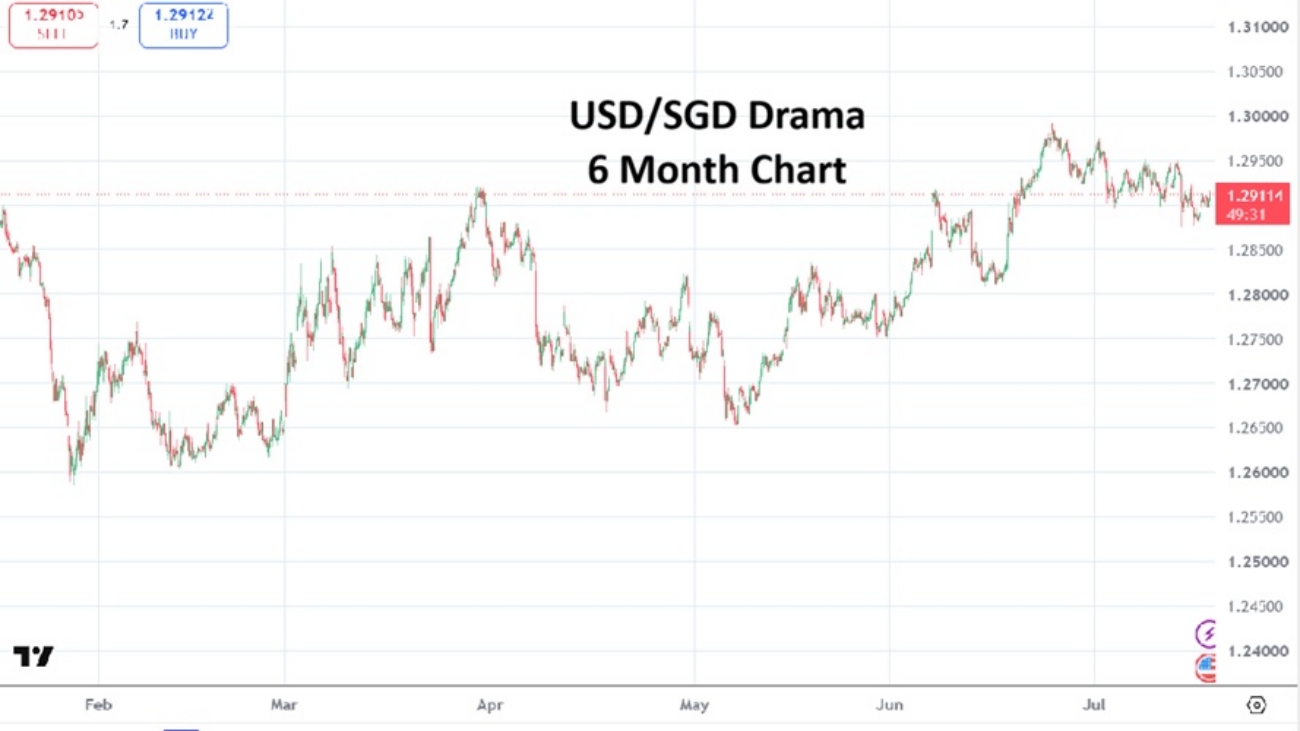
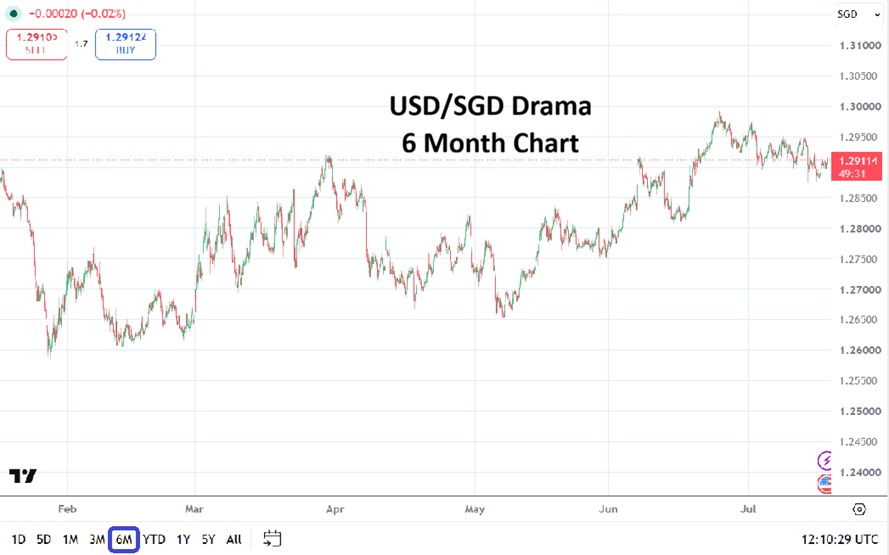
The USD/SGD is near the 1.29110 vicinity as of this writing. Financial institutions apparently have combined their cautious outlooks in the broad Forex market as USD centric strength continues to leak into sentiment, while their instincts technically demonstrate that over the mid-term currencies like the Singapore Dollar should be stronger and the USD/SGD is supposed to show some bearish activity.

For dramatic purposes let’s call this current phase of Forex trading including the USD/SGD as the hope and prayers act. The Singapore Dollar has sustained highs, but it has traversed lower over the past few weeks. On the 24th of June the USD/SGD was near the 1.29940 ratio. Let’s be clear, for small speculative Forex traders broad market wagering on USD direction remains dangerous.

USD/SGD Six Month Chart as of 17th July 2026

Fed Chairman Keven Warsh and His Desire to Introduce New Data

During the recent testimony of Fed Chairman Kevin Warsh in Washington D.C he made it clear he is keen on introducing AI tools into interpretations regarding Federal Reserve policy. However, he also said that AI will not be relied upon alone. From a coding perspective, Warsh essentially said proactive data will become part of the Fed’s thinking with proper supervision: some of you may want to call this a stack developer’s job.

At the same time while refusing to tip his cards regarding his stance on interest rates too much, Forex markets responded by selling the USD in incremental bouts. Intraday trading flared in its usual manner, but started show a core belief that Warsh is demonstrating dovish sentiment regarding interest rates.

USD/SGD as a Forex Barometer and Near-Term Behavioral Sentiment

The USD/SGD serves as a solid barometer of the Forex market. It offers perspectives on Asian sentiment, but also shows how global financial institutions are leaning. The escalation of firepower in the Middle East the past week and into today has caused reactions in the USD/SGD, but somewhat politely.

Having been able to trade below the 1.29000 mark on Tuesday and Thursday of this week, the currency pair is trading near values seen on the 8th of June and 18th. A lack of clarity remains a theme in Forex. The USD/SGD is the 10th biggest Forex pair via transactional averaged volume, so traders should give it attention even if they do not pursue.

Wall Street Remains Nervous and the Tense Weekend to Come

Going into this weekend Forex traders have created downside pressure on the EUR/USD and GBP/USD. The USD/JPY remains stubbornly above the 162.300 ratio. Nervous selling on the Nasdaq 100 via futures trading has been seen today and it looks as if Wall Street will be in for another bumpy ride. The wishful thinking drama in the financial markets is being confronted by the reality of a potentially loud weekend of military conflict between Iran and the U.S, and a seemingly unconvinced marketplace that doesn’t want to demonstrate risk appetite.

WTI Crude Oil prices via futures trading are above $80.00. Having been able to sustain values above the 1.29100 mark in the USD/SGD signals that bearish mid-term perspectives still need additional impetus to create more selling, but this doesn’t appear a wise speculative bet going into the weekend.

A cautious stance over the coming hours should be anticipated as folks wonder what the coming weekend will bring. At least there is the World Cup championship on Sunday (New York time) to take our minds off of concerns. However, Monday will not react to the trophy being raised, but to behavioral sentiment that will takes its cue via today’s finish on Wall Street and noise generated via the Strait of Hormuz this weekend.

Copy and paste the text from AMT that you want to share

Troll

India Insider: A Giant Bureaucracy Needs an Urgent Reset

Paperwork Cyclones and Slow Pace Confront Indian Citizens and Corporate Investment

Almost every single day Indians are confronted by massive bureaucratic problems when they have to approach the government for basic services. When this will change?

For example if you apply for an Aadhaar card (which is used for proof of identity and address in India), birth certificate or ration card (used primarily for getting subsidized groceries in government run stores), or want an electricity connection or passport, you have to move through a myriad of unnecessary bureaucracy in many government offices.

Recently, I went to renew my passport which was authorized and overseen in a regional passport office in Tiruchirappalli of the Tamil Nadu State. To my astonishment, there were no single chairs or any other type of sitting amenities for visitors carrying their applications. Visitors had to sit down on the floor outside the passport office.

India Insider: A Giant Bureaucracy Needs an Urgent Reset

Also applicants inside the premises had no access to office drinking water or restroom facilities. And the waiting hours were too long. The authorities there treat people like teachers treating students, making normal people wonder why they have to apply for their  passports by undergoing this giant bureaucracy as if it were a psychology test of some sort. Many people pour their anger and frustrations onto online forums complaining about the mistreatment.

Some of these people likely wondered how India despite showcasing it can send satellites to space and the Chandrayaan to the moon, doesn’t seem to have a stable, nor easier services for the day to day needs of the people regarding government affairs.

The government may argue that due to large numbers of people constantly applying for various forms and certificates, and a lack of adequate staff, things are more than a little complex in many overburdened government departments. But the fact the government seems to miss and a critical point people are driven to anger about, is that the nation collect taxes from its citizens to insure adequate services which are not fulfilled comfortably in most cases.

Indian citizens are not applying empty handed for a passport and expecting charity or miracles from the government, rather they pay an accepted fee to the passport office. Thus, it’s the duty of the government bureaucracies to be held accountable.

In government run local panchayats (rural government assemblies), there is always rampant corruption. An example can be given regarding the simple renewing of a business license. Corruption is a common thing. Vishalini (name changed) told me that she had to pay a 5000 Rupees fee ($51 USD) in 2019 in order to bribe a local panchayat to get her father’s death certificate

Imagine what would happen if some officers from the government or its employees, went to a restaurant and they were treated badly and charged $20 instead of $2 for a Dosa or Vada Pav. Would they silently pay the bill with cash not resisting, or would they fight back and ask questions?

As a former Forex broker working in the Indian financial markets and servicing retail clients, I have witnessed how this bureaucracy has worked. In April 2024, the authorities simply banned the exchange traded currency derivatives market that allowed retail speculators, small scale exporters and importers to hedge their exposure, wagering on the direction of the Rupee against 4 currencies – the EUR, GBP, Yen and USD. Many clients lost money, because they couldn’t sell at the available market price and some of the trades were liquidated by brokers’ risk management systems when the directive was put into force. The authorities neither compensated, nor took responsibility for these actions. The government action was decisive and swift.

Almost everyone in India knows that we have ‘missed the boat’ by making small manufacturing detrimentally hard due to red tape, poor infrastructure and giant bureaucracy. Free enterprise and entrepreneurship create innovation, less government intervention and greater economic freedom could allow small scale manufacturing to flourish.

Not Only Indian Citizens Suffer, So Do Investors

India has huge gaps to fill, but even if someone injects capital for an infrastructure project, makes money, and is creating jobs, there are still many things to be done about the burden of bureaucracy. The results of government inefficiency and corruption also creates hurdles and disadvantages for investors who would like to participate in India’s growth story with much needed foreign money.

India’s enormous bureaucracy needs urgent improvement and progress in order to facilitate and revitalize its approval system to receive Aadhaar cards, marriage certificates and even death certificate in a more timely manner. Everything can and should be digitized, so people don’t have to wait in long cues to verify or get new documents.  

A lack of effective and transparent services in government offices have to be dealt with effectively. Standards need to be created, upheld and checked on regularly, a host of problems need to be eradicated. Indian citizens would benefit.

India is a current account deficit country and it needs foreign direct capital to help finance its deficit. Investment opportunities need to be made easier for financial institutions abroad to facilitate capital inflows into India so it is less reliant on its own domestic borrowing and savings. Weak frameworks and institutional voids create problems. For India to reverse the weakened foreign direct investment being demonstrated and attract meaningful capital, fundamental changes need to take place, we cannot rely on mere hope for more favorable diversification cycles from abroad. With better policies implemented by the government, India can attract global investment funds easier and help foster improvements for all.

Copy and paste the text from AMT that you want to share

10Y US Treasury Yield 20260716

Why the U.S Fed Should Lower Interest Rates Closer to 2%

Fighting Inflation with Higher Interest Rates is Totally Counterproductive

For nearly a century, central banks have relied on one dominant prescription to fight inflation: raise interest rates. The theory is straightforward. Higher borrowing costs discourage spending and investment, reducing demand and eventually slowing price increases.

While this approach may have worked reasonably well in the past, today’s economy is fundamentally different. Applying the same monetary formula developed in the past century by Irving Fisher is obviously creating more problems than it solves. In many cases, raising interest rates has become a counterproductive way to fight inflation.

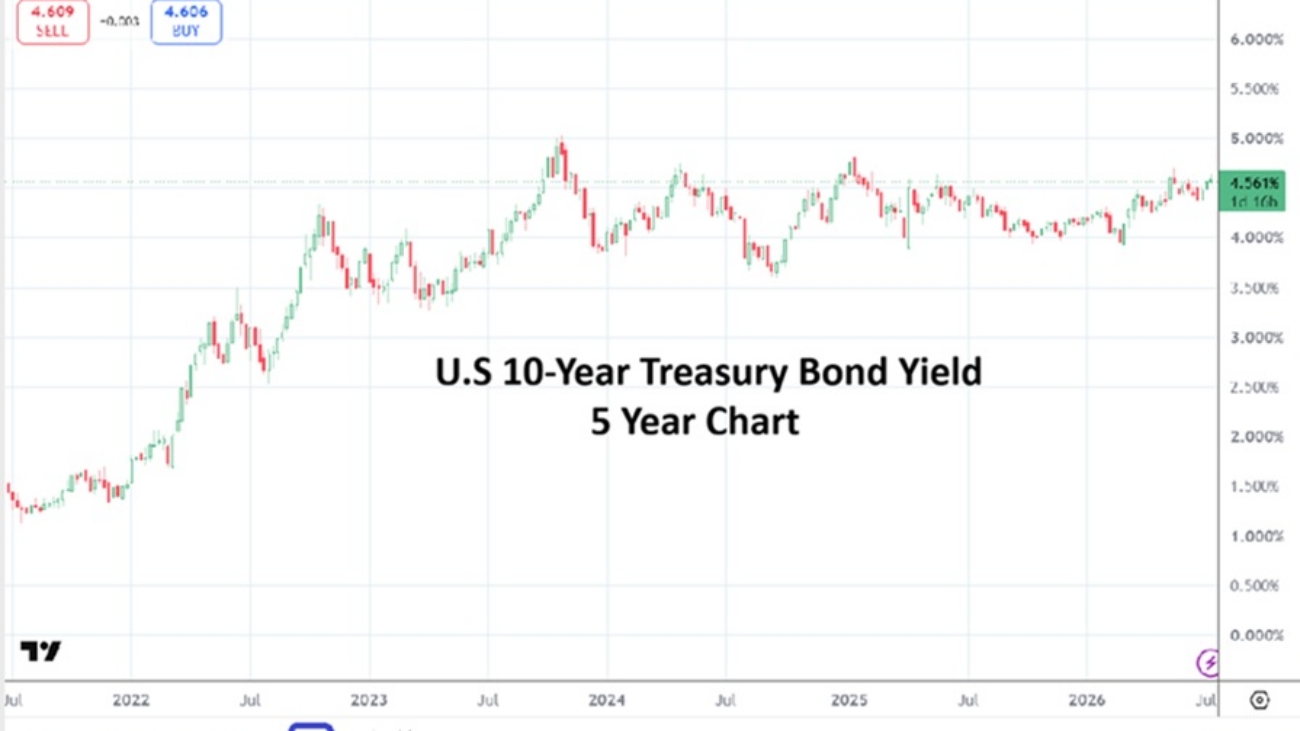
  • The first and most obvious consequence is the impact on government finances. As interest rates rise, the U.S. Treasury must refinance its enormous public debt at increasingly expensive rates. The result is an explosion in annual interest payments, which now exceed $1 trillion. Those payments are in fact a direct injection of additional liquidity into the economy while simultaneously widening the federal deficit.

U.S 10-Y Treasury Yields Five Year Chart as of 16th of July 2026

Ironically, a policy designed to reduce inflation is contributing to larger government spending through higher debt-servicing costs. Instead of easing inflationary pressures, excessively high interest rates may actually reinforce them through this fiscal channel.

  • Consumers also bear a heavy burden. Modern households depend far more on credit than previous generations. Credit cards, auto loans, and consumer financing have become an integral part of everyday life. When the Federal Reserve raises interest rates, millions of Americans see the interest on their credit card balances climb to 20% or more.

Many families attribute their declining purchasing power entirely to inflation, when in reality a significant portion of the financial pressure comes from soaring interest payments.

  • Businesses suffer as well. Higher interest rates increase the cost of financing, while the same capital could be dedicated to investment, expansion, innovation, and research. Every additional dollar spent on interest is a dollar that cannot be invested in productive activity.

A recent example is SpaceX, which issued debt carrying a yield of approximately 6.65%. Given the company’s negative cash flow, investors naturally require a risk premium. However, if the Federal Reserve’s policy rate were closer to 2% rather than current levels, the company’s borrowing costs would be at least half their current level. The extra interest payments would instead be directed toward research, development, hiring, that would strengthen long-term economic growth.

In the current race for AI, that requires heavy investments, the Fed should lower the financing burden on U.S companies. Every additional percentage point of interest represents billions of dollars transferred from productive investment to debt servicing. Money that could finance AI chips, data centers, engineers, research laboratories or new factories instead goes to creditors.

The U.S cannot simultaneously declare China its principal strategic competitor while maintaining a monetary policy that systematically makes capital more expensive for American businesses than for their Chinese rivals, that benefit from much lower rates. The Fed may intend to fight inflation, but it is also making it more costly for American companies to invest in the industries that will determine economic leadership over the decade. The Fed may believe it is fighting inflation, but it is simultaneously increasing the cost of winning the AI race.

Perhaps the greatest weakness of relying on high interest rates is that much of today’s inflation originates from supply-side shocks that monetary policy simply cannot fix.

How does raising interest rates reduce the price of oil when energy prices are driven by geopolitical tensions such as the war with Iran?

How does raising interest rates lower egg prices when shortages stem from productivity issues in the poultry industry?

How does raising interest rates lower the prices of wheat, corn, or cocoa when inflation is due to droughts, floods, or other climate-related events?

How does it reduce insurance premiums that are rising because natural disasters have become more frequent and more costly?

In each of these cases, higher interest rates are totally inefficient to address the underlying cause of inflation. Instead, they merely increase financing costs across the economy while leaving supply constraints largely unchanged.

A more effective strategy would be to fight inflation where it actually originates. Governments possess fiscal tools that can be deployed with much greater precision than broad monetary tightening. Temporary subsidies, targeted tax relief, incentives for increased production, strategic investment in critical industries, and, in exceptional circumstances, carefully designed price controls can address specific inflationary pressures without unnecessarily slowing the entire economy.

For example, if geopolitical tensions cause oil prices to spike, temporarily subsidizing fuel or reducing fuel taxes is likely to be a far more direct and effective response than raising interest rates across the entire economy. Similarly, boosting domestic agricultural production is a better solution to food inflation than making mortgages, business loans, and credit cards more expensive.

The Fed should therefore focus on reducing the financing burden on both the federal government and the private sector. Maintaining interest rates closer to 2% would significantly lower debt-servicing costs, support productive investment, and allow fiscal authorities to intervene more effectively with targeted measures when inflation arises from specific sectors.

The doctrine of fighting inflation through higher interest rates was developed by Irving Fisher nearly a century ago, in an era with very different financial institutions, consumer behavior, and sources of inflation. Credit cards did not exist. Household debt was far lower. Global supply chains, geopolitical energy shocks, and climate-related disruptions were not defining features of inflation.

The modern economy requires modern solutions. Rather than relying almost exclusively on higher interest rates, policymakers should recognize that today’s inflation often demands targeted fiscal responses. Persisting with an outdated monetary framework risks imposing unnecessary costs on governments, businesses, and households while failing to address the real drivers of rising prices.

Supporters of high interest rates often argue that they are unavoidable whenever inflation rises. Yet international experience suggests otherwise.

Switzerland has repeatedly maintained policy interest rates close to 1%, or even below zero in previous years, despite being exposed to many of the same global shocks affecting other economies. Switzerland imports energy, is affected by fluctuations in oil prices, and faces the same geopolitical uncertainties. Yet the Swiss National Bank has generally preferred to tolerate modest inflation rather than impose unnecessarily high financing costs on households, businesses, and the government.

This illustrates an important principle: not every inflation shock requires an aggressive monetary response. When inflation is primarily imported through energy prices or supply-chain disruptions, forcing the entire economy to pay dramatically higher borrowing costs creates more economic damage than the inflation itself.

Copy and paste the text from AMT that you want to share

Gemini3 20270711

The Great Compression Part 3: The Immovable Object

The Landlord Beneath the Cloud

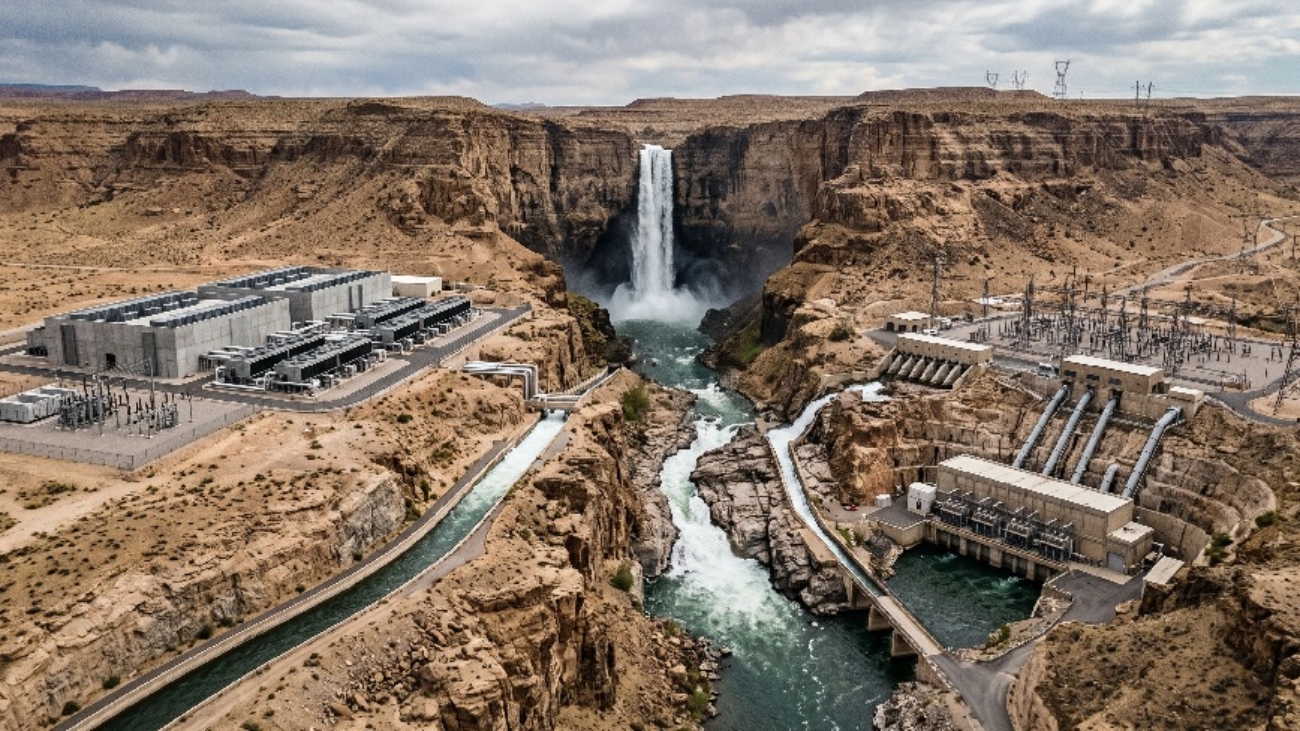
There is an old paradox: what happens when an unstoppable force meets an immovable object? The AI buildout is the unstoppable force – the largest concentrated wave of capital spending in history. The immovable object is the physical world it is colliding with. Land, power, and water are the tangible bedrock that no balance sheet can conjure into existence. The paradox has a resolution the classical philosophers never thought of: the immovable object collects the rent.

Consider the scale of the force first. The four hyperscalers – Amazon, Alphabet, Meta, and Microsoft – plan to spend roughly $725 billion on capital expenditures in 2026, up nearly 80% from the year before. Add Oracle, the neoclouds, sovereign funds, and the rest of the AI heavy spenders – and total compute capex crosses $1 trillion in a single year, the first trillion-dollar year of its kind. Much of that money flows to the visible beneficiaries the market already knows by heart: NVIDIA for the GPUs, Micron for the memory, Dell for the servers, Cisco for the networking. Silicon, racks, interconnects.

The Great Compression Part 3: The Immovable Object 

But every one of those chips has to be housed somewhere. It has to be powered. It has to be cooled. And this is where the unstoppable force runs into something it cannot simply outspend.

The constraint is no longer capital, and it is increasingly no longer silicon. It is the physical world. The bottleneck has shifted to power generation and grid interconnection, which take years to permit and build, and to the land and water that data centers consume at industrial scale. The richest corporations that have ever existed are discovering that a signed check does not produce a megawatt or a water right. The immovable object has begun to set the terms.

Nowhere is this clearer than in a deal signed on June 23rd. Texas Pacific Land Corporation, aka TPL, agreed to provide the surface acreage and brackish water for Project Kilby, a large-scale power generation facility Chevron is building to supply a Microsoft data center cluster in Reeves County, Texas. When the announcement crossed the wires, Chevron’s name led every headline – and TPL was a footnote.

Meanwhile, the framing should be exactly backwards. Chevron, for all its scale, is the replaceable party in that transaction. Exxon, Occidental, or any of a dozen major energy companies could have built that power plant. What none of them could have supplied is the specific land and the specific water rights in that specific corner of the Permian Basin – because those belong to TPL, and there is no substitute for them at any price. The company that got the headlines is interchangeable. The company that got the footnote is the immovable object.

TPL is the purest expression of the scarcity trade beneath the AI buildout. It owns roughly a million acres of West Texas and produces almost nothing itself. It does not drill. It does not manufacture. It collects royalties, easements, and water fees from everyone who needs to operate on its ground. It is a toll booth on the physical world, and the AI buildout has just become one of its largest new customers. For years the market valued it as an oil-and-gas royalty play. It is quietly becoming an infrastructure landlord for compute – and almost nobody has ever heard of it.

The same logic radiates outward through the entire physical layer. Power is the genuine bottleneck, and the companies that generate it are being repriced accordingly. Constellation Energy, the largest operator of nuclear plants in the U.S., has become an unlikely AI stock as hyperscalers sign long-term deals for the one thing they cannot build fast enough: reliable, always-on baseload power. The grid that carries it has its own set of indispensable names – Quanta, which builds and maintains transmission infrastructure; GE Vernova, which supplies the turbines and grid equipment; Eaton, whose electrical systems distribute power inside the data center itself. And as chip density rises, the heat has to go somewhere, which has turned Vertiv, a maker of cooling and thermal management systems, into a core holding of the buildout.

What is striking is that this category does not merely sit still and collect. Some of its members are actively repositioning to attack. Ford, unable to win the electric-vehicle war against Tesla and nursing a $19.5 billion writedown on its EV investments, has taken the same physical assets – its plants, its battery capacity, a century of manufacturing expertise – and redirected them. In May it launched Ford Energy, a subsidiary building grid-scale battery storage systems, with data centers named explicitly as the demand driver. The immovable object, it turns out, can also choose its targets.

This is the HALO trade: Heavy Assets, Low Obsolescence. Companies whose value rests on tangible, physical assets and established operations that are expensive, time-consuming, or regulated – and therefore very hard to replicate. Land. Power. Grid. Water. Steel and concrete and copper. The unglamorous inputs that no model can commoditize because they cannot be reduced to software, and no amount of capital can summon into existence overnight.

None of this is permanently fixed, and it would be dishonest to pretend otherwise. Innovation erodes scarcity: small modular reactors, advanced geothermal, and better transmission technology will, in time, loosen some of the constraints that look absolute today. But two things blunt that threat. The first is Jevons paradox – when a resource becomes cheaper to use, consumption rises to swallow the savings, which means more efficient power generation is likely to expand the buildout, not shrink the edge of the providers. The second is that not all heavy assets are equal. The manufacturers and equipment makers face real competitive pressure over time. The owners of irreplaceable location – the specific acre, the specific water right – do not. You can build a better reactor, but you cannot build another Permian Basin.

The value that fled the human middlemen, that commoditized in the model layer, that migrated up the stack toward proprietary data and orchestration – also flows downward, and at the bottom it stops. It settles into the ground, into the wires, into the water table. But the ground is not neutral territory: land is permitted, power is regulated, water is allocated, and the fabs that print the silicon sit inside country borders. The unstoppable force keeps accelerating; the immovable object keeps collecting. And the moment we ask who owns the immovable object, the scarcity trade stops being a matter of markets and becomes a matter of sovereignty.

Copy and paste the text from AMT that you want to share

Nifty 50 20260708

India Insider: Foreign Investors and Their Selective Choices

Return of Global Investors into the Indian Marketplace

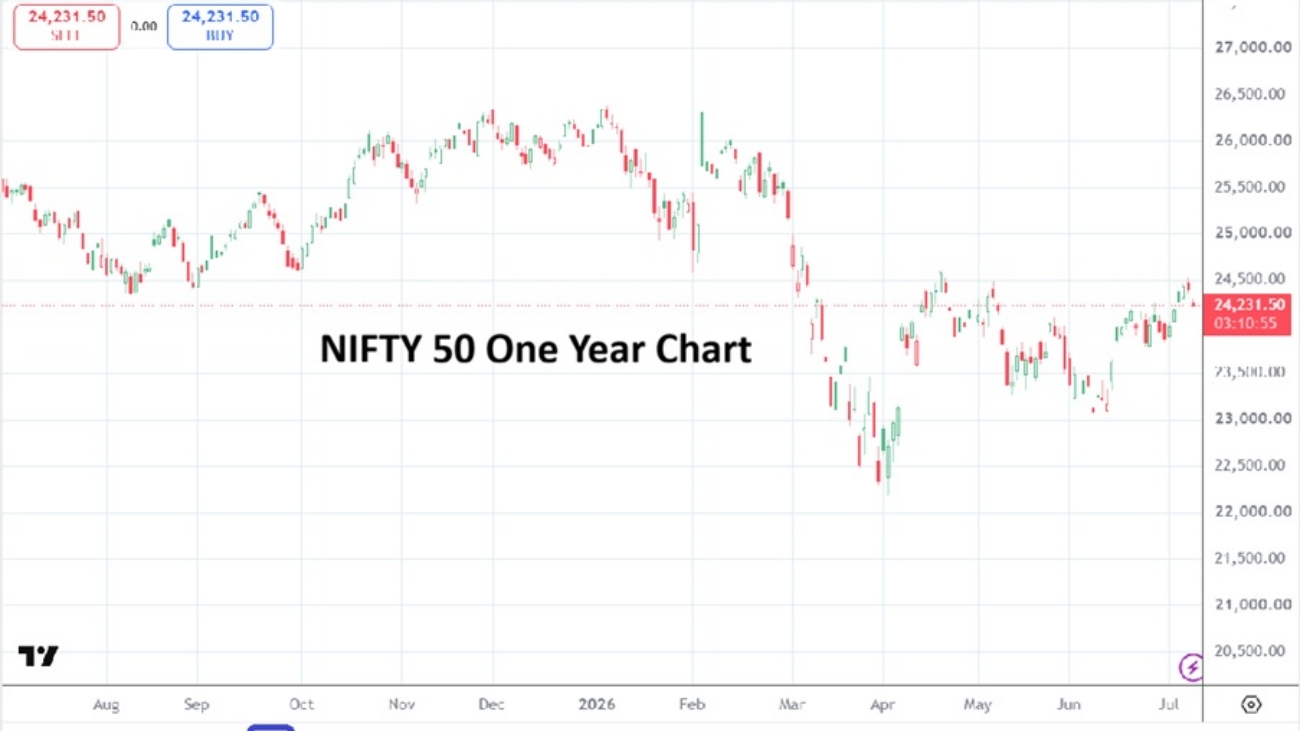
Global investors are gradually returning to Indian assets after months of persistent outflows as risk appetite sentiment has been ignited by an extended ceasefire between the U.S and Iran. Energy prices have moved in India’s favor, sparking favorable conditions. 

Despite recent flare ups in the Strait of Hormuz, Brent Crude has dropped about 30% in the past quarter, easing India’s fuel concerns as the world’s third largest Crude Oil buyer. AI trade rotation is gathering pace in Asia also, this as investors pull money from chipmakers that powered this year’s rally and hunt for cheaper ways to deploy their cash.

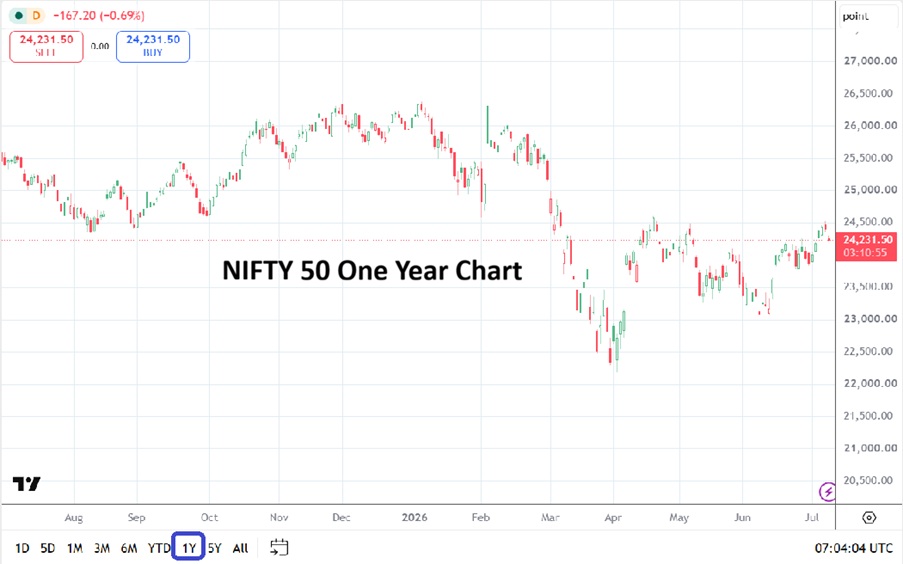
NIFTY 50 One Year Chart as of 8th of July 2026

Indian equities beat its emerging markets peers in June by its biggest margin in seven months. The Reserve Bank of India’s measures to attract foreign currency deposits and overseas capital have eased funding concerns for lenders, record foreign inflows into government bonds have helped stabilize the Rupee and improve liquidity conditions. According to Bloomberg, “Goldman Sachs favors 30-Year government bonds as lower oil prices allay inflation and fiscal risks”. 

Combined with resilient credit growth and improving asset quality, India’s banking sector is once again attracting global investors, this after trading at meaningful discounts to historical valuations for quite a while.

Second Opportunity May Be Information Technology

Indian IT companies have undergone a sharp valuation correction over the past two years. Unlike the post pandemic period, when large Indian technology firms traded at substantial premiums to global peers such as Accenture. These premiums have now narrowed considerably after earnings growth slowed, and enthusiasm surrounding Artificial Intelligence shifted investor attention towards US technology companies.

As highlighted in Business Line magazine, the sector is undergoing a healthy valuation reset, with investors increasingly questioning whether premium valuations remain justified without a corresponding acceleration in earnings growth.

However, the discussion extends beyond valuations. Artificial Intelligence is fundamentally reshaping the enterprise software industry. For decades, Software as a Service (SaaS) companies dominated enterprise technology by offering standardized cloud based solutions that were cheaper and easier than developing software in-house. That advantage is now beginning to erode.

Large AI companies such as OpenAI and Anthropic are building AI agents capable of operating across multiple enterprise applications through a single conversational interface. Rather than competing within individual software categories, these horizontal AI platforms could reduce the importance of stand alone enterprise applications by seamlessly connecting them. At the same time, AI native startups are targeting specialized business functions, while advances in generative AI are encouraging enterprises to revisit the traditional ‘build versus buy’ decision as they develop customized software internally at significantly lower costs.

For Indian IT services companies, this represents both a disruption and a new opportunity. Routine application development and maintenance may become increasingly automated, placing pressure on traditional outsourcing revenues. Yet demand for AI integration, cloud migration, cybersecurity, enterprise transformation, and customised AI deployment is likely to create an entirely new investment cycle. The winners will be firms that evolve from conventional software service providers into strategic AI implementation partners.

Risks ahead for Indian Markets

The near term outlook is not without risks for India. A weak monsoon could push food inflation higher. Elevated Crude Oil prices may widen India’s external balances. And a stronger USD with elevated U.S interest rate yields could moderate foreign capital inflows. The technology sector also faces a structural challenge as Artificial Intelligence reshapes the traditional software business model, requiring companies to adapt more quickly than in previous technology cycles.

Even so, the broader macro backdrop appears to be improving. Policy measures have eased liquidity conditions, corporate balance sheets remain healthy, and valuations across several sectors have become considerably more attractive after an extended correction. Rather than chasing expensive momentum trades elsewhere in emerging markets, global investors may increasingly look toward Indian sectors where fundamentals are strengthening while expectations remain relatively subdued.

Copy and paste the text from AMT that you want to share

Nvidia 20260630

Nvidia Suffering From the AI Cold Bothering Investors and Speculators

AI: Exuberance and Threats of Fatigue

Has Nvidia now been oversold? While the Nasdaq 100 produces a casino like experience for day traders and large players, the velocity of value changes in the index should serve as a simple reminder that before stepping into traffic a speculator needs to acknowledge the road. A large collision is taking place before our eyes and it will generate more noise over the coming months. 

Nvidia is a solid indicator of behavioral sentiment being influenced by a mix of optimism and fears by speculators and investors competing, and trying to define terrain as turmoil swirls and a battle for profits rage. Day traders need to remember a lot of hyperbole is amplified to get eyeballs on opinions, hoping that your attention is grabbed. (Please buy me a cup of coffee has become a begging mantra).

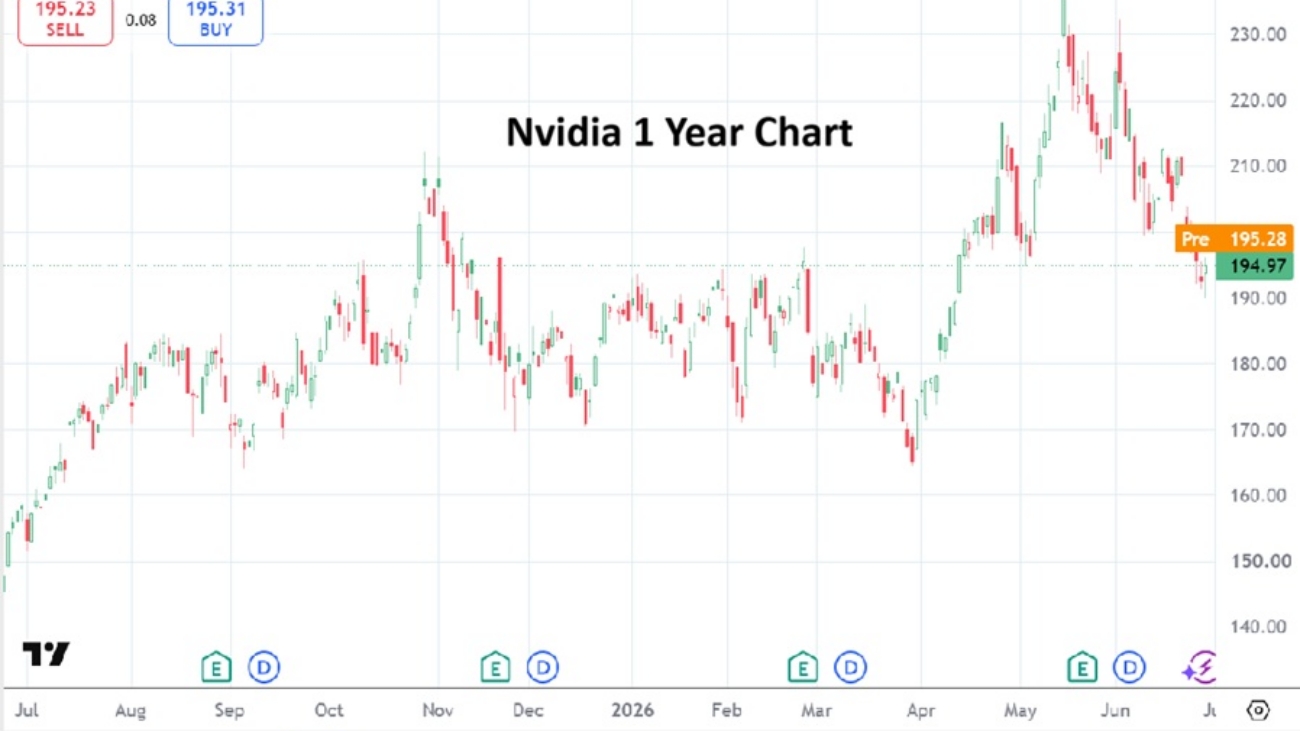
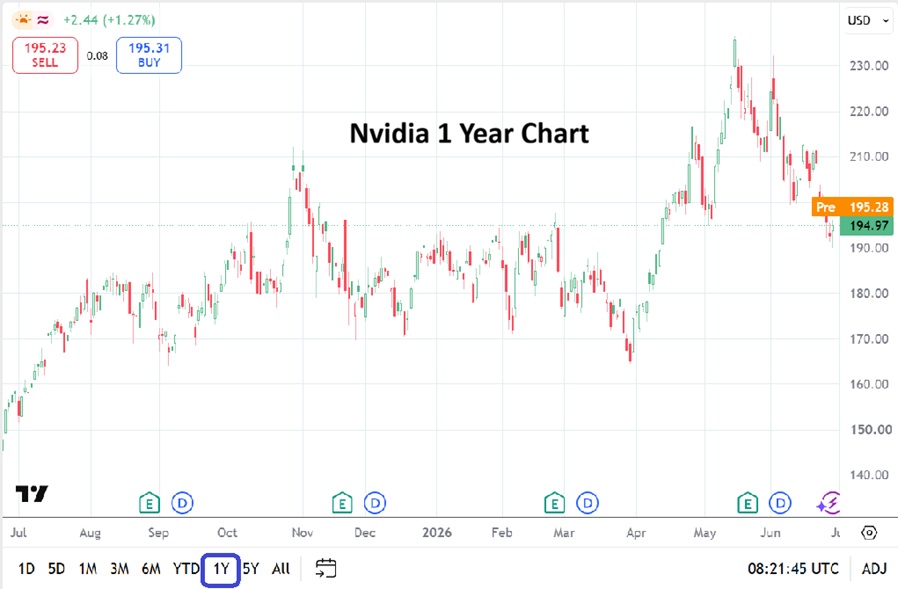
Nvidia One Year Chart as of 30th June 2026

Nvidia finished yesterday’s trading near $195.00, this after touching highs in May around the $238.00 vicinity. The fact that NVDA has lost a large chunk of its value indicates sentiment is not entirely rational. There is a vast difference between speculative hopes compared to long-term investing. 

Results in the stock markets do show symptoms of overbought conditions prevail, but over indulgent fears are taking hold as folks try to interpret every move in a haphazard manner and make correlations which often have no evidence. Nvidia is a solid company which will continue to produce product lines that will be needed long-term. Talk of Nvidia suffering from an AI cold is relevant because it has certainly lost value, but the patient is going to survive.

Others however may not. AI companies and their proclamations about being able to deliver substantial change for users has become tiresome. Supply of software is widespread. While there is demand for use, competitors are abundant and growing daily. Users can now question just how reliable and strong the products they are using are, and if promises meet the results wanted. Costs users are paying for services will also become more critical. If products don’t meet needs, other AI systems can be easily installed nowadays. 

Oversupply is Saturating the Marketplace

Because AI tools are widespread it means users will demand services get cheaper. At some point it is clear that consumers will gravitate to competitive pricing, because at the end of the day there is only a certain amount of time to verify all the products in the marketplace and understand what works best. Branding as always is important, but so is quality. Loyalty in the AI world is only a couple of years old and cannot be counted on, some early companies are already seen as legacies and allegiances will shift. 

Competitors and new ideas continue to be brought forth quickly. A lot of product is being rushed to the market that lacks proper Q&A and actually does not deliver what is promised. Proof of concept is fluid with Artificial Intelligence, along with many claims of superiority. A company can get a product into consumers hands first, but at some point value has to be delivered too.

Investors are growing wary from too many claims. Yes, a revolution has taken place, but a counter-revolution is certainly coming. A lot of AI products are simply poor. Day traders have seen chaotic results on the Nasdaq 100 over the past year. 

President Trump, tariffs, the war in Iran, Federal Reserve and interest rate uncertainty, fear of inflation (all headlines from only the past few weeks) and other complexities can be blamed for volatility as folks wager on values on the Nasdaq 100. However, the prime mover of the index has not only been investing by long-term players, it has come from speculation chasing momentum via the Artificial Intelligence boom. However, a genuine concern that a fear of missing out is turning into fatigue exists.

AI because of its abundance is going to eliminate competing systems which are seen as cumbersome and expensive. Chinese companies appear ready to confront American enterprises with cheaper products that consumers may not mind paying less for even if this means consumers are sharing intellectual property and data with unknown entities. 

Sakana AI from Japan has announced and shown the past couple of weeks that it has software, Sakana Fugu, that is comparable in a favorable manner to Anthropic and Claude services. Sakana testers claim their system is robust and offers a multi-integrated modeling system, meaning a user doesn’t have to toggle in and out of models to deliver efficient information. The data via Sakana’s system is brought together via coordinated agent forces for the user. What will this do to valuation of Anthropic moving forward?

There is also a South Korean company called Furiosa, which is not public yet, that stands in the shadows and makes outstanding AI infrastructure. Furiosa appears ready to become an important player in chips and software innovation. Nvidia is certainly keeping their eyes on Furiosa. Meta offered Furiosa 800 million USD and was rejected in March 2025. 

Investors and speculators should not discount the potential of an AI tech dump from global competitors into the U.S and elsewhere developing over the next year. Mobile phones became a rather boring commodity after their initial entry astonished first time users two decades ago, AI will undergo the same pathway.

Some AI companies will certainly struggle over the next few years, but other enterprises will succeed merrily and profit. There is a big difference between investing and speculating. Even mid-term forays into the stock markets remain only gambles if a person plans on cashing out profits when they have hit a price target, instead of long-term ambitions to own shares in a quality company. 

Nasdaq100 bubble talk which has recently reignited in a loud manner should be given attention but astutely. It is hard to argue that the value of the indices like the Nasdaq 100 and S&P 500 are not in over-inflated territory. Looking at historical p/e ratios seems to have gone out of fashion. Warren Buffet cannot be thrilled and his fundamental strategies should not be ignored. Speculative hype needs to be confronted by investment reality. Folks will continue talking themselves into stances that are comfortable, even if they make little sense. The markets will certainly survive and so will AI.

Copy and paste the text from AMT that you want to share

Nifty 50 20260626

India Insider: Systematic Investment Plan Boom

Liquidity, Valuations and the Limits of Domestic Capital

India’s equity market has surprised many investors over the past two years. Despite persistent foreign institutional investor selling, weak net foreign direct investment (FDI), subdued private capital expenditures and a depreciating Rupee, the broader markets have not fallen and proven remarkably resilient. But risks abound.

Many observers point to the rapid growth of Systematic Investment Plans (SIPs), which millions of retail investors invest regularly via mutual funds in India. Monthly SIP inflows into the Indian equity market has reached record highs at the tune of 32,087 Crore Rupees ($3.38 billion USD) in March, 2026 per AMFI (Association of Mutual Funds India) data. 

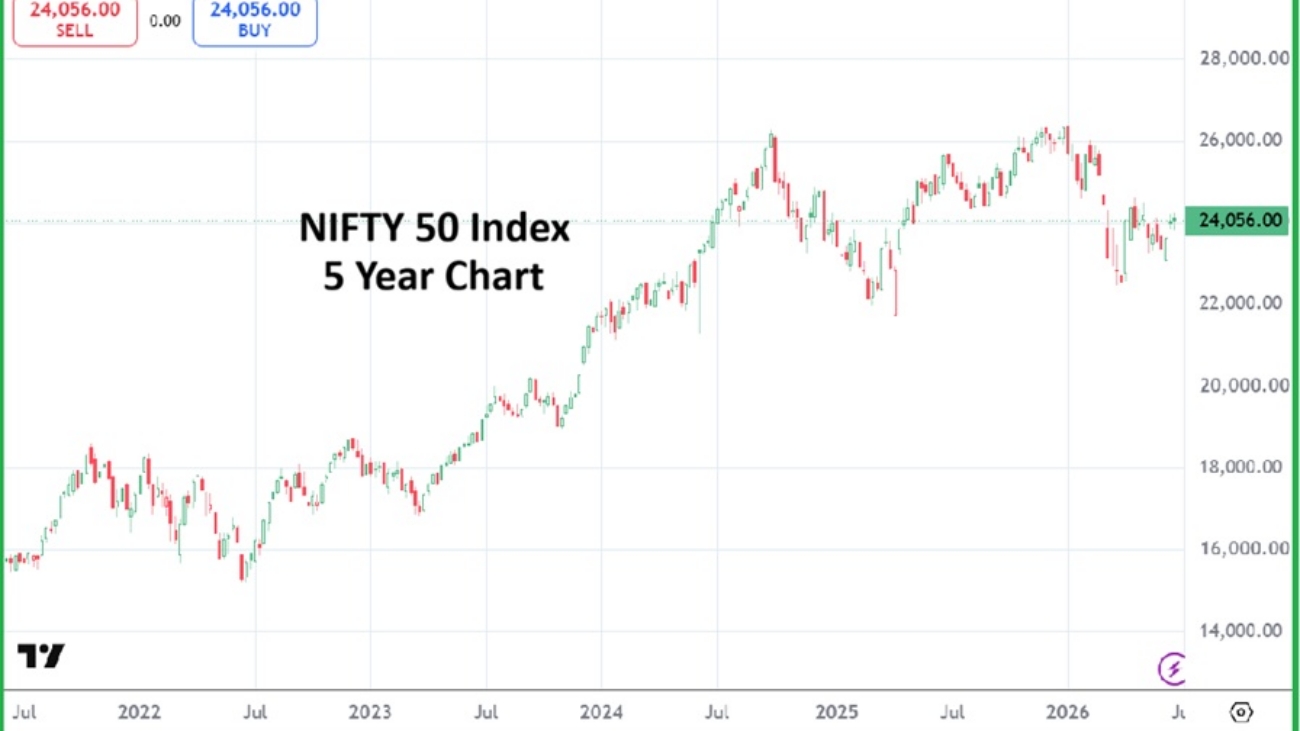
Nifty 50 Five Year Chart as of 26th June 2026

Before COVID-19, the stock market industry in India was a boring business. Accounts were opened via paperwork, and demat (the account in which the digital shares were held) in a bureaucratic manner with multiple paperwork requirements. Clients who liked to participate in the Initial Public Offerings (IPOs) had to go to their broker or issue a cheque to participate in the bidding process. As of 2019, the total demat accounts in India stood at 40 million. Sophisticated retail investors would go to their local branches of associated brokers and trade stocks, derivatives or commodities. They sometimes would use telephone or online orders.

All this changed during the Covid-19 pandemic, when equity market valuations became depressed and people were forced to stay at home. This ushered a wave of new retail traders who had time to master the game and wanted to capitalize on the falling valuations of many companies and take advantage of opportunities they believed in. Astonishingly, demat accounts opened between 2020-2026 totaled around 180 million, almost quadrupling pre-Covid levels. Due to digital penetration and the rise of discount brokers, young retail traders were able to quickly allocate substantial portions of their monthly income into SIPs.

SIPS have strengthened the financial market resilience of India, compared to the previous decade when it was the domestic institutional investors who helped market stability. Yet concerns are now arising whether domestic household savings are supporting fundamentally stronger companies, or are creating systematic inflows which help tenuous companies to have higher valuations?

For instance, a famous financial markets journalist recently argued that India’s SIP boom has fueled expensive stocks. Thus, enabling insiders and institutions to exit at favorable prices, reduced future return potential, has weakened the Rupee, and exposed the limitations of crowd-driven investing.

As the AMT India Insider columnist, I decided to investigate these considerations and talked with some people in the financial markets who offered different perspectives regarding the issue.

Mr. Mahalingam, an IIM alumnus noted, “it is difficult to generalize like that. Total SIP inflows should be viewed relative to the total market capitalization of listed companies, not in absolute terms. If the Nifty delivers around 12% returns, it roughly doubles every six years. SIP inflows must also increase over time, simply to purchase the same proportion of shares.”

Arguably, the SIP flows into the Nifty Index some 15 years back are not comparable to today. Considering the higher capitalization of Nifty listed companies (which means greater share values), and given the Nifty index has delivered 12% returns in the last few years, and that it took 6 years for it to double at this rate, it’s important that investors look at higher share prices values arising out of company earnings while considering their investment decisions.

Mr. Prasath, who taught economics and finance to students during his tenure at a private educational institution, argues, “I think there are many dimensions. In stock markets, everything comes down to valuations, the continuous SIP flows may diminish future returns if the earnings don’t grow. But comparing SIP flow with 2005 numbers exaggerates the issue. The Indian economy has grown bigger since 2005 and naturally inflows will also grow accordingly. India has one of the lowest public participation in the capital markets, even with current SIP numbers.”

Mr. Prasath continued, “currently the world is going through turbulent times with the Russia-Ukraine war, the Trump Presidency including tariff actions, the Iran situation and energy crisis, and supply chain disruptions, etc., which are effecting economic growth. The Indian government is also not taking some required steps. Indian companies also have low R&D and failed to participate in emerging themes like AI and semiconductor development. These turbulent times will continue for awhile and Indian markets will underperform its peers. So we have to wait for better times or for world leaders to come to their senses. I think we have to remain both optimistic/realistic and plan our investments accordingly”

If India grows at 7.7% during the 2025-2026 annual year, and foreign capital (especially foreign portfolio investment) is leaving, while private capital expenditures are weak and government capital expenditures are increasing, then what’s the point of higher stock prices for many of these companies? Is it due to steady retail SIP inflows? Does it really help institutions and insiders to cash out, and make retail investors vulnerable?  Foreign investors have sold $29 billion USD worth of equities so far this year, and the Rupee has taken a hit, yet we have not see drastic changes in companies’ share or indices values.

In 2022, when the U.S Federal Reserve was raising interest rates, the Nifty 50 Index lost around 3000 points, but this did not happen in 2026. The SIP retail crowd and domestic institutional investors have absorbed the foreign investors’ outflows and provided a cushion for share prices.

Even if some people in the financial markets argue that the foreign investors’ selloff off did not result in poor corporate performance or themes becoming weak, given that the growing market capitalization and the past earnings has justified the higher share prices, it’s significant to note that the Net FDI remains weak. Indian and foreign corporations are repatriating cash at a faster pace, and capital is flowing out of India. That’s ironically what hit the Rupee this year, along with higher oil prices due to the Iran war. In my opinion, private capital expenditures of listed corporations has to grow to justify higher earnings multiples.

Kotak Mahindra Bank director Paritosh Kashyap, while talking to Business Line said that private capital expenditures in India has been subdued for the last 10 years. Higher interest rates, expensive oil and lower equity valuations has dampened sentiment. India’s government Capex (capital expenditure strategy) remains the primary driver.

To summarize and conclude, weak foreign direct investment, subdued private investment, and inflated valuations of Indian assets along with a lack of AI related development is a large underlying issue and concern. For foreign investors to return with greater force again into Indian equities, either the Rupee has to depreciate or equity prices have to decline to generate investor confidence and create an appealing landscape. Retail investors may soon have to face drawdowns in their portfolios as returns dwindle and headwinds move against them.0

Copy and paste the text from AMT that you want to share

AI Aluminium 20260624

The Great Compression Part 2: The Intelligence Trap

AI Aluminum

On June 17th, the U.S. Air Force handed Anduril Industries a contract for its FQ-44 autonomous combat drone, making it the first new entrant to win a U.S. fighter aircraft program since the 1970s. The Silicon Valley startup beat Lockheed Martin, Northrop Grumman, and Boeing – companies that between them have defined American air power for generations – to the target. Anduril, a defense technology firm founded in 2017, did not win on relationship or on legacy: it won on AI-native architecture.

The shift this represents is psychological as much as commercial. Defense procurement is arguably the most bureaucratic, relationship-driven, clearance-protected industry on earth. If AI-native vertical integration can break this barrier, anything is now open for re-negotiation.

The Great Compression Part Two: The Intelligence Trap

The compression of the human intermediary layer across the economy – the subject of this series’ opening piece – raises a question that is both philosophical and financial: if the old middlemen are disappearing, and if the AI models replacing them are themselves becoming commodities, where does value go?

What made the Air Force announcement structurally significant was a detail that went largely unnoticed: the service deliberately separated the drone hardware from its AI software, specifying that the intelligence layer could be upgraded or replaced independently of the platform. By doing so, the Air Force drew a line that the market is still catching up to – and then immediately complicated it. The aircraft is the delivery vehicle. The intelligence tier is what matters, except that intelligence is also commoditizing fast.

The commoditization signal had already arrived earlier this month, when Google cut the price of its AI plan by nearly 40% overnight. OpenAI is reportedly considering steep token-price cuts as competition with Anthropic intensifies. The models themselves are beginning to resemble a capital-intensive utility more than a premium software business. As intelligence becomes cheaper, the investment question shifts to what models cannot easily access: proprietary data, regulated workflows, institutional trust, and the systems that turn AI output into real-world action.

The answer, in the most durable cases, is proprietary domain data combined with deep sector integration. Anduril is not a defense company that adopted technology: it’s a technology company that chose defense as its vertical. Palmer Luckey, who sold Oculus to Meta when he was just 21, founded Anduril alongside veterans of Palantir with a specific thesis: Silicon Valley had abandoned defense, leaving a widening gap between what the military needed and what the traditional primes could deliver.

Where Lockheed and Boeing run bid-led organizations optimized for cost-plus contracting cycles measured in decades, Anduril built a product-first company that moves at software speed, focused on cheap, autonomous, attritable systems designed to be deployed and lost without catastrophic cost. The competitive edge that results has nothing to do with which model runs underneath it. It is purpose-built architecture, mission-specific design, and the kind of deep operational embedding that no generalist technology company can shortcut and no traditional prime can easily imitate.

Palantir built the same competitive edge a decade earlier, at the intelligence level. Their forward-deployed engineers embedded themselves inside classified environments, building proprietary data structures around defense and intelligence that competitors cannot access, let alone replicate. The model is almost beside the point. What matters is the institutional trust above it and the data structure underneath it.

The same logic plays out in banking, and the psyche shift there is equally striking. JPMorgan Chase is not an obvious candidate for AI leadership – a 150-year-old Wall Street institution steeped in regulatory obligation and institutional conservatism. Yet it has become arguably the most digitally aggressive major bank outside the fintech world, spending north of $17 billion annually on technology and deploying AI across trading, risk, legal document review, and client services. JPMorgan’s AI advantage over any fintech competitor is not compute – it is 150 years of proprietary transaction data, credit history, and market intelligence, combined with the institutional will to deploy it at scale. Many large banks sit on comparable reserves; few have built the machine to turn them into a competitive weapon. The model commoditizes; the data does not – but only in the hands of someone with the commitment to exploit it.

The pattern across defense, banking, and every sector where this is playing out is consistent: the prize migrates to whoever owns the scarce position that generic models cannot substitute for. Right now the prize sits with domain data and deep sector integration. What’s forming above it is agentic orchestration – systems that coordinate networks of specialized AI agents across high-stakes workflows: routing battlefield targeting decisions, flagging fraud across millions of simultaneous transactions, managing the exception-handling that no single model can resolve alone. Palantir’s AIP platform is the most mature example of this emerging tier, and it is no coincidence that the same company that mastered domain-specific data is now positioning for that orchestration tier. Salesforce’s Agentforce is building toward the same position from the enterprise side. The race for this trophy is not yet decided, but the companies that already own those domain data advantages are the natural favorites to own the control plane above them.

The stack, in other words, keeps moving upward. Value migrates to the next bottleneck, then the next. And below all of it – the models, the sectors, the orchestration layer – something has to hold the weight. Every control plane needs a floor. What that floor looks like, who owns it, and why it may be the most durable investment thesis of the AI era is the subject of the next piece.

Copy and paste the text from AMT that you want to share

US Cash Index 20260617

Forex and the Fed Chair: Kevin Warsh in the Spotlight Later Today

New Federal Reserve Chairman will Cause a Reaction in Forex Today

I offer readers a ‘what if’ proposition ahead. These are my opinions and I am simply trying to give my perspective on what may happen in the Forex market in the coming hours.

The Fed Press Conference later today will be must watch television for Forex traders, including retail speculators, large players and financial institutions. Federal Reserve Chairman Kevin Warsh will make his first appearance after a FOMC rate decision. Dynamic conditions in the broad Forex market should be anticipated – that doesn’t tell day traders much I know, keep reading, please. 

U.S inflation has sparked higher this as energy prices have ignited upwards and caused logistics, manufacturing and agriculture to become more expensive. The Bank of Japan raised its interest rate by a quarter of a point yesterday to 1.00%. However, these two bits of evidence doesn’t mean the Federal Reserve will increase its interest rate today. 

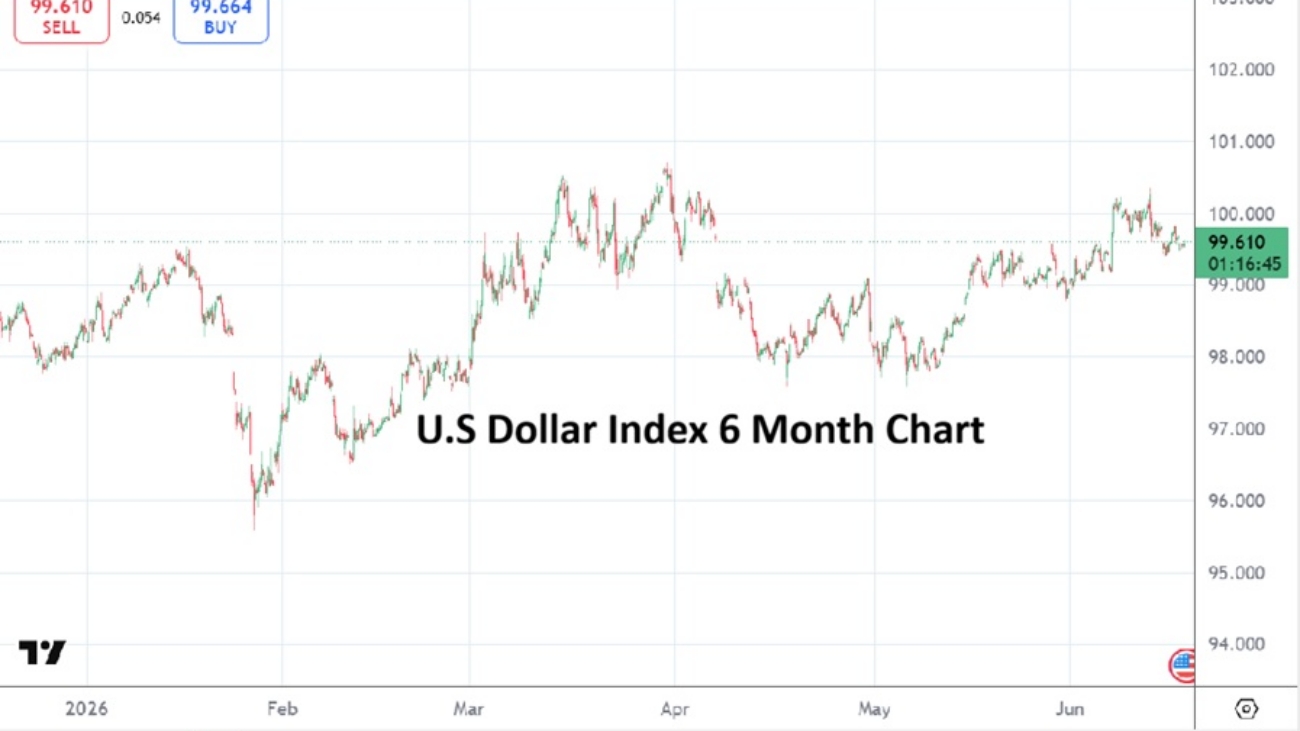
The U.S Dollar Index is trading near relative highs. The broad FX market is certainly cautious, but financial institutions may be leaning into the notion of USD centric weakness. Yes, the USD/JPY remains above 160.000+ for the moment, but the USD/SGD is flirting with its lower range and came within sight of the 1.28000 mark on Monday. So why is this important? Because folks are acting cautious before a potential storm.

U.S Dollar Index Six Month Chart as of 17th of June, 2026

Perhaps this will go down as an infamous egg on the face situation for me personally, but does Fed Chair Kevin Warsh really want to raise interest rates during his first FOMC meeting at the helm? Yes, Jerome Powell is still around as a voting Governor, but Warsh may find he has enough votes (and influence) to get a majority of other FOMC voting members to allow today’s decision to be a test case in favor of patience. 

If the Fed holds the Fed Funds Rate in place and announces it will use the near and mid-term as a trial period regarding their belief inflation will lessen, because it believes energy prices over the mid-term will erode rapidly, that may be enough to cause USD centric selling later today. The Fed will not use the word transitory I suspect, but an argument can certainly be made that now is the time to actually elucidate on the subject of transitory inflation.

Monday’s trading in the broad Forex markets showed that financial institutions bought into the optimism of an anticipated U.S and Iranian agreement and what it could deliver – a glut of Crude Oil, including lower costs for its ancillary products. Financial institutions were also relieved that U.S equity markets survived the launch of the SpaceX IPO certainly. While yesterday’s broad market trading turned cautious and demonstrated sideways action in Forex, many major currencies are traversing near curious values. Equities also went sideways for the most part on Tuesday.

The U.S Dollar Index is swimming within its higher terrain via a six month chart (per a look above), yet financial institutions – if they hear dovish sentiment from the new Fed Chair today could spring into action and sell the USD quickly. Day traders need to understand even if this occurs that it will still be ultra-dangerous to bet ahead of the Fed rate announcement and Press Conference. This because volatility leading up to and following the FOMC Federal Funds Rate decision will create large spreads in Forex and choppiness that small retail accounts cannot handle most of the time – particularly when too much leverage creates wildfires.

While the before and after of the Fed interest rate announcement will garner the headline news, and create a reaction on Wall Street for the S&P 500 and Nasdaq 100 immediately; it will be wise to pay attention to Fed Chairman Kevin Warsh a half hour later when he steps into the spotlight for the first time. There has been chatter that Warsh is not keen on trying to give too many signals regarding the Fed’s thinking regarding every move it is contemplating. 

This coincides with thoughts that Kevin Warsh and Scott Bessent believe in a more high-tech and pro-active approach to interest rate and monetary policy based on forward looking data. The consideration of a more dynamic approach to interest rates has not been widely considered by financial institutions quite yet. If the new Fed Chair surprises reporters and onlookers at the Press Conference today with a new philosophy on the way the Fed will work, this will set the stage for potentially large behavioral sentiment shifts that were not wagered on quite yet. In other words mid-term outlooks regarding U.S interest rate policy may change in a handful of hours more than many people think. 

Maybe I am wrong, maybe I am interpreting the political and financial landscape incorrectly, but these are my thoughts as a risk analyst – one who thinks the U.S White House would not mind seeing a weaker USD, a Fed that likely wants a different approach to interest rates – as they both hope for energy prices to lower (and may get their wishes fulfilled).

Copy and paste the text from AMT that you want to share

Indian Rupee 20260611

India Insider: Should the RBI Raise Interest Rates?

A Case for Higher Interest Rates In India

As the Rupee remains under pressure and oil prices continue to rise amid tensions in the Middle East, the debate has shifted towards what the Reserve Bank of India (RBI) should do next.

Economist Janak Raj has argued that raising interest rates to defend the Rupee comes with significant costs. Higher rates increase the cost of capital for businesses, reduce investment activity, and compress equity valuations. In theory, this could even accelerate foreign outflows from equities rather than attract fresh capital. Yet the RBI may soon find itself with limited options.

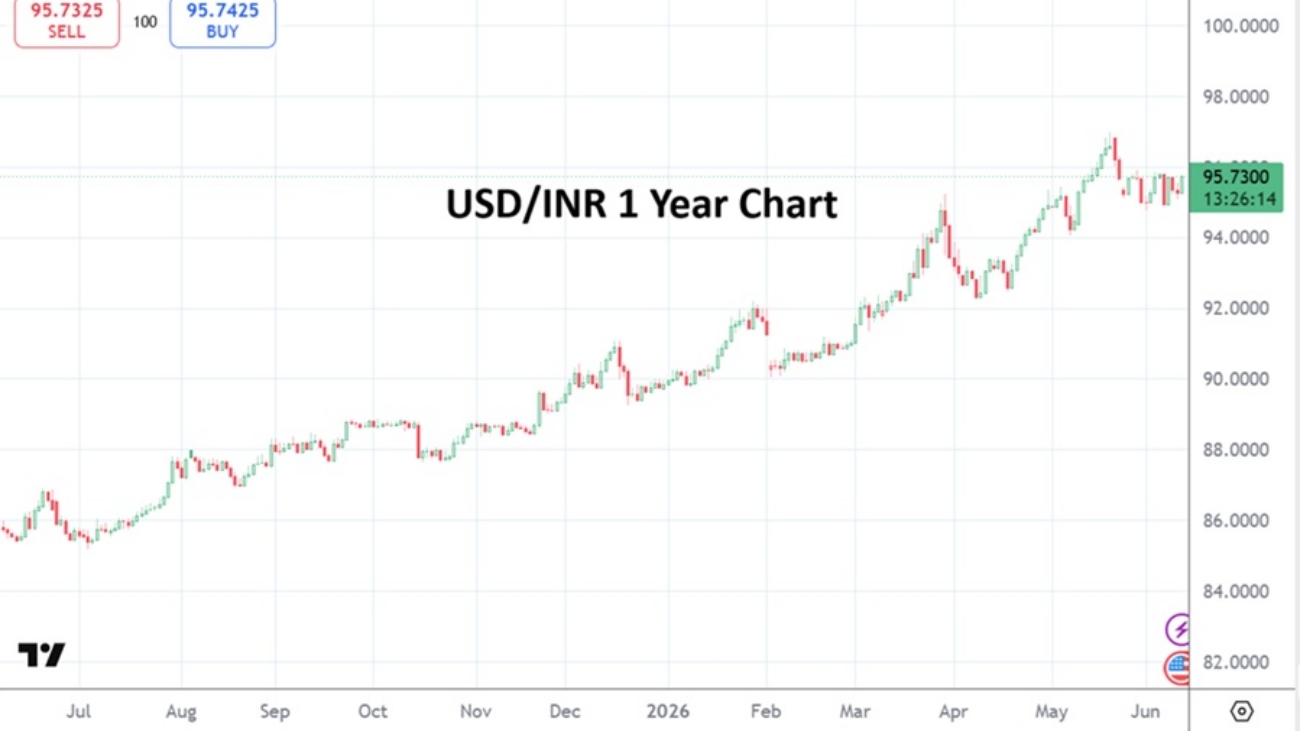
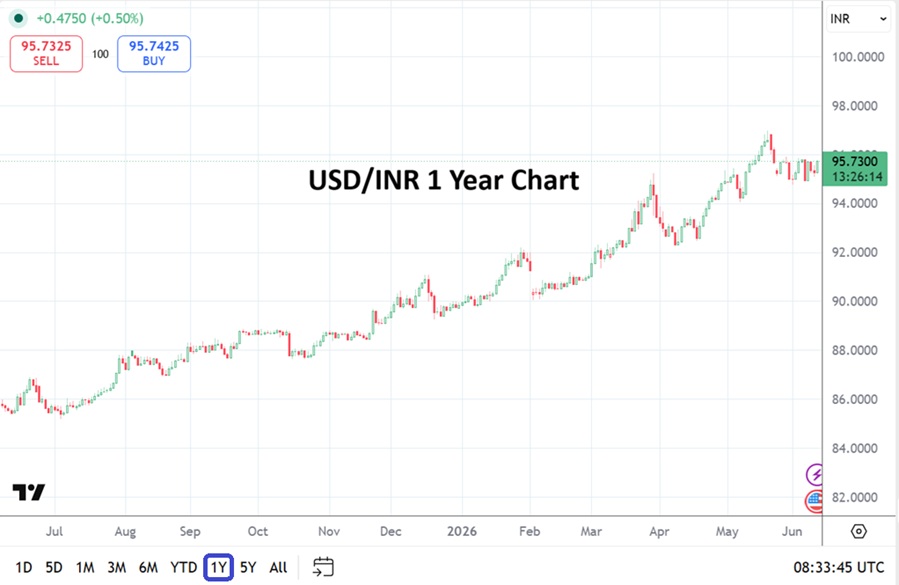
USD/INR One Year Chart as of 11th of June 2026

Foreign Portfolio Investors (FPIs) were net buyers of Indian equities for most of the period between 2004 and 2024, with only a few exceptions such as 2011, 2018 and 2022. However, the trend has changed. FPIs sold approximately $19 billion USD worth of Indian equities in 2025 and another $24 billion USD so far in 2026.

Question: Why are Foreign Investors Selling

One reason is that global investors today have alternatives. The growth of Artificial Intelligence related companies in the United States has created significant investment opportunities. At the same time, U.S Treasury yields hovering around 4.6% offer attractive risk-free returns in a strengthening dollar environment.

For many global investors, earning high returns in Dollar assets is preferable to taking exposure in emerging markets that face current account pressures from rising  Crude Oil prices and other energy costs.

Taxation is another factor. India taxes foreign investors at 20% on short-term capital gains and 12.5% on long-term gains. Meanwhile, competing financial centres such as Singapore, Hong Kong, Malaysia and Thailand generally do not tax foreign investors’ capital gains.

Some global funds have argued that India should move closer to international norms, where capital gains are usually taxed in the investor’s home jurisdiction rather than the country where the investment is made. Higher post-tax returns would undoubtedly make Indian assets more attractive.

A stable Rupee would also reduce hedging costs, lower currency-risk premiums and improve the overall risk-reward profile for overseas investors. However, tax cuts alone cannot solve India’s problem.

The Real Issue is Balance of Payments

As Business Line columnist Lokeshwari Mam has pointed out, a significant portion of equity outflows consists of short-term speculative capital. Long-term capital tends to remain invested. This is why the decline in net Foreign Direct Investment (FDI) should concern policymakers more than short-term fluctuations in portfolio flows.

Net FDI has fallen sharply from $28 billion in FY 2022-23 to just $7.7 billion in the year ended March 2026. This is a worrying trend because FDI is the most stable source of external financing. Unlike portfolio flows, it creates factories, jobs, exports and long-term productive capacity.

India therefore needs more than tax incentives. A genuine single window clearance system, reduced bureaucracy, easier business regulations and reforms in manufacturing remain essential. Attracting long-term capital should be a national priority.

The recent foreign buying of Indian bonds after tax cuts is encouraging. But relative to India’s current account financing requirements, it remains a small drop in the ocean.

For example, in FY 2025, the current account deficit was 0.6% of GDP. And in Q4, the current account became a surplus. Is it really that difficult to finance it’s small current account deficit?

India’s external vulnerability is determined not merely by a current account deficit, but by whether the capital account can be comfortably financed. A modest current account deficit still creates currency pressure if foreign capital inflows weaken (which we are seeing), while a larger deficit may be sustainable when capital inflows remain strong. The risk of sustained higher oil prices could widen the deficit, increasing India’s dependence on foreign capital at a time when global liquidity is tightening and U.S Treasury yields are rising.

Furthermore, hedging costs continue to erode much of the yield advantage that Indian bonds offer over U.S Treasuries. In that sense, active global money is likely to prefer Dollar assets over emerging-market debt or equities

India’s repo rate currently stands at 5.25%. The RBI’s decision to raise its inflation forecast to 5.1%, while lowering its GDP growth projection to 6.6% reveals where the shock from the Iran conflict is likely to be felt via higher inflation and weaker growth. For an economy that remains heavily dependent on imported oil, a depreciating Rupee only compounds the problem by increasing the cost of energy imports. 

In such an environment, the Monetary Policy Committee is unlikely to focus solely on growth. Currency stability, inflation expectations and the availability of foreign capital to finance India’s external requirements could become increasingly important considerations. If these pressures persist, the RBI should raise the repo rate, in the same manner other Asian central banks have done in recent weeks.

Copy and paste the text from AMT that you want to share

Celtics and the Middle East 20260609

Falling into the Middle Eastern Trap

When Talking Becomes an Obsession

Opinion: The following article is commentary and its views are solely those of the author. This article was first published the 9th of June via The Angry Demagogue.

The United States is falling into the Middle Eastern trap that Israel fell into thirty years ago. This trap fits nicely with the post cold-war progressive Western way of diplomacy in that its goal is “talking”. Perpetual talking rather than deal making is the key to understanding the Middle Eastern way of things and Israel has become a practitioner in the “way” that led directly to October 7. The idea of perpetual talking is to reach a situation where you can defeat your opponent without making concessions. In the Middle East, they suck you in to a point where just “talking” becomes an obsession. The United States is heading into the same where results are less important than the act of discussion itself.

Falling into the Middle Eastern Trap – When Talking Becomes an Obsession 9th of June 2026

This obsession, this being sucked into something against your best interests reminds me of a wonderful episode of Cheers, the sitcom that takes place in a Boston bar – a bar in which pints of beer plus inane discussions over anything that leads to nowhere is its reason for being. The episode that I am thinking of has Boston Celtics great Kevin McHale as a guest and the two main instigators of irrelevant and purposeless conversation, Norm and Cliff, (not so) innocently ask McHale how may bolts are in the famous parquet floor at the Boston Garden.

The waitress Carla, Boston working class par excellence, begs the basketball star to ignore them, knowing he will become obsessed and sucked into something that clearly will lead to a disaster for him and her beloved Celtics. Sure enough, the episode ends with McHale driving towards the basket with what ought to be the winning shot only to get distracted by trying to figure out how many bolts are in the floor of the Boston Garden.

That is exactly what is happening now in in the Middle East where President Trump is the basketball star being distracted by Iran and their attempt to suck him into endless discussions that are meant to lead to nothing productive. We don’t know if McHale ever figured out the number of bolts, but besides going back to Cheers with the answer, it is a useless endeavor that can only lead to defeat. So too, with the Trump Administration and the sacred talks with Iran where the end game might be something he can bring back to a press conference in DC or a rally in Pennsylvania but will be worth as much as knowing the number of bolts in the Boston Garden floor.

Israel fell into this trap with the Palestinian Authority of Yasser Arafat and when talks ended, the only goal was to start them up again. Just return to talking. The result didn’t matter. This trap picked up again after October 7 when the goal seemed to be to always be talking with Hamas via Qatar or Egypt even if everyone knew it would lead to nowhere. Ironically, it was President Trump who realized this and was able to do his dealmaking magic to free the hostages – but only after the IDF put Hamas in an untenable situation and Qatar wanted a “great deal” with the Trump administration. Talks never led anywhere.

So here we are, the Trump Administration is hell bent on continuing discussions for the sake of discussions no matter how many times Kuwait, UAE, Bahrain, Israel, or even the U.S military get shot at by Iran. When the goal is talking – when the obsession becomes talking – you have fallen into the Middle Eastern trap much as Keven McHale fell into the trap of inane bar talk for the sake of inane bar talk.

While the American President is a deal maker par-excellence, the Middle Eastern leaders, this time Iran’s, are the experts at making you think that talking is always the best outcome – because it is, for them. Eventually, their experience tells them, you will make a mistake. The Administration has allowed Iran to attack allies at will in the Gulf and in Israel, as Iran gains concession after concession due to the trap that is “talks at all costs”. The first concession was linking Lebanon to the talks and the next, done just yesterday was in putting Iran and Israel on the same level.

This is the mistake one would expect from the Obama-Biden crowd where they always believed that talks were the purpose – they didn’t have to fall into any trap as they were there already. However, the Trump Administration understood the fallacy of forever talks which is what makes it so painful to see them fall into the same Middle-Eastern and Western, progressive trap. Obsession to make a deal is good because results oriented; but an obsession that is just to “get back to talking” will lead only to results that you never wanted in the first place.

Disclaimer: the views expressed in this opinion article are solely those of the author, and not necessarily the opinions reflected by angrymetatraders.com or its associated parties.

Follow Ira Slomowitz via The Angry Demagogue on Substack https://iraslomowitz.substack.com/
Copy and paste the text from AMT that you want to share