SP500 20261002

All Quiet on the Trump Front?

Biased Information Extends to Economic Reporting as Much as It Does To Global Affairs

Nearly one month from now, on the 3rd of November, the U.S mid-term elections will be held. Today the Non-Farm Employment Change date will be published. But will these economic numbers matter? The coverage of the Trump presidency remains problematic no matter what your political beliefs are because it is difficult to know the truth regarding details being reported, particularly as the vote approaches and folks want to influence your decisions.

Depending on which media source you are paying attention to and what the outcome is you are certain to be spoon-fed a large amount of bias. The problem for voters in one month, and for investors today is that a lot of the information and opinions being consumed cannot and should not be trusted. Everyone has bias, to not admit this is not honest. AngryMetaTraders tries to give a solid centrist reasoning of the speculative and investing world based on – truth must win out. However, certainly I and our other writers within AMT have insights that are based on our unique perspectives. 

Reality is important: A case in point is the Fly Dubai terror incident which occurred two days ago. Media outlets are depicting the events in a myriad of ways. Clearly the co-pilot tried to kill the 1st pilot, this so the plane could be be crashed into the ground over the Middle East on its way to Tel Aviv – or possibly be flown into a building. The nosedive of the plane which equated into roughly 5,000 meters in about one minute’s time was only stopped because of the heroic actions by the Indian 1st pilot, and by an Israeli passenger who grabbed the control wheel and leveled off the plane during the confrontation in the cockpit as others also intervened to avert a tragic disaster.

What does this have to do with economics and the markets? Many media sources did not report the events transparently, nor did they provide details on the actual attack. In other words they showed bias.
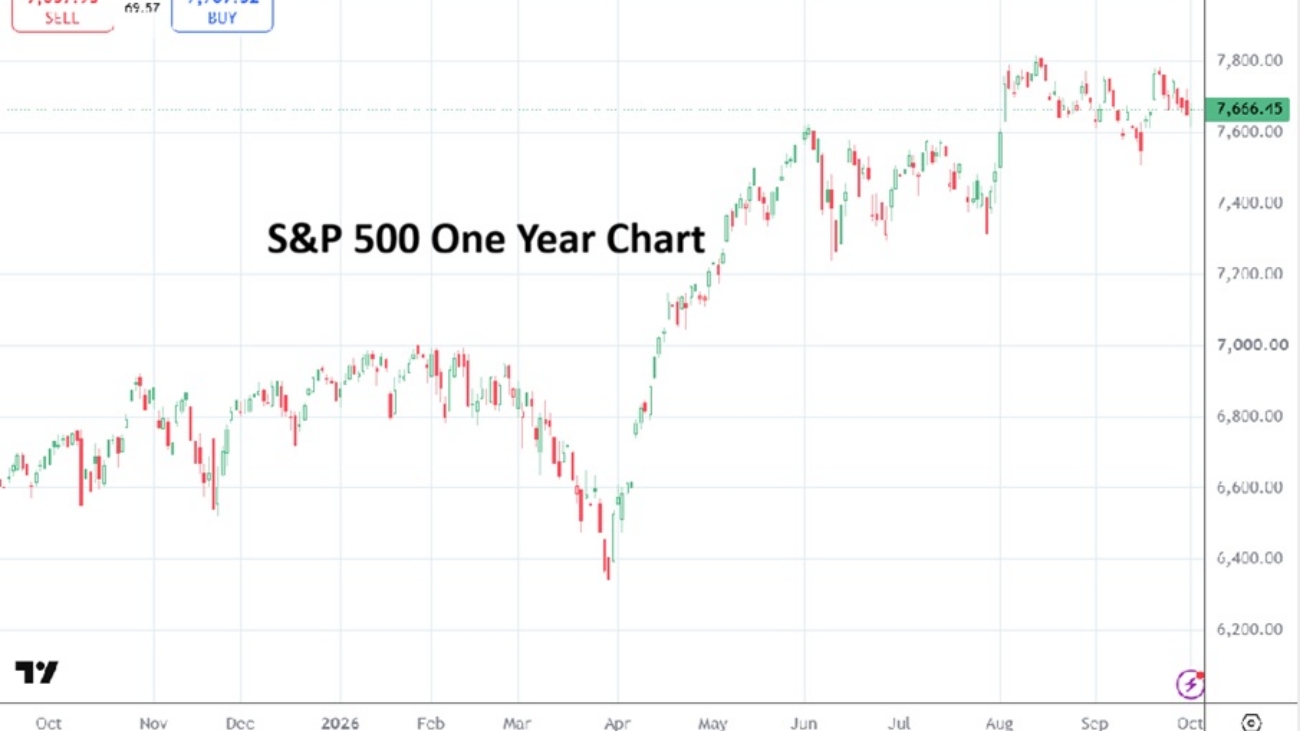
S&P 500 One Year Chart as of 2nd October 2026

The reason this is important is because like the incident in the Middle East in which a plane flying from the United Arab Emirates to Israel received a variety of different reporting, economic news receives the same type of bias. How can you trust a media source that doesn’t want to be transparent about outcomes? Now while it may be simply a lack of known details and an attempt to get a story reported on quickly to beat competitors, it would be foolhardy to say bias wasn’t a culprit in many instances.

As a consumer of news, speculators and investors need to be aware they are looking at information that often is being presented with details that the source wants to convey, while possible omitting facts. Unfortunately, global markets are being confronted by a complex amount of circumstances which include interpretation by the media which is reporting and this can lead to bad trading decisions. 

The war (conflict) with Iran continues to traverse a fragile  and unresolved path. Higher energy costs remain. WTI Crude Oil as of this moment is trading near $92.00. Gold is around $4,180.00. President Trump seemingly is attempting to practice relative calm – within his frequently loud characteristics – and not escalate the Middle East saga until the mid-term elections are complete. Perhaps that is merely my own bias as an observer.

Today Non-Farm Employment Change numbers will be published. And getting back to the original paragraph and its question, will the data matter and how will it be presented. Bias is apparent in most publications that cover the economy, to deny this would be a mistake by investors and speculators. 

While it is likely the jobs numbers are not going to have a significant impact on the voting decisions, nor the trading choices by market participants, what matters is the fact that the presentation is being geared towards an audience depending on bias of the source. The Wall Street Journal, Bloomberg, CNBC all have reporters who certainly have their own perceptions and beliefs. There is nothing wrong with this, but as a consumer of news and as a market participant you must understand that you are being influenced intentionally by media sources. 

The results from Wall Street the past handful of months have seen plenty of trading opportunities. Yet, there is a loud debate on what the near and mid-term will produce. Plenty of risk analysts are nervous about their forecasts. Yet, even soothsayers need to be aware and remind themselves they are being influenced (including myself) by the news they are consuming.

There are facts. Market results are a truth. Higher U.S Treasury yields are a reality, the stronger USD in recent weeks is happening. Sideways results – via a handful amount of months – in the SP 500, Nasdaq 100 and Dow 30 are facts – but importantly too is they remain within sight of apex highs. But the market results and their storylines are determined by media depending on how they would like you to interpret the results.

As an investor or speculator you must know your own timeframes and what your ambitions are regarding targets. Is there an AI bubble, can AI make enough revenues to cover existing valuations? Market results are delivering real values, but they still need to be interpreted and with open and flexible perspectives to determine what might happen near and mid-term.

Be careful folks. Understand what you are looking at is in fact meant to make you feel a certain way, you must digest the information and manner it is being conveyed the same way you treat a meal depending on what you have eaten. Some of the information you are taking in is junk food. You need to be able to decide on your own – hopefully with reliable insights and information – on what trading and investment paths you want to pursue.


Copy and paste the text from AMT that you want to share

AMT Top 10

AMT Top Ten Miscellaneous Insights, Mischief and Concerns for the 22nd of September

Trump's Saga, Market Conditions, Saudi Arabia, Investor Outlooks and More

10. Naima: John Coltrane’s classic composition from the late 1950’s should be listened to intently with eyes closed as his harmony and provocative ability to create a devotional hymn enchants. What do you hear? Instead of playing music for mere mortals, it sounds as if Coltrane is orchestrating for gods – take a moment to listen.

9. Upwards: Bitcoin, cough, cough is again making some look foolish as it traverses higher. As of this moment, BTC/USD is at $86,000 and making doubters – among them some AMT staff – shake their heads in disbelief (disdain). Michael Saylor’s Strategy/MicroStrategy entities have MSTR share prices around $168.00 per yesterday’s close. This is occurring as AI concerns because of its ability to challenge cybersecurity and coding of crypto remains relevant. Additionally, higher energy costs are causing miners to wince, running out of folks who are willing to speculate in the domain remains a danger (because of Ponzi suspicions), notions about government supervision getting stronger instead of becoming more lax, quantum technology, and known rogue nations keeping Bitcoin and other cryptos vibrant to hide illicit money shadow. But this is nothing to worry about it appears for Bitcoin believers and influencers.

AMT Top 10 Miscellaneous Insights, Mischief and Concerns for the 22nd of September

8. Unheralded Victories: While many were looking away purposely and likely do not want to give President Trump applause, Denmark extended the U.S administration not only an olive branch regarding Greenland, but perhaps a signal that they have acquiesced by expanding U.S security jurisdiction. From a foreign policy perspective the Trump administration has changed the Venezuela leadership, secured greater military capabilities in Greenland, and remains focused on bringing Cuba’s leadership to their knees as the island nation suffers from extended electrical outages.

7. Berkshire Hathaway: Warren Buffet stepped away from his job as Chairman on the 18th of September and named his son as successor. Share values via BRK.A were above $800,000 in April and March of 2025. This August BRK was again over $800,000. Yesterday’s close was near $752,000. Warren Buffet’s brand and era is coming to a close and the new leadership will be hard pressed to fill the confidence void. Berkshire Hathaway investors however, are some of the most loyal constituents in the marketplace. They will want to see a steady ship run by Howard Buffet and CEO Greg Abel.

6. New School: What will the Fed do now that they have raised the Federal Funds Rate by a quarter of a basis point on the 16th of September? Kevin Warsh has proven he is not exactly in the coat pocket of President Trump. After the Fed’s unanimous vote last week to raise rates, what happens on the 28th of October? Via Forex it appears financial institutions have braced their outlooks for another hike sometime later this year, but are they correct? Old theories via central banking to attack inflation with higher interest rates is a standard practice, but the escalating costs via higher energy prices has nothing to do with a sudden emergence of pent up demand, it is a supply shock that has caused more expensive WTI Crude Oil – not one driven by an increase in desire. Will Warsh prove he is new-school and proactively fight for lower interest rates sooner rather than later? Higher interest rates will not stop the Middle East saga from remaining an economic influence and spectacle.

5. Bank of Japan: Like the Fed the BoJ is not in a particularly safe space. After following in the footsteps of the Federal Reserve last week, the interest rate hike of 0.25% by the BoJ was viewed as a rather lackluster move from financial institutions and Forex players who seemingly wanted an increase of at least 0.50%. The USD/JPY remains a volatile speculative wager and is above 156.850 – give or take the tantrums and punishment inflicted from the FX market. The Bank of Japan has only had 3+ decades of questionable policy, here’s to another decade worth of doubts and consistent critical observations from outsiders.

4. Hear No Trump: The U.S President is entering a dangerous political phase for his legacy and risks losing his grip on power. Mid-term elections are rapidly drawing closer and the White House could lose its Republican led majority of the House. The President is starting to be viewed as a lame-duck by some observers. Trump who is known for his ability to change his rhetorical stances and policies quickly is still at the epi-center of global affairs. The question is if other policy makers and nations are listening. The Republican party is entering a dangerous phase and its leadership is likely going to endure a rather loud fight for control as factions take sides. The Vance and Rubio camps are likely to grow louder and divergent.

3. Saudi Arabia: Ask a friend to point to Yemen on a map, can they do this correctly? The Houthis of Yemen and Saudi Arabia may feel like a world away from known geographies, but what is happening in the wake of attacks on port areas and islands in the Red Sea (and even Riyadh) is significant. Crude Oil production and shipping problems suffered because of pipeline vulnerability is a vital concern for energy supply to Europe and Asia. While large investors may feel like they have digested the dangers, Iran and its proxies – including the Houthis may have additional theater to present. WTI Crude Oil has come down in price since yesterday but remains volatile and is around $93.00. Will optimistic banter continue?

2. FOMO: The Nasdaq 100, S&P 500, Dow 30 and their global counterparts are within their higher apexes as traders and financial institutions keep placing their money into these known asset spheres. The bond market is still producing high yields and folks are seemingly letting their casino like bets ride on a wheel they hope propels solid momentum for as long as possible. But alas, number 1, should make people pause:

1. Bandages: Perhaps our circle of contacts is too small, but behavioral sentiment is not exactly robust regarding positive market outlooks via mid-term queries. Concerns about equity indices, bond yields, inflation (because of sticky energy costs) and the general malaise that is hovering over the broad markets is not appealing. It feels as if sutures are keeping wounds from becoming infected in a haphazard manner. Investors are cautious and appear ready for the Band-Aid to be ripped off. The late ’90s and early 2000s dot.com bubble bursting, the 2006 bank and housing whispers and rumors flotilla which turned into the catastrophe of 2007-08 feel oddly similar. Perhaps it is a good time for accumulation if nothing seriously bad takes place in the markets. Circumstances feel as if a wave of blind market powers may harm those who seek never ending profits with a tsunami of losses. Perhaps it is a good time to be a speculator.

Copy and paste the text from AMT that you want to share

Share:
WTI Crude Oil 20260428

Shift To Economic War Against Iran to Deprive Funds to Regime and IRGC

What If Everyone Is Looking At The Wrong Things About Iran?

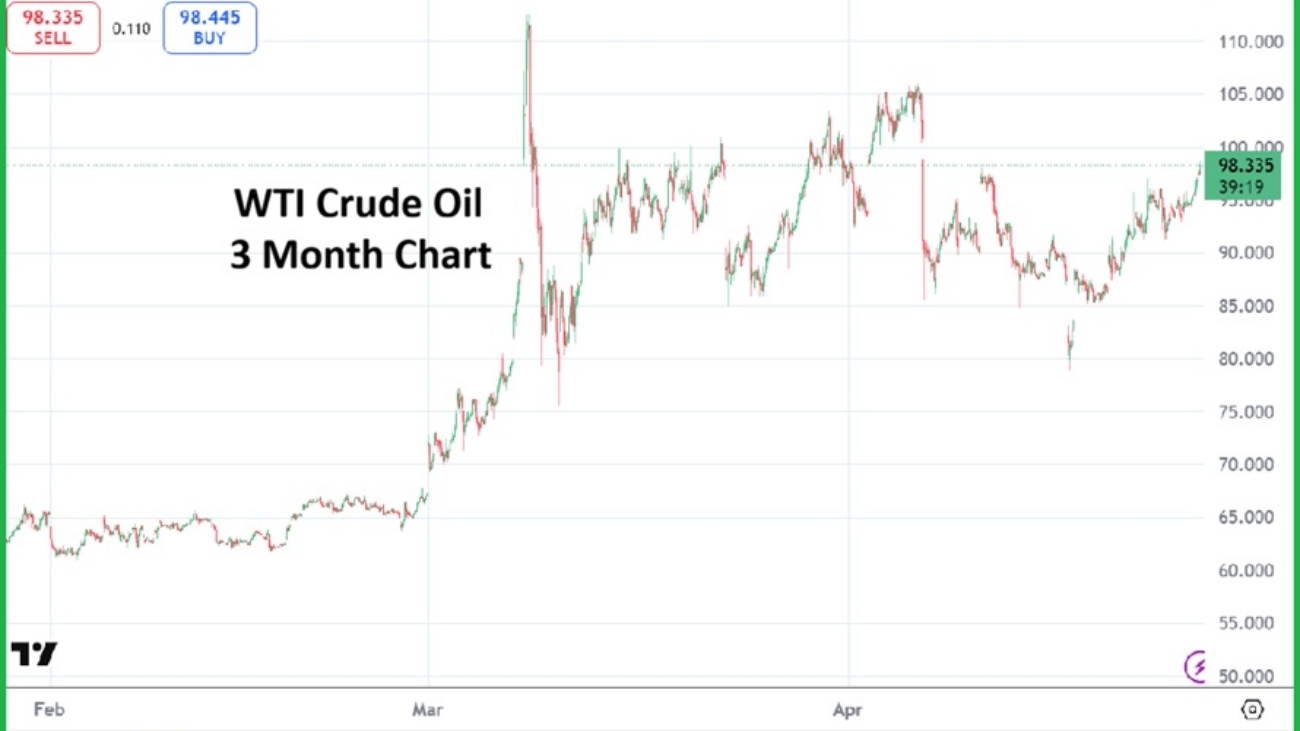
The current futures price for WTI Crude Oil is above $98.00. The cash price for the commodity is above $103.00. While many people continue to fret about what endgame strategy the U.S White House is conducting, what if we are seeing it play out in real time via the price of Crude Oil? Is it possible that President Trump has a coordinated plan to starve the Iranian regime and the IRGC of its much loved and needed money? It appears this is the case.

WTI Crude Oil Futures Three Months Chart on the 28th of April

Simply put, the Iranian Revolutionary Guard Corps is a mafia. They stay in power using the tool of fear brought upon by their ability to be ruthless to the Iranian citizens. They are a terrorist organization in the truest sense. If you disagree with that assessment, you are free to do so. However, facts when they are studied point to the conclusion Iran is a terrorist state led by its regime and the IRGC. 

Iran has made massive amounts of money via its energy products for decades. The shutdown of the Hormuz Strait, or at least the inability to export Crude Oil freely, is putting a strain on global energy prices, and it is causing a major fracture in the main financial export of Iran. 

The U.S has not only shut down easy navigation in the Hormuz Strait, but it is also going after Iran’s cryptocurrency operations. The ability to receive and transfer digital money by Iran is being strangled. What if President Trump is not only listening to the opinions of his military officers, and Secretary of State Rubio and Vice-President Vance, but also Treasury Secretary Scott Bessent who has an abundance of financial knowledge about how money flows internationally and how to create obstacles.

If the IRGC is not able to pay its own members, and other adherents to the Iranian regime are only slowly reimbursed, the apparatus of the IRGC will certainly lose its influence. The inability to pay allies that exists merely because they are employed or corrupted by the IRGC likely is starting to cause fractures regarding loyalties. 

China needs Iranian oil too. And evidence is starting to be speculated upon that China is facing tough decisions about acquiring Crude Oil from other sources. China will not be happy about having to pay higher costs, this because discounted Iranian oil that has abundantly been used is no longer available. 

Equities via the major U.S indices have done incredibly well since the end of March. The Nasdaq 100 has seemingly forgotten about AI overbought concerns, the S&P 500 is within apex territory and the VIX is acting as if sunny days are in the forecast. Forex has been volatile, but the value of the USD is within known realms.  However, the price of WTI Crude Oil is high and it has gotten higher since the 17th of April when futures prices briefly flirted with the $80.00 realm – this before going into a weekend. And this is a clue that something is afoot, beside larger players speculating on what their outlooks are for WTI Crude Oil in the mid-term.

The weekend of the 18th and 19th of April witnessed talk of an end to the Iranian war fall short; and heard President Trump essentially declare the ceasefire is still on but with the caveat that the U.S would create a blockade in the Hormuz Strait. While the semantics of a blockade can be debated, the U.S has caused shipping problems for tankers that were supposed to ship Iranian Crude Oil. The U.S clearly decided to create economic distress for Iran.

The Iranian regime still stands, but its leadership is rather shaken. The IRGC is controlling a lot of the decision making for the time being, and it appears the U.S White House is trying to make the IRGC weaker by ending their financial lifelines. It appears that it has been figured out that an economic war which includes starving Iran of cash is the most certain way to create revolts inside of the nation. When the influence of money is eroded, and temptations via other spheres of power suddenly sound tempting and can be joined, this is when shifts in authority and leadership can occur. 

While many analysts wonder about the lack of an obvious endgame being announced by the Trump administration, maybe it is already being played out. President Trump has a large ego and he is happy to extoll the virtues of his ‘tremendous’ policies frequently, but he also has shown the ability to remain quiet when it comes to plans of action and carrying them out. Yes, this can be argued into the late hours by pro-Trump and anti-Trump people. But maybe Trump is simply telling the truth when it comes to the U.S having time on its side regarding the Iranian ceasefire and the Strait of Hormuz. Maybe the clock is ticking on the eroding cash pile the Iranian regime and IRGC has within its grasp.

Copy and paste the text from AMT that you want to share