
Power of Intelligence 20260906

The Great Compression Part 4: Sovereignty Franchise

The Power of Intelligence

The most valuable piece of real estate in the world is a fab complex on the western edge of the Pacific, a short flight from the coast of a huge country that claims the ground it sits on. Taiwan Semiconductor Manufacturing Company, aka TSMC, prints the chips that every frontier AI model on earth depends on – and nearly all of them are currently made on that shore in Taiwan. This is simply a given; geography, unlike software, doesn’t scale, doesn’t copy, and doesn’t move.

For a decade the industry treated intelligence as something borderless, a global utility that would flow to wherever demand called for it. That framing is way past obsolete in a world that is split, lost along with the old dream of an uncensored Internet and free information exchange. Now, the crack is widening along a new axis. Forty years ago, the division ran through Berlin, and it was drawn by ideology. Today it runs through a supply chain, and it is drawn by who can make, buy, and run the machines that think. The AI chips are only the part of the split you can see and touch.

The Great Compression Part 4: Sovereignty Franchise

The Independence Chokepoint

Compute has already left the free market and entered the permitted layer of the economy. Advanced NVIDIA processors are no longer something a buyer simply purchases; they are something a government allows a buyer to receive. Export licenses now stand between the most capable silicon and any customer headquartered on the wrong side of the line. Washington has spent three years building this wall chip by chip – and the reshoring push, the fabs rising in Arizona, the equipment and materials supply chains being pulled back onto home turf, is the same impulse cast in concrete: move the chokepoint onto ground you control.

The scale of the gap explains the urgency. The U.S. holds a lead in AI compute capacity measured not in percentages but in multiples. China’s domestic production of the highest-end accelerators runs at a small fraction of American-equivalent scale. Its most advanced labs still lean on Western silicon to train their best models, whether the chips arrive through smuggling networks or through the gray route of renting restricted hardware inside third-country data centers.

Even when it’s leaking, the chokehold does its work. The controls slow every Chinese frontier effort, force it onto inferior domestic silicon, and keep it a step behind the labs it is chasing. But compute is only the first roadblock to independence: the next ones – on the intelligence itself – are only going up now.

The Gate to Intelligence

A wall around compute would be contained if compute were the end of the story, but it isn’t. The same logic that gates the chip is now reaching for what runs on it.

In June 2026, the U.S. Commerce Department required an export license for any foreign national to access a frontier AI model made by Anthropic – including the developer’s own non-citizen staff. Unable to verify the nationality of its users, the company withdrew the model entirely, and for the first time in this cycle a publicly available AI capability moved backward by government order. The controls were contested, the legal basis was unsettled, and access was restored within weeks. But the precedent was set: the authority to license the export of chips had been stretched to license access to an intelligence provider, and the mechanism worked before anyone had settled whether it lawfully could.

Beijing read the same lesson and moved to mirror it, drafting a regime to fence its own leading model weights behind national-security law rather than let them diffuse into the world. Two capitals, the same month, reaching the same conclusion from opposite sides: an AI model is not a product to be sold freely but a strategic asset released on terms. Intelligence has crossed into the permitted layer, and it crossed at both ends of the divide at once.

The Chained Brains

All of that is behind us; the interesting part is ahead.

Every ally now starting up its own sovereign AI is building it on a stack it doesn’t own – because the models, the chips, and the cloud beneath them are all American. What the ally holds is the building, the flag over the door, and the electricity bill. But the intelligence itself answers to another country’s export regime. This is sovereignty in name and franchise in fact.

The precedent for this arrangement already flies. Allied air forces buy the F-35 – the most expensive piece of weaponry in history – but they don’t thereby own it. The U.S. controls the source code and the mission-data files, and the aircraft’s full capability remains under American authority no matter how large the check. The buyer flies a plane whose brain is licensed, not sold, because withholding the core is the entire instrument of leverage. You can’t buy your way to control over a capability whose value to the seller depends on never fully handing it over.

While the F-35’s licensed brain governs a single platform, a national AI stack governs the layer through which a modern state thinks: its analysis, its logistics, its intelligence fusion, its administration. The fighter is a product on a leash, while the intelligence layer is the nervous system on a leash.

The Thinking Franchise

And the company installing that nervous system is already doing it. Palantir’s value was never the model but the trust above it and the data structure beneath it – the ontology layer that ingests a government’s data and turns it into decisions. In mid-2026 it began offering sovereign customers what they most wanted to have: full ownership of their model weights, retrainable, air-gapped, sealed behind their own walls. Still, the weights are the airframe that a buyer can own – but they will still have to run on NVIDIA silicon, inside an operating layer a U.S. company builds and controls, under the same export regime that pulled a frontier model offline in June.

Canada shows how thin the sovereignty can wear. Ottawa named itself the anchor customer of its own national AI strategy in mid-2026 while already running tens of millions of dollars in undisclosed Palantir contracts inside its defense and policing systems. The strategy announced sovereignty, but the procurement had already outsourced it. And by late summer, the two were trading tariffs and hard words, the closest alliance on the continent gone frosty, with the most sensitive systems of one side still running on the other’s stack. Nobody had to threaten anything. The dependency simply sat there, the way it was always going to.

Right in front of our eyes, the forward base of the last century gives way to the forward stack of this one. Instead of a U.S. army base near a European capital, a data-orchestration system running on NVIDIA chips, wired into the host government’s own operations, doing quietly what the garrison once did loudly. Land, power, and data can belong to Berlin or Paris, on paper – but the intelligence stack that holds the dependency will be American. It’s a cheaper umbrella, a deeper one, and a far harder one to ask to leave.

The End of Sovereignty

The immovable object was supposed to be the safe end of this story. Land, power, fabs, the heavy and hard-to-replicate assets that no software cycle can compress, the bedrock beneath the cloud. All of that still holds. But immovable is not the same as owned – and anyway, even the owner isn’t sovereign, because sovereignty itself is what’s being compressed at the top of the stack.

Every chokepoint described above rests on a fact that holds only for now: advanced compute is scarce, and what it produces can be walled. Practical quantum advantage dissolves both, and it is a contest between the same two powers that have run through every layer of this story. Perhaps one arrives first. Perhaps, if less likely, two arrive together. It changes little for everyone else. The machine owner reads what others hide and shields what it keeps. The only defense is a new cryptography built to withstand it, and it takes the same frontier compute and talent that only those two powers command. Even the lock is provisioned by the vendor.

It doesn’t matter who owns the oil or holds the warheads if the secrets around them can be opened at will and the means to reseal them belongs to someone else. The world is already two powers and their satellites, although most of them still speak as though sovereignty were something they possessed. The quantum edge is the point where the pretense ends.
Copy and paste the text from AMT that you want to share

Nifty 50 20260708

India Insider: Foreign Investors and Their Selective Choices

Return of Global Investors into the Indian Marketplace

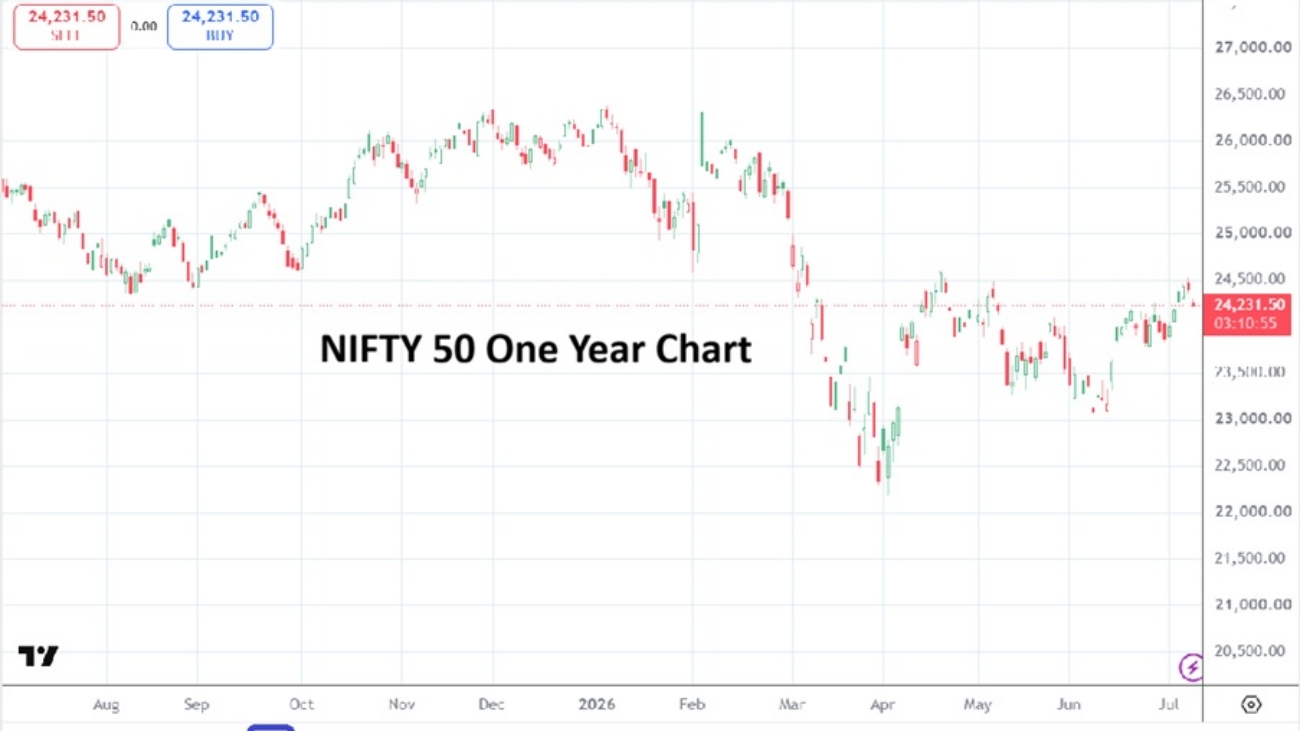
Global investors are gradually returning to Indian assets after months of persistent outflows as risk appetite sentiment has been ignited by an extended ceasefire between the U.S and Iran. Energy prices have moved in India’s favor, sparking favorable conditions. 

Despite recent flare ups in the Strait of Hormuz, Brent Crude has dropped about 30% in the past quarter, easing India’s fuel concerns as the world’s third largest Crude Oil buyer. AI trade rotation is gathering pace in Asia also, this as investors pull money from chipmakers that powered this year’s rally and hunt for cheaper ways to deploy their cash.

NIFTY 50 One Year Chart as of 8th of July 2026

Indian equities beat its emerging markets peers in June by its biggest margin in seven months. The Reserve Bank of India’s measures to attract foreign currency deposits and overseas capital have eased funding concerns for lenders, record foreign inflows into government bonds have helped stabilize the Rupee and improve liquidity conditions. According to Bloomberg, “Goldman Sachs favors 30-Year government bonds as lower oil prices allay inflation and fiscal risks”. 

Combined with resilient credit growth and improving asset quality, India’s banking sector is once again attracting global investors, this after trading at meaningful discounts to historical valuations for quite a while.

Second Opportunity May Be Information Technology

Indian IT companies have undergone a sharp valuation correction over the past two years. Unlike the post pandemic period, when large Indian technology firms traded at substantial premiums to global peers such as Accenture. These premiums have now narrowed considerably after earnings growth slowed, and enthusiasm surrounding Artificial Intelligence shifted investor attention towards US technology companies.

As highlighted in Business Line magazine, the sector is undergoing a healthy valuation reset, with investors increasingly questioning whether premium valuations remain justified without a corresponding acceleration in earnings growth.

However, the discussion extends beyond valuations. Artificial Intelligence is fundamentally reshaping the enterprise software industry. For decades, Software as a Service (SaaS) companies dominated enterprise technology by offering standardized cloud based solutions that were cheaper and easier than developing software in-house. That advantage is now beginning to erode.

Large AI companies such as OpenAI and Anthropic are building AI agents capable of operating across multiple enterprise applications through a single conversational interface. Rather than competing within individual software categories, these horizontal AI platforms could reduce the importance of stand alone enterprise applications by seamlessly connecting them. At the same time, AI native startups are targeting specialized business functions, while advances in generative AI are encouraging enterprises to revisit the traditional ‘build versus buy’ decision as they develop customized software internally at significantly lower costs.

For Indian IT services companies, this represents both a disruption and a new opportunity. Routine application development and maintenance may become increasingly automated, placing pressure on traditional outsourcing revenues. Yet demand for AI integration, cloud migration, cybersecurity, enterprise transformation, and customised AI deployment is likely to create an entirely new investment cycle. The winners will be firms that evolve from conventional software service providers into strategic AI implementation partners.

Risks ahead for Indian Markets

The near term outlook is not without risks for India. A weak monsoon could push food inflation higher. Elevated Crude Oil prices may widen India’s external balances. And a stronger USD with elevated U.S interest rate yields could moderate foreign capital inflows. The technology sector also faces a structural challenge as Artificial Intelligence reshapes the traditional software business model, requiring companies to adapt more quickly than in previous technology cycles.

Even so, the broader macro backdrop appears to be improving. Policy measures have eased liquidity conditions, corporate balance sheets remain healthy, and valuations across several sectors have become considerably more attractive after an extended correction. Rather than chasing expensive momentum trades elsewhere in emerging markets, global investors may increasingly look toward Indian sectors where fundamentals are strengthening while expectations remain relatively subdued.

Copy and paste the text from AMT that you want to share

AI Aluminium 20260624

The Great Compression Part 2: The Intelligence Trap

AI Aluminum

On June 17th, the U.S. Air Force handed Anduril Industries a contract for its FQ-44 autonomous combat drone, making it the first new entrant to win a U.S. fighter aircraft program since the 1970s. The Silicon Valley startup beat Lockheed Martin, Northrop Grumman, and Boeing – companies that between them have defined American air power for generations – to the target. Anduril, a defense technology firm founded in 2017, did not win on relationship or on legacy: it won on AI-native architecture.

The shift this represents is psychological as much as commercial. Defense procurement is arguably the most bureaucratic, relationship-driven, clearance-protected industry on earth. If AI-native vertical integration can break this barrier, anything is now open for re-negotiation.

The Great Compression Part Two: The Intelligence Trap

The compression of the human intermediary layer across the economy – the subject of this series’ opening piece – raises a question that is both philosophical and financial: if the old middlemen are disappearing, and if the AI models replacing them are themselves becoming commodities, where does value go?

What made the Air Force announcement structurally significant was a detail that went largely unnoticed: the service deliberately separated the drone hardware from its AI software, specifying that the intelligence layer could be upgraded or replaced independently of the platform. By doing so, the Air Force drew a line that the market is still catching up to – and then immediately complicated it. The aircraft is the delivery vehicle. The intelligence tier is what matters, except that intelligence is also commoditizing fast.

The commoditization signal had already arrived earlier this month, when Google cut the price of its AI plan by nearly 40% overnight. OpenAI is reportedly considering steep token-price cuts as competition with Anthropic intensifies. The models themselves are beginning to resemble a capital-intensive utility more than a premium software business. As intelligence becomes cheaper, the investment question shifts to what models cannot easily access: proprietary data, regulated workflows, institutional trust, and the systems that turn AI output into real-world action.

The answer, in the most durable cases, is proprietary domain data combined with deep sector integration. Anduril is not a defense company that adopted technology: it’s a technology company that chose defense as its vertical. Palmer Luckey, who sold Oculus to Meta when he was just 21, founded Anduril alongside veterans of Palantir with a specific thesis: Silicon Valley had abandoned defense, leaving a widening gap between what the military needed and what the traditional primes could deliver.

Where Lockheed and Boeing run bid-led organizations optimized for cost-plus contracting cycles measured in decades, Anduril built a product-first company that moves at software speed, focused on cheap, autonomous, attritable systems designed to be deployed and lost without catastrophic cost. The competitive edge that results has nothing to do with which model runs underneath it. It is purpose-built architecture, mission-specific design, and the kind of deep operational embedding that no generalist technology company can shortcut and no traditional prime can easily imitate.

Palantir built the same competitive edge a decade earlier, at the intelligence level. Their forward-deployed engineers embedded themselves inside classified environments, building proprietary data structures around defense and intelligence that competitors cannot access, let alone replicate. The model is almost beside the point. What matters is the institutional trust above it and the data structure underneath it.

The same logic plays out in banking, and the psyche shift there is equally striking. JPMorgan Chase is not an obvious candidate for AI leadership – a 150-year-old Wall Street institution steeped in regulatory obligation and institutional conservatism. Yet it has become arguably the most digitally aggressive major bank outside the fintech world, spending north of $17 billion annually on technology and deploying AI across trading, risk, legal document review, and client services. JPMorgan’s AI advantage over any fintech competitor is not compute – it is 150 years of proprietary transaction data, credit history, and market intelligence, combined with the institutional will to deploy it at scale. Many large banks sit on comparable reserves; few have built the machine to turn them into a competitive weapon. The model commoditizes; the data does not – but only in the hands of someone with the commitment to exploit it.

The pattern across defense, banking, and every sector where this is playing out is consistent: the prize migrates to whoever owns the scarce position that generic models cannot substitute for. Right now the prize sits with domain data and deep sector integration. What’s forming above it is agentic orchestration – systems that coordinate networks of specialized AI agents across high-stakes workflows: routing battlefield targeting decisions, flagging fraud across millions of simultaneous transactions, managing the exception-handling that no single model can resolve alone. Palantir’s AIP platform is the most mature example of this emerging tier, and it is no coincidence that the same company that mastered domain-specific data is now positioning for that orchestration tier. Salesforce’s Agentforce is building toward the same position from the enterprise side. The race for this trophy is not yet decided, but the companies that already own those domain data advantages are the natural favorites to own the control plane above them.

The stack, in other words, keeps moving upward. Value migrates to the next bottleneck, then the next. And below all of it – the models, the sectors, the orchestration layer – something has to hold the weight. Every control plane needs a floor. What that floor looks like, who owns it, and why it may be the most durable investment thesis of the AI era is the subject of the next piece.

Copy and paste the text from AMT that you want to share

Gordons Bay Sunset 20260514

The Great Compression Part 1: The End of the Middlemen

Elevator Boys of GenAI

In the 1920s, every office building had an elevator boy. Although automated elevators already existed, people found the idea of riding in a driverless box dangling by steel cables terrifying, and delegated the role to a uniformed human they trusted, accepting the necessity to pay for the privilege. Over the years, people got used to elevator buttons, but the force of habit and the preference for human touch kept the profession flourishing for years.

The operators were so confident in their indispensability that they went one step too far: in 1945, a New York strike brought the city to a grinding halt, costing it hundreds of millions of dollars. That was the final straw, leading to a massive push to upgrade to automated systems. Within a short while, the job ceased to exist, entering the history books as the only major job category to be completely wiped out from the U.S. Census purely due to automation. The only one so far, that is.

Elevator boys were the cleanest definition of a middleman: someone who exists not because they create value, but because of information asymmetry or transaction friction. The history of modern commerce is largely a history of those “toll booth” trades, and of the technologies that remove them one by one.

Newspapers were once the only viable printed information channel, using their middleman position to bundle content with ads and classifieds, fattening their revenues. People accepted it because nothing else existed – but then the Internet broke their business model. Craigslist alone did more damage to newspaper economics than any editorial failure ever could; Twitter and Facebook finished the job. Today the newspaper is a diminished thing, sustained largely by institutional inertia and nostalgia.

Real estate agents had an informational moat – access to listings, knowledge of comparable sales, relationships with buyers – which was valuable in a world without Zillow. Once that information became freely available, their commission became very hard to justify. The agent survived by clinging to the execution layer, but that too is shrinking.

Here is where the story gets interesting. The companies that dismantled the old middlemen wasted no time building new ones. Uber eliminated the taxi dispatcher and the phone-in booking system, then inserted itself between driver and passenger for a fat slice of every fare. DoorDash did the same between restaurant and customer. Expedia aggregated what travel agents used to know and charged airlines and hotels for access to their own customers. These were genuine technological improvements, but the business model was identical to what they replaced: find a friction point, own it, and extract rent from both sides. The market rewarded them handsomely for this, for a while. Then the next wave arrived.

Generative AI is driving a change of extraordinary scale and speed. We cannot assess the impact of the tsunami from inside it, but we can see the fish floating belly-up, and extrapolate. The agentic economy is eliminating many roles that just a couple of years ago seemed staple of our service-based economy. AI agents will (if they haven’t yet) replace secretaries, clerks of all kinds, brokers, advisors, recruiters, customer service representatives, paralegals – and the buck won’t stop there.

What is happening now to companies like Capgemini, Accenture, and McKinsey is structurally identical to what happened to newspaper classified departments and taxi dispatchers. AI agents do not merely reduce friction – they eliminate the information asymmetry that made the intermediary necessary in the first place. A system embedded inside an enterprise does not need a consultant to explain what it is doing. It does it, iterates, and reports back.

OpenAI and Anthropic understood this early, which is why both recently announced joint ventures – in a parade lockstep – to deploy engineers directly inside corporate clients. OpenAI has built an elite, highly technical consulting wing – a multi-billion dollar venture backed by TPG, Brookfield, Bain Capital and others. Anthropic teamed up with alternative asset titans like Blackstone, Hellman & Friedman, and Goldman Sachs to form a dedicated AI services company. AI labs are moving fast into services and deployment because model commoditization is a risk, and because adoption bottlenecks hurt revenue growth.

The Big Four are seemingly fine for now, touting alliances with the AI leaders, helping them scale AI implementation across their enterprise clients. However, professional consultants are clearly the next elevator boys, hanging by the thread of the “human in the loop” habit. The only chunk of the consulting business that is accelerating involves embedding the AI revolution into enterprises – and very soon, Anthropic and OpenAI will not require the help of PwC or Deloitte for that. They are the owners of the technology: why would they pay a toll for a booth on their own road?

The irony is pointed: the companies building the technology that makes middlemen obsolete are inserting themselves as the new middlemen between the AI model and the enterprise. But even this layer is temporary. Once AI agents can deploy themselves, even that layer compresses. The OpenAI and Anthropic JV story is the last gasp of the middleman era.

The real and durable beneficiaries of the AI economy are not the model builders. Raw intelligence, reasoning, and pattern-matching are no longer rare, expensive breakthroughs – they are becoming cheap, standardized, and universally accessible. Core AI technology is turning into a commodity, just like electricity once did – and the value moves both up and down the stack.

“Up the stack” is a constantly moving target. Right now, it sits in hyper-specific vertical applications – defense, aerospace, finance, and medicine – where proprietary data, regulatory compliance, and domain expertise create durable moats. It also lives in the integration layer: the software plumbing that turns raw AI reasoning into auditable, legally compliant enterprise actions.

In the near term, value will shift further to agentic orchestration – the “Agent Overlords” that coordinate swarms of specialized AI agents, manage workflows, handle exceptions, and maintain oversight across complex business processes. These control planes will become the new scarce and valuable layer, much as operating systems and databases once did. What comes after that is harder to predict, but the pattern is clear: as each layer commoditizes, the economic prize moves to the next bottleneck.

“Down the stack” is the physical layer underpinning everything, and that’s where the true moat is. Every agentic transaction, every automated workflow, every AI-mediated business relationship runs on cloud compute, which runs on power, which runs on tangible assets unlikely to be replaceable for at least the next decade. After a century of disruption, humanity has come full circle: the “boring” material world – acres, bricks, pipes, wires, water, and power – has once again become the real source of scarcity and enduring value.

OpenAI and Anthropic are the last of the middlemen: brilliant, richly capitalized, yet ultimately dependent on infrastructure they do not own. What sits beneath them is not a new intermediary – it is bedrock.

Copy and paste the text from AMT that you want to share