Liquidity, Valuations and the Limits of Domestic Capital
India’s equity market has surprised many investors over the past two years. Despite persistent foreign institutional investor selling, weak net foreign direct investment (FDI), subdued private capital expenditures and a depreciating Rupee, the broader markets have not fallen and proven remarkably resilient. But risks abound.
Many observers point to the rapid growth of Systematic Investment Plans (SIPs), which millions of retail investors invest regularly via mutual funds in India. Monthly SIP inflows into the Indian equity market has reached record highs at the tune of 32,087 Crore Rupees ($3.38 billion USD) in March, 2026 per AMFI (Association of Mutual Funds India) data.
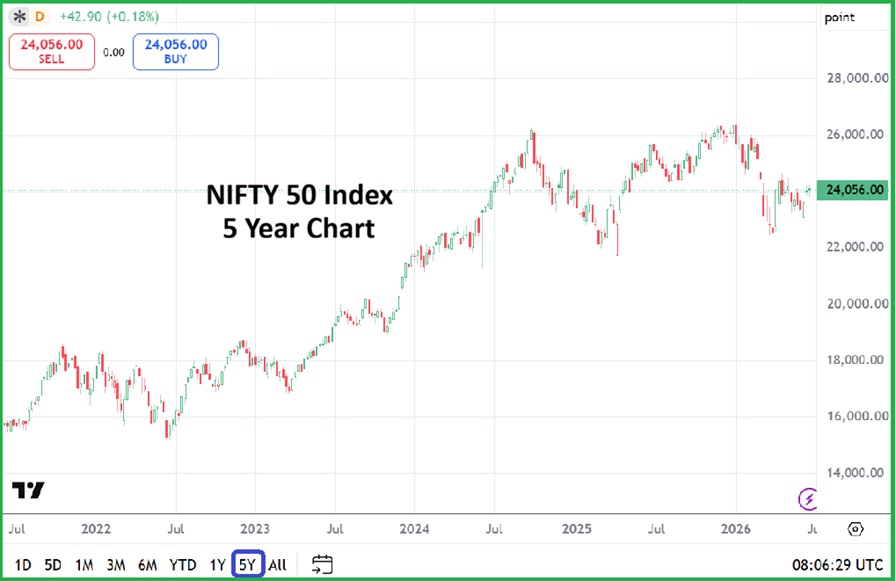
Nifty 50 Five Year Chart as of 26th June 2026
Before COVID-19, the stock market industry in India was a boring business. Accounts were opened via paperwork, and demat (the account in which the digital shares were held) in a bureaucratic manner with multiple paperwork requirements. Clients who liked to participate in the Initial Public Offerings (IPOs) had to go to their broker or issue a cheque to participate in the bidding process. As of 2019, the total demat accounts in India stood at 40 million. Sophisticated retail investors would go to their local branches of associated brokers and trade stocks, derivatives or commodities. They sometimes would use telephone or online orders.
All this changed during the Covid-19 pandemic, when equity market valuations became depressed and people were forced to stay at home. This ushered a wave of new retail traders who had time to master the game and wanted to capitalize on the falling valuations of many companies and take advantage of opportunities they believed in. Astonishingly, demat accounts opened between 2020-2026 totaled around 180 million, almost quadrupling pre-Covid levels. Due to digital penetration and the rise of discount brokers, young retail traders were able to quickly allocate substantial portions of their monthly income into SIPs.
SIPS have strengthened the financial market resilience of India, compared to the previous decade when it was the domestic institutional investors who helped market stability. Yet concerns are now arising whether domestic household savings are supporting fundamentally stronger companies, or are creating systematic inflows which help tenuous companies to have higher valuations?
For instance, a famous financial markets journalist recently argued that India’s SIP boom has fueled expensive stocks. Thus, enabling insiders and institutions to exit at favorable prices, reduced future return potential, has weakened the Rupee, and exposed the limitations of crowd-driven investing.
As the AMT India Insider columnist, I decided to investigate these considerations and talked with some people in the financial markets who offered different perspectives regarding the issue.
Mr. Mahalingam, an IIM alumnus noted, “it is difficult to generalize like that. Total SIP inflows should be viewed relative to the total market capitalization of listed companies, not in absolute terms. If the Nifty delivers around 12% returns, it roughly doubles every six years. SIP inflows must also increase over time, simply to purchase the same proportion of shares.”
Arguably, the SIP flows into the Nifty Index some 15 years back are not comparable to today. Considering the higher capitalization of Nifty listed companies (which means greater share values), and given the Nifty index has delivered 12% returns in the last few years, and that it took 6 years for it to double at this rate, it’s important that investors look at higher share prices values arising out of company earnings while considering their investment decisions.
Mr. Prasath, who taught economics and finance to students during his tenure at a private educational institution, argues, “I think there are many dimensions. In stock markets, everything comes down to valuations, the continuous SIP flows may diminish future returns if the earnings don’t grow. But comparing SIP flow with 2005 numbers exaggerates the issue. The Indian economy has grown bigger since 2005 and naturally inflows will also grow accordingly. India has one of the lowest public participation in the capital markets, even with current SIP numbers.”
Mr. Prasath continued, “currently the world is going through turbulent times with the Russia-Ukraine war, the Trump Presidency including tariff actions, the Iran situation and energy crisis, and supply chain disruptions, etc., which are effecting economic growth. The Indian government is also not taking some required steps. Indian companies also have low R&D and failed to participate in emerging themes like AI and semiconductor development. These turbulent times will continue for awhile and Indian markets will underperform its peers. So we have to wait for better times or for world leaders to come to their senses. I think we have to remain both optimistic/realistic and plan our investments accordingly”
If India grows at 7.7% during the 2025-2026 annual year, and foreign capital (especially foreign portfolio investment) is leaving, while private capital expenditures are weak and government capital expenditures are increasing, then what’s the point of higher stock prices for many of these companies? Is it due to steady retail SIP inflows? Does it really help institutions and insiders to cash out, and make retail investors vulnerable? Foreign investors have sold $29 billion USD worth of equities so far this year, and the Rupee has taken a hit, yet we have not see drastic changes in companies’ share or indices values.
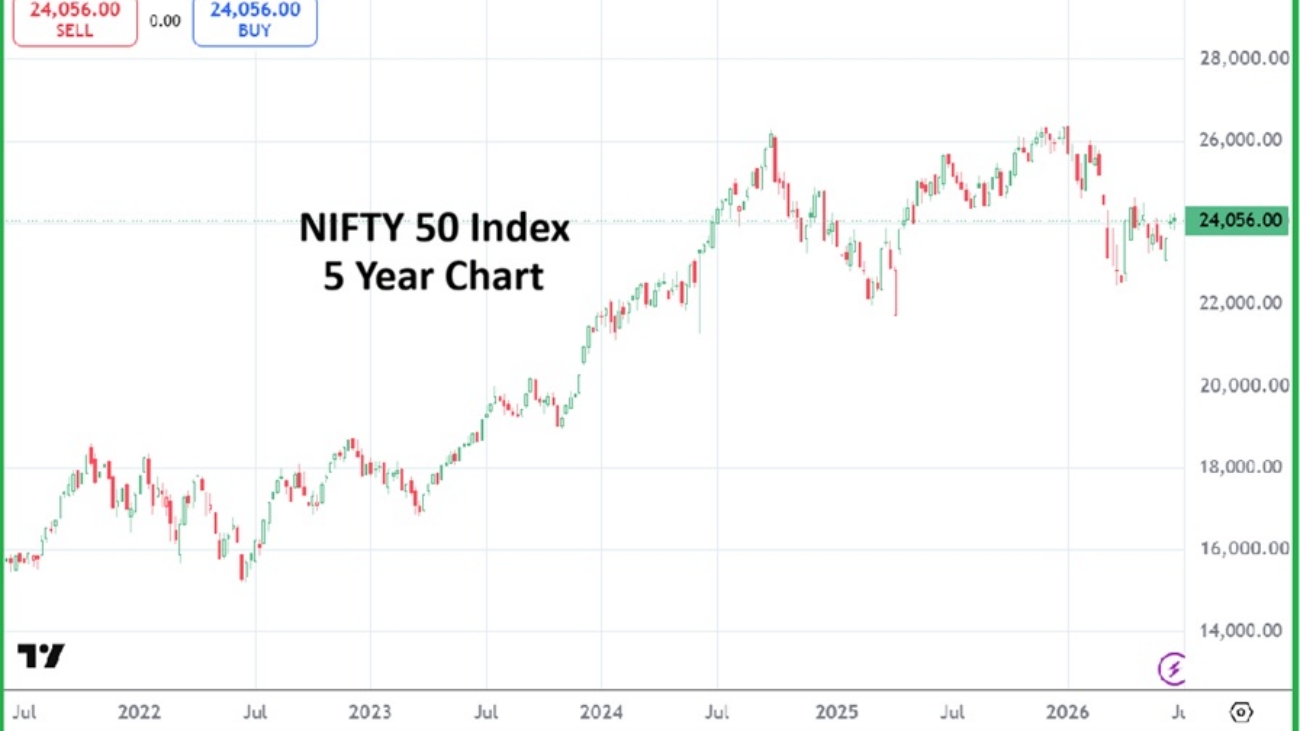
In 2022, when the U.S Federal Reserve was raising interest rates, the Nifty 50 Index lost around 3000 points, but this did not happen in 2026. The SIP retail crowd and domestic institutional investors have absorbed the foreign investors’ outflows and provided a cushion for share prices.
Even if some people in the financial markets argue that the foreign investors’ selloff off did not result in poor corporate performance or themes becoming weak, given that the growing market capitalization and the past earnings has justified the higher share prices, it’s significant to note that the Net FDI remains weak. Indian and foreign corporations are repatriating cash at a faster pace, and capital is flowing out of India. That’s ironically what hit the Rupee this year, along with higher oil prices due to the Iran war. In my opinion, private capital expenditures of listed corporations has to grow to justify higher earnings multiples.
Kotak Mahindra Bank director Paritosh Kashyap, while talking to Business Line said that private capital expenditures in India has been subdued for the last 10 years. Higher interest rates, expensive oil and lower equity valuations has dampened sentiment. India’s government Capex (capital expenditure strategy) remains the primary driver.
To summarize and conclude, weak foreign direct investment, subdued private investment, and inflated valuations of Indian assets along with a lack of AI related development is a large underlying issue and concern. For foreign investors to return with greater force again into Indian equities, either the Rupee has to depreciate or equity prices have to decline to generate investor confidence and create an appealing landscape. Retail investors may soon have to face drawdowns in their portfolios as returns dwindle and headwinds move against them.0